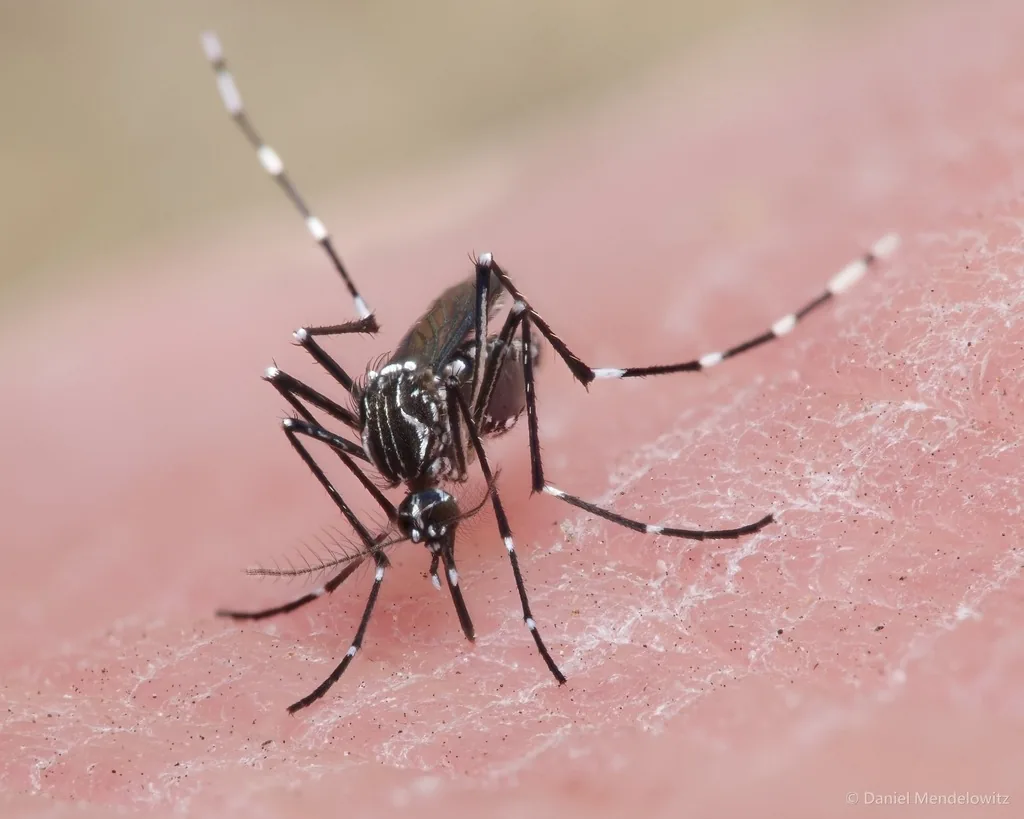
How to identify it
- It is a small to medium mosquito, about 1/4 inch long, dark brown to black with white markings.[1]
- The best field mark is a white lyre- or violin-shaped pattern of scales on top of the thorax.[1]
- The hind legs have white bands at the base of each segment, so they look striped.[1]
- It bites readily in daylight and indoors, unlike the many mosquitoes that bite mainly at night, dawn or dusk.[1]
Look-alikes
| Look-alike | How to tell them apart |
|---|---|
| Asian tiger mosquito | Nearly identical to the unaided eye, but it has a single white stripe down the middle of the thorax instead of a lyre shape, and it lives outdoors.[1][2] |
| Other mosquitoes | Many mosquitoes bite at night, dawn or dusk; the yellow fever mosquito bites in the daytime and also indoors.[1] |
Where it lives
Originally from Africa, it lives in tropical, subtropical and some temperate climates. In the U.S., it remains common in South Florida cities and along the Texas and Louisiana Gulf Coast, CDC maps where it could potentially live, though actual populations vary by county.[1][3]
Biology and life cycle
Females lay eggs on the inside walls of containers just above the waterline, and the eggs stick there like glue.[2]
Eggs survive drying out for up to 8 months, hatching when water covers them, and can survive a winter in the southern United States.[2]
An egg becomes a biting adult in about 7 to 10 days.[2]
Typical breeding spots include flowerpots, spare tires, untreated swimming pools, rain barrels, clogged gutters and stored water.[1]
Adults fly only a few blocks in their lifetime, so they usually come from containers close by.[2]
Damage and signs
- Bites cause itching and skin irritation; most bites aren't medically significant, but this daytime, indoor biter is a persistent nuisance.[1]
Health risk
It is the primary vector of yellow fever and a vector of dengue and chikungunya viruses. Dengue outbreaks in the U.S. are rare, and most chikungunya cases documented here are tied to international travel.[1]
Control
Prevention
Protect yourself in daytime too: wear loose long sleeves and pants, and use an EPA-registered repellent containing DEET, picaridin, IR3535, oil of lemon eucalyptus, PMD or 2-undecanone.[5][1]
Keep them out
Tightly cover water storage containers, and install, repair and use window and door screens.[4]
Sanitation
Once a week, empty and scrub, turn over, cover or throw out anything that holds water, inside and outside the house.[4]
Turn over empty flowerpots, maintain swimming pools, get rid of unused tires, keep gutters clear, and empty plant saucers and refresh pet bowls daily.[1]
Pesticides
Outdoor adulticides can treat dark, humid resting spots such as under patio furniture or in carports; follow label directions.[4]
When to call a professional
If mosquitoes persist indoors after these steps, hire a pest control professional to treat inside the home.[4]
Common questions
- Can yellow fever mosquitoes live inside my house?
- Yes. Unlike the Asian tiger mosquito, Aedes aegypti lives indoors as well as outdoors and prefers to bite people.[2]
- Why do dry containers still produce mosquitoes?
- Aedes eggs glued to a container's walls can survive drying out for up to 8 months, then hatch after the next rain or refill.[2]
- Is yellow fever spread in the United States?
- U.S. cases are rare today, helped by an effective vaccine, but this mosquito can carry the virus where outbreaks occur.[1]
Sources
- University of Florida IFAS Extension, Featured Creatures, “Yellow Fever Mosquito, Aedes aegypti (Linnaeus) (IN792).” ask.ifas.ufl.edu/publication/IN792 (accessed 2026-10-06)
- U.S. Centers for Disease Control and Prevention, “Life Cycle of Aedes Mosquitoes (reviewed April 16, 2024).” www.cdc.gov/mosquitoes/about/life-cycle-of-aedes-mosquitoes.html (accessed 2026-10-06)
- U.S. Centers for Disease Control and Prevention, “Potential Range of Aedes Mosquitoes (reviewed July 1, 2024).” www.cdc.gov/mosquitoes/php/toolkit/potential-range-of-aedes.html (accessed 2026-10-06)
- U.S. Centers for Disease Control and Prevention, “Mosquito Control at Home (reviewed April 16, 2024).” www.cdc.gov/mosquitoes/mosquito-control/mosquito-control-at-home.html (accessed 2026-10-06)
- U.S. Centers for Disease Control and Prevention, “Preventing Mosquito Bites (reviewed August 28, 2024).” www.cdc.gov/mosquitoes/prevention/index.html (accessed 2026-10-06)
- iNaturalist, “Aedes aegypti taxon page (order and family).” www.inaturalist.org/taxa/155453 (accessed 2026-10-06)