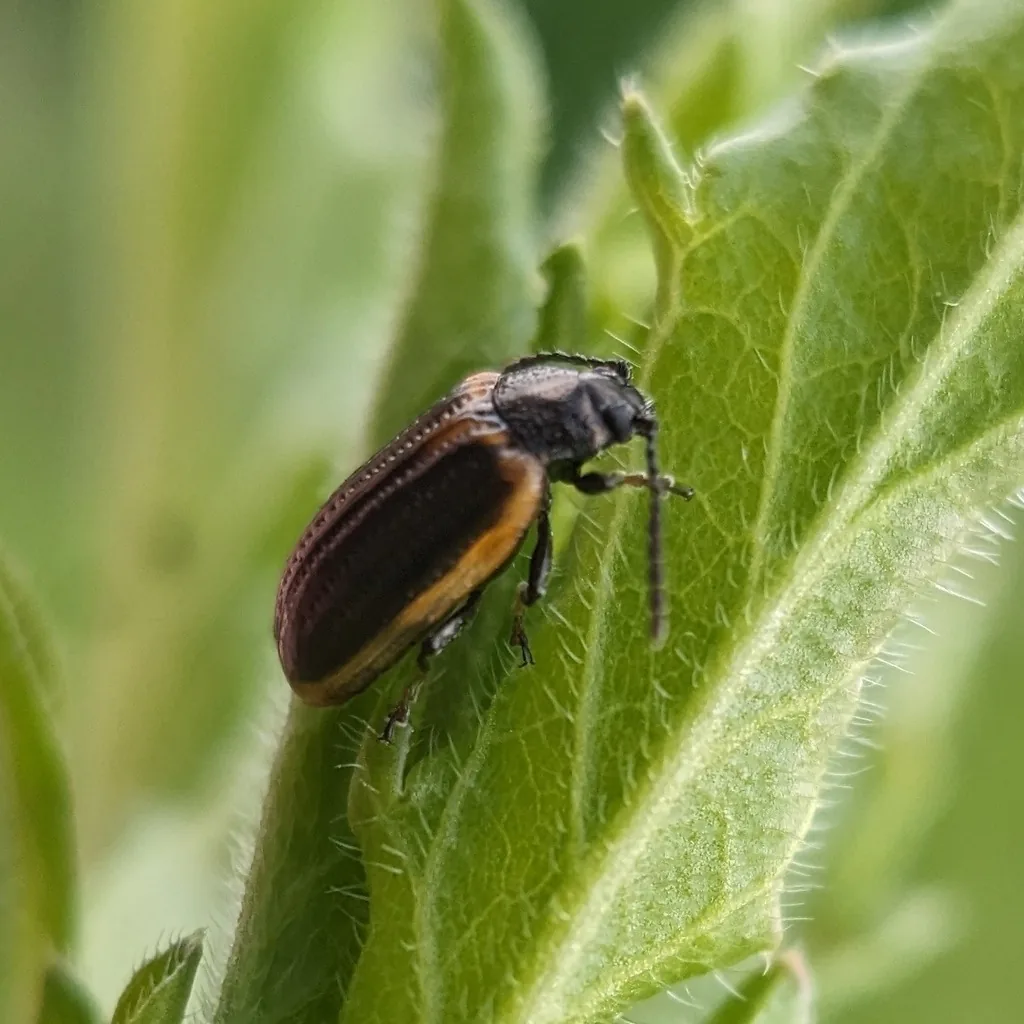
How to identify it
Where it lives
Native to South America, it was first found in the U.S. at Mobile, Alabama, in 1947.[1]
Biology and life cycle
Turnip is the most preferred host, followed by mustard, radish, collards and cabbage.[1]
Most damage occurs in spring, when larvae and adults feed together.[1]
Damage and signs
- They chew small holes and leaf edges, often defoliating plants; young larvae work in groups to strip stems.[1]
Health risk
It feeds on plants; UF/IFAS mentions no risk to people.[1]
Control
Prevention
For organic growers, using turnip as a trap crop has shown promise.[1]
Pesticides
It's usually controlled by foliar insecticides used against other pests.[1]
Common questions
Sources
- University of Florida IFAS Extension (Featured Creatures), “Yellowmargined Leaf Beetle, Microtheca ochroloma (Featured Creatures).” edis.ifas.ufl.edu/publication/IN625 (accessed 2026-10-06)
- iNaturalist, “Microtheca ochroloma taxon page (order and family).” www.inaturalist.org/taxa/533267 (accessed 2026-10-06)