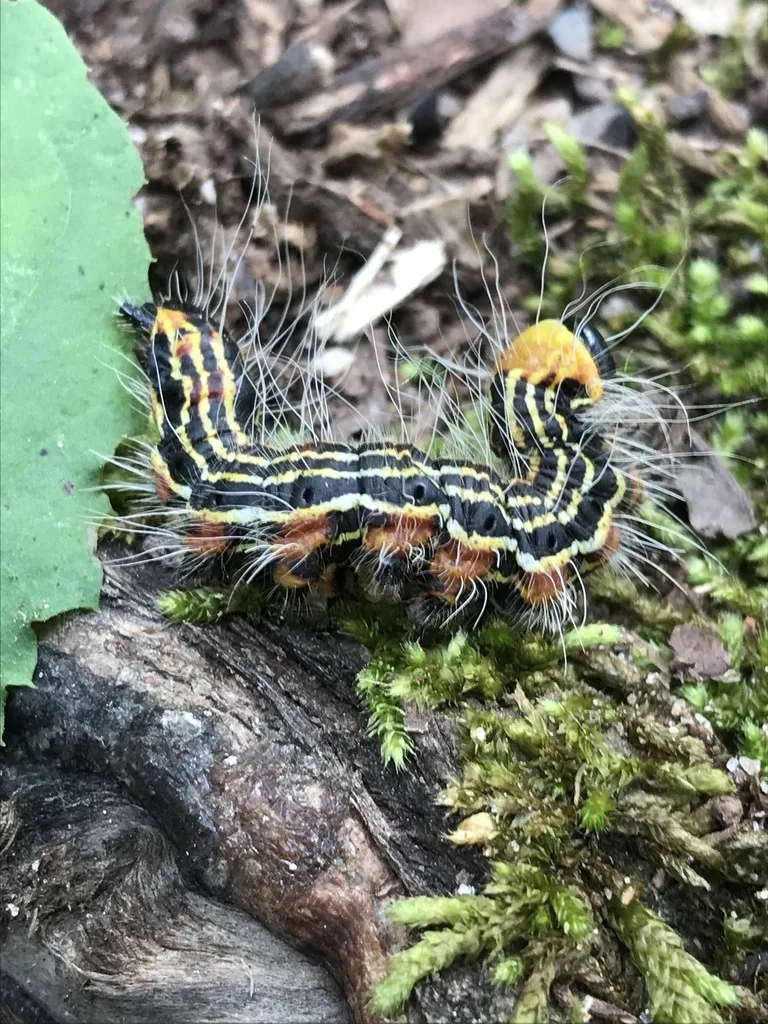
How to identify it
Where it lives
NC State calls it one of the most frequently reported pests of oaks, birches and other hardwoods, and Iowa State covers it in Iowa landscapes.[1][2]
Biology and life cycle
Moths emerge from the soil in June and July; they are reddish to cinnamon brown with about a 2-inch wingspread.[1]
Females lay masses of up to 100 or more eggs on the undersides of leaves, and young caterpillars feed in clusters.[1][2]
In August and September mature caterpillars burrow 2 to 4 inches into the soil to pupate for winter; there is one generation a year.[1]
Damage and signs
Health risk
NC State and Iowa State treat it as a leaf feeder of trees and note no health concerns.[1][2]
Control
Traps and physical control
Young caterpillars still in clusters can be removed by pulling off a leaf or pruning a branch tip in mid to late July, or knocked from low branches and crushed.[1][2]
Biological control
They are parasitized by tachinid flies and eaten by other insects and birds.[1]
Pesticides
Control is not usually warranted; if it is, spray while caterpillars are small, since late-season control is hard to justify and mature caterpillars are much less susceptible.[1][2]
Common questions
- What are the striped caterpillars in a group on my oak?
- In mid to late summer, a cluster of black-and-yellow striped caterpillars with an orange neck patch is likely yellownecked caterpillars.[1][2]
- Do I need to treat yellownecked caterpillars?
- Usually not; defoliation is mild. Small, newly planted or stressed trees benefit most from protection.[2]
- Why do they lift their heads and tails?
- The whole group raises both ends of the body when disturbed, behavior that may discourage predators.[1]
Sources
- NC State Extension, “Yellownecked Caterpillar in the Landscape (PDIC Factsheet).” content.ces.ncsu.edu/yellownecked-caterpillar (accessed 2026-10-15)
- Iowa State University Extension and Outreach (Yard and Garden), “Yellownecked Caterpillar.” yardandgarden.extension.iastate.edu/encyclopedia/yellownecked-caterpillar (accessed 2026-10-15)
- iNaturalist, “Datana ministra taxon page (order and family).” www.inaturalist.org/taxa/47719 (accessed 2026-10-06)