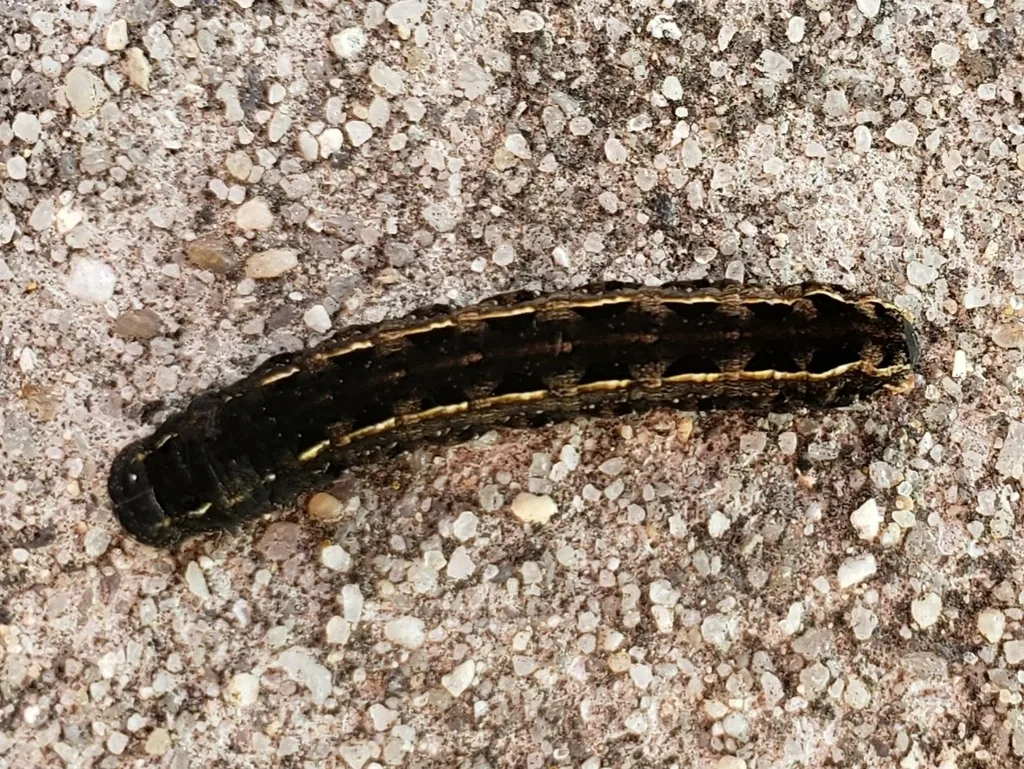
How to identify it
Where it lives
It's common in the eastern U.S. west to the Rocky Mountains, but as a pest it's limited mainly to the Southeast.[1]
Biology and life cycle
There are three to four generations a year, about 40 days from egg to adult.[1]
Young larvae feed in groups, then spread out, sometimes riding the wind on silk strands.[1]
Damage and signs
Health risk
It feeds on plants; UF/IFAS mentions no risk to people.[1]
Control
Prevention
Crops near weedy rangeland or alfalfa are more prone to injury.[1]
Biological control
Bacillus thuringiensis kills armyworms but should be applied while larvae are young.[1]
Pesticides
Foliar insecticides prevent injury, and larvae eat bran baits containing insecticide.[1]
Common questions
Sources
- University of Florida IFAS Extension (Featured Creatures), “Yellowstriped Armyworm, Spodoptera ornithogalli (EENY-216).” edis.ifas.ufl.edu/publication/IN373 (accessed 2026-10-06)
- iNaturalist, “Spodoptera ornithogalli taxon page (order and family).” www.inaturalist.org/taxa/118930 (accessed 2026-10-06)