Pest profile

Zimmerman Pine Moth

Dioryctria zimmermani · Lepidoptera: Pyralidae[2]

Zimmerman pine moth caterpillars tunnel into pine trunks and branches, weakening limbs so they die or break.[1]

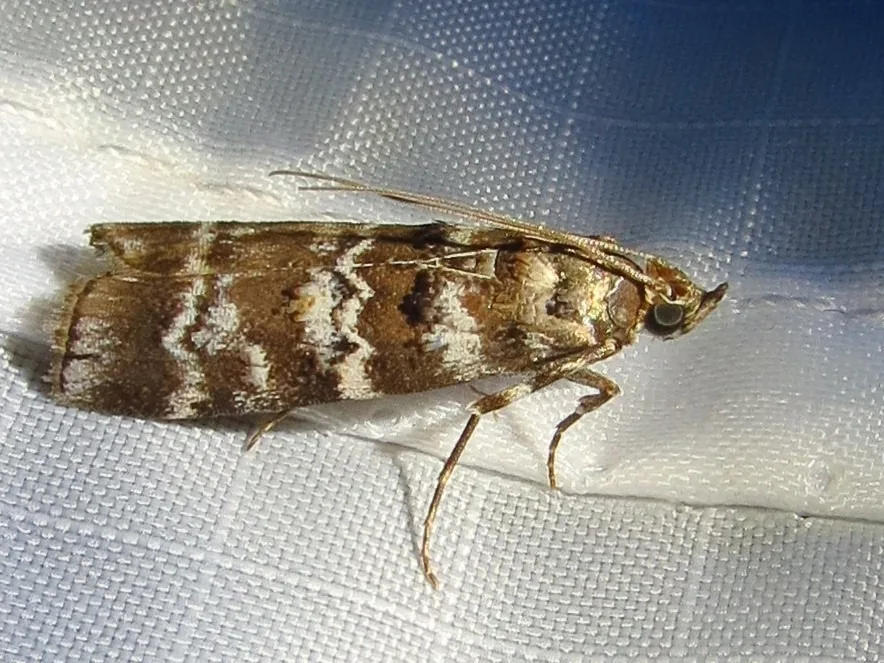
Zimmerman pine moth, a gray-brown moth with red-brown and white zigzag bands on its wings
Zimmerman pine moth, a gray-brown moth with red-brown and white zigzag bands on its wings. (c) Annika Lindqvist, some rights reserved (CC BY) — via iNaturalist, CC BY 4.0

How to identify it

  • Pale yellow, popcorn-like masses of sap form over feeding wounds, mostly where branches meet the trunk in the upper tree.[1]
  • Caterpillars are dirty white or gray, sometimes tinged pink or green, and often sit under fresh pitch.[1]

Where it lives

It was accidentally introduced into and established in several areas of Colorado.[1]

US map: public records from 19 states since 1990 (GBIF).

Biology and life cycle

Young caterpillars overwinter in tiny cocoons on the bark and start tunneling between mid-April and early May.[1]

Moths emerge in late July and August and lay eggs near old wounds; there's one generation a year.[1]

Damage and signs

  • Austrian and Scotch pines are especially susceptible; wounds structurally weaken trees.[1]

Health risk

It feeds on plants; CSU Extension mentions no risk to people.[1]

Control

Traps and physical control

On small trees, caterpillars can be found under fresh wounds and removed by hand.[1]

Pesticides

Bark sprays only work while caterpillars are exposed, best in mid- to late April or during late-summer egg hatch.[1]

Common questions

What are the yellow sap blobs on my Austrian pine?
Popcorn-like pitch masses at branch whorls are a sign of Zimmerman pine moth.[1]
Why did a branch snap off my pine?
Zimmerman pine moth tunneling at the branch base can weaken limbs until they break.[1]

Sources

  1. Colorado State University Extension, “Zimmerman Pine Moth (Fact Sheet 5.591).” extension.colostate.edu/resource/zimmerman-pine-moth/ (accessed 2026-10-06)
  2. iNaturalist, “Dioryctria zimmermani taxon page (order and family).” www.inaturalist.org/taxa/1296264 (accessed 2026-10-06)

Updated 2026-10-14. Built from sourced records. Spot an error? Tell us.