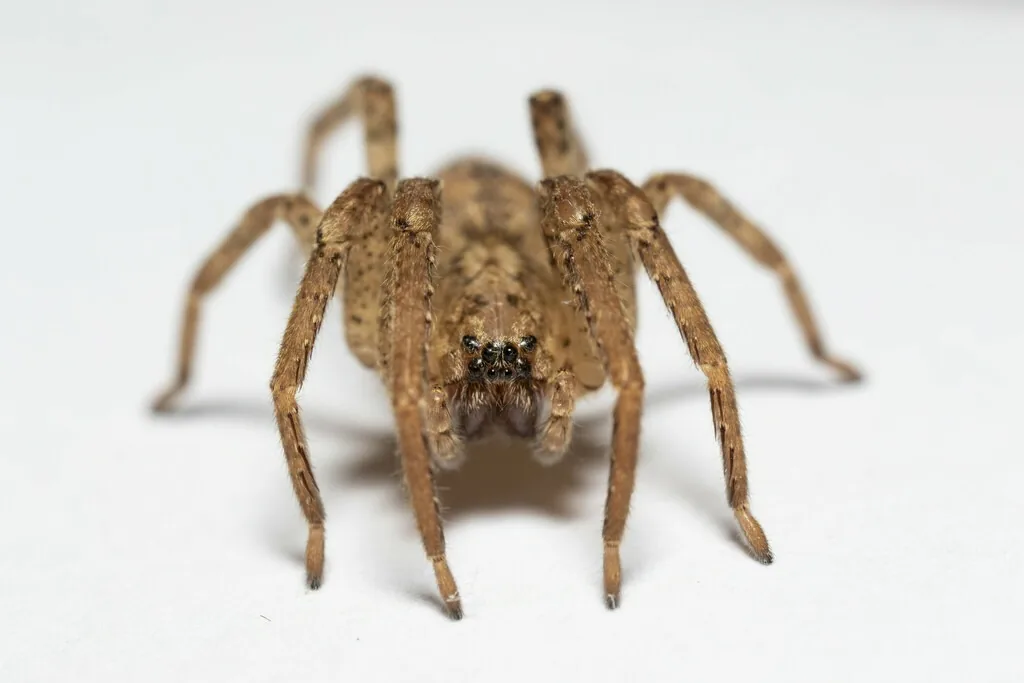
How to identify it
Look-alikes
| Look-alike | How to tell them apart |
|---|---|
| Wolf spiders | Wolf spiders' marks are usually diamond-shaped with one flare, and their eyes spread across the front third of the head region.[1] |
Where it lives
First reported near Sunnyvale in 1992, it's established around much of San Francisco Bay, so far mostly in and around homes.[1]
Biology and life cycle
It's a hunting spider that doesn't spin webs; silk mainly covers the female's egg sac.[1]
Adults wander indoors from September to May, often in winter, usually searching for mates.[1]
Damage and signs
- It eats mostly insects and causes no damage.[1]
Health risk
It's harmless: no spider in this genus is known to be medically important, and there are no verified bites causing significant problems.[1]
Control
Prevention
Control is unnecessary; reducing clutter removes hiding places.[1]
Keep them out
Weather-stripping at door bottoms helps keep spiders and insects out.[1]
Traps and physical control
Capture the spider and put it outside; they don't invade in groups.[1]
Common questions
Sources
- University of California Statewide IPM Program, “Pest Notes: Zoropsis Spider (Publication 74143).” ipm.ucanr.edu/PMG/PESTNOTES/pn74143.html (accessed 2026-10-06)
- iNaturalist, “Zoropsis spinimana taxon page (order and family).” www.inaturalist.org/taxa/127112 (accessed 2026-10-06)