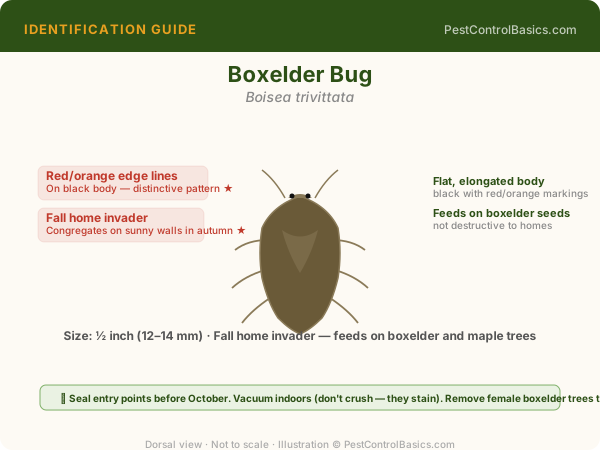
Both invade homes in fall but look completely different. One has a distinctive stink; the other has distinctive red markings.
🐛
Boxelder Bug
Black with red markings; flat
VS
🤢
Brown Marmorated Stink Bug
Marbled brown/grey; shield-shaped
📐 FIELD GUIDE ILLUSTRATION
Original illustration by PestControlBasics.com. Use anatomical labels above to confirm your identification.
🔑 Key Difference
Boxelder bug: black oval with distinctive red lines on wings and thorax; flatter body. BMSB: shield-shaped; marbled brown/grey; alternating black and white bands on abdomen edge. Both smell when disturbed but BMSB has a stronger, sharper odor.
⚠️ Urgency
Both are nuisance-only invaders requiring identical September perimeter spray prevention. Neither is medically concerning. Both should be vacuumed (not crushed) indoors.
📊 Full Comparison: Boxelder Bug vs. Brown Marmorated Stink Bug
Feature
Boxelder Bug
Brown Marmorated Stink Bug
Shape
Elongated oval, flatter
Shield-shaped, more rounded
Color
Black with red/orange markings
Mottled brown/grey with marbling
Size
½ inch
⅝ inch
Odor
Mild, slightly acidic
Strong, pungent (cilantro-like to some)
Season
Fall entry, spring exit
Fall entry, spring exit
Treatment
Identical — September perimeter spray
Identical — September perimeter spray
🔧 Treatment Guide
Both are nuisance-only invaders requiring identical treatment: perimeter spray with bifenthrin in September before they enter, followed by sealing all entry points. Neither is medically dangerous.
💡 Confirm before treating: Misidentification is common with these two species. Capture a specimen and compare against the table above before purchasing any products.
❓ Identification FAQ
Do I need different products to treat each one?
No. Both boxelder bugs and brown marmorated stink bugs respond to the same treatment: bifenthrin or permethrin perimeter spray applied in September, before they seek entry points. Seal gaps around windows, doors, and utility penetrations for lasting prevention.
Why do they both invade homes in fall?
Both species are seeking warmth for overwintering. They're attracted to sun-warmed south and west-facing walls. Neither breeds indoors — they're just sheltering and will exit in spring. Vacuuming is the best indoor control once they're inside.
What's the fastest way to confirm which pest I have?
Capture a live or dead specimen and compare it directly against the identification features in this guide. A clear close-up photo submitted to your county's cooperative extension service will get you a free expert identification within 1–3 business days. iNaturalist is also excellent for invertebrate ID.
Can I treat for both at the same time?
If you're unsure which pest you have, it's often more effective to wait for confirmation rather than applying multiple treatments. Misapplied pesticides can scatter populations without eliminating them. The exception: if both pests require identical treatment (as with many fall invaders), treating once covers both.
Building field ID skills for Boxelder Bug vs. Brown Marmorated Stink Bug
Field identification gets faster with practice, and the practice is mostly about pattern recognition rather than memorizing taxonomic detail. The fastest learners develop a habit of noting three things on every specimen: where it was found, what it was doing, and one or two distinctive structural features. Over a season this builds a regional mental library that beats any single reference page.
For look-alike pairs specifically, the deciding feature is usually one detail that is consistent across both adults and juveniles, even when overall appearance differs. Antenna structure, leg count, and wing venation patterns hold up better than color or size, which both vary significantly with diet, season, and development stage. Photographing the specimen against a known scale (a coin, a ruler, or a U.S. quarter) is more useful than describing size verbally.
When two species cannot be distinguished from a single photograph, the next step is habitat. Most close look-alikes actually have non-overlapping habitat preferences, and where the specimen was found often resolves the ID without requiring expert consultation.
Tools that speed up identification
A few inexpensive tools make field ID dramatically faster. A 10x hand lens (jewelers loupe) reveals features invisible to the unaided eye and costs under twenty dollars. A small clear specimen vial allows safe capture and handling without damaging identifying features. A flashlight bright enough to use in daylight (for low-angle illumination that highlights texture) speeds inspection considerably.
Software helps too, but with caveats. Generic identification apps trained on global image libraries often confuse regional look-alikes, especially for pests with high intraspecific variation. State Extension service pages and regional field guides consistently outperform global apps for the species likely to be encountered in any particular area. Bookmarking the relevant state Extension entomology page is one of the highest-value identification habits a homeowner can develop.
For specimens that resist identification, university Extension diagnostic services accept mail-in samples for under twenty dollars in most states and return an expert ID within a few business days. This service is dramatically underused given its accuracy and cost.
Why correct identification matters before treatment
Treatment selection depends on identification, and getting the ID wrong wastes time and money. Two pests that look nearly identical can have completely different susceptibility profiles, lifecycle timing, and harborage preferences. Applying the right product against the wrong target produces the appearance of failure when the real problem was identification all along.
The financial impact compounds quickly. A misidentified pest typically triggers two or three rounds of unsuccessful treatment before the homeowner returns to the identification step, and by then the original population has often grown enough to require professional intervention. Spending five minutes confirming the ID at the start is the highest-leverage step in the entire control workflow.
For shared-wall situations (apartments, condos, townhomes), correct ID also affects who is responsible for treatment costs under most lease and HOA structures. A pest misidentified as a structural issue versus a sanitation issue can shift several thousand dollars of cost between landlord and tenant.
Published: Jan 1, 2025 · Updated: Apr 7, 2026
How content is reviewed and updated
Content on this site is reviewed by Derek Giordano, a former pest control company owner and previously licensed Pest Control Operator in Florida with several years of field experience servicing thousands of regular customers. Reviews check treatment recommendations against current EPA-registered products and label use directions, cross-reference major treatment claims against university extension publications and CDC public health guidance, and verify that any product mentions reflect current registration status and reasonable consumer availability. Pages get updated as treatment recommendations evolve — pesticide products are deregistered, resistance patterns shift, regional pest distributions change. The 'Updated' date at the bottom of each page reflects the most recent review pass on that specific page; the site-wide approach to E-E-A-T (experience, expertise, authoritativeness, trustworthiness) follows Google's published guidance on health and safety topics.
Choosing the right product formulation for the situation
Active ingredient gets most of the attention, but formulation often determines outcome. The same active ingredient in different formulations performs very differently: microencapsulated formulations last longer on porous surfaces and reduce human re-entry exposure, wettable powders give the longest residual on porous substrates but leave visible residue, suspended concentrates give a balance of residual and appearance, dusts are uniquely effective in wall voids and dry harborage but should never be broadcast indoors, baits are appropriate when pests must transport active to the colony or nest, and aerosols are appropriate for direct contact and quick knockdown but rarely give meaningful residual. Choosing formulation by the substrate (porous vs. nonporous), the access (open spray vs. crack-and-crevice vs. void), and the goal (knockdown vs. residual vs. transferable) routinely improves outcomes more than upgrading active ingredient.
Sources used across this site
Editorial sources used consistently across this site: the EPA pesticide registration database for current product use directions and active ingredient information; CDC for public health context on pest-borne disease; the National Pesticide Information Center (NPIC) for homeowner pesticide questions; university Cooperative Extension publications (UC IPM, NC State Extension, Penn State Extension, University of Florida IFAS, and others) for region-specific identification and treatment guidance; the National Pest Management Association (NPMA) for industry context; and peer-reviewed entomological literature for biology, resistance management, and emerging issues. Product reviews reflect editorial testing and aggregated user-reported outcomes rather than manufacturer-supplied claims. Where regional information matters, we link to state and local extension publications rather than generalizing across regions.
How to use this guide effectively
This guide is one entry point in a connected library. Each pest profile, treatment guide, and tool on this site links to related references that go deeper than any single page can. Working through a pest problem effectively usually means starting with identification (so you know what you're treating), reading the species-specific treatment guide, checking the product or tool references for specific selection guidance, and confirming approach with the FAQ and troubleshooting sections. Bookmarking a few core references — the species profile, the relevant treatment guide, and one tool that supports the decision-making (product selector, cost estimator, treatment schedule) — gives you a workflow you can return to as the situation evolves. The structure is intentional: surface-level summary first, then increasing depth, with the deepest detail in the dedicated tool and reference pages.
How environmental conditions affect treatment efficacy
Pesticide efficacy is highly sensitive to the conditions at application and immediately after. Temperature affects both vapor pressure (volatility) and residual binding — products applied above ~90°F often volatilize before binding to surfaces, while applications below ~50°F can fail to spread properly. Surface porosity changes residual duration: a residual that lasts eight weeks on a sealed concrete slab might last three weeks on bare wood. Rainfall within four hours of an outdoor application typically washes off most surface deposits, though microencapsulated products are more rain-fast. UV exposure degrades many pyrethroids within days to weeks on sunny surfaces, which is why fence-line applications often fail mid-summer. Indoor humidity affects bait acceptance — dry baits perform worse in high humidity as they absorb moisture and lose palatability. Reading conditions correctly explains many otherwise mysterious treatment failures.
Choosing a pest control company: questions worth asking
Pest control companies vary substantially in approach, training, and pricing, and the questions to ask before signing a contract often aren't the obvious ones. Worth asking: what's the technician's training and certification (state pest control certification is the floor; advanced training in IPM, structural inspection, or specific pest specialties is meaningful additional credentialing); what does the service include beyond visiting and spraying (inspection, monitoring, exclusion recommendations, follow-up scheduling); what guarantees apply if pests return between visits; what's the protocol for hard-to-resolve issues (some companies escalate to senior technicians or supervisors; others repeat the same approach); what active ingredients are used and whether the company will use specific products on request (homeowners with chemical sensitivities, pollinator gardens, or other concerns may want specific products); and what's the contract structure (per-visit, annual, multi-year). Worth less than expected: brand recognition and advertising spend (large national chains and small local operators both produce excellent and mediocre service); 'green' or 'organic' labels (which mean different things to different companies and often don't correspond to specific product or practice differences); price alone (typical pricing variance is modest, and the floor of cheap options often includes poor service).
How structural moisture issues drive pest problems most homeowners miss
A surprising fraction of pest problems are downstream of moisture issues that go uncorrected because they don't produce obvious damage. Subterranean termites require moist soil contact; correcting drainage and downspouts often reduces termite pressure more than any chemical treatment. Carpenter ants nest in damp or previously-damp wood; the colony moves in only after moisture has softened the substrate. Drain flies, fungus gnats, and springtails are all moisture-driven and resolve when the moisture source resolves. Mold mites and booklice indicate humidity that exceeds about 70%, often in unventilated bathrooms or basements. Even rodent activity correlates with moisture: rodents need accessible water and follow water-supply intrusions to bring themselves into structures. The diagnostic question worth asking on any chronic pest problem: is something wet that shouldn't be? Common offenders are clogged gutters, downspouts that drain near the foundation rather than away from it, condensate lines from HVAC systems and water heaters, slow plumbing leaks under sinks, sweating cold-water pipes in unconditioned spaces, and crawlspaces without adequate vapor barriers. Fixing the underlying moisture issue typically yields permanent improvement that chemical treatment alone cannot match.
Integrated pest management for households: the practical hierarchy
Integrated pest management (IPM) is a structured approach to pest control developed for agricultural and commercial settings that translates well to residential use. The hierarchy: prevention first (sanitation, exclusion, habitat modification to make conditions unfavorable for pests), monitoring second (sticky monitors, visual inspection, identifying pests at low population before infestation establishes), targeted intervention third (using the least disruptive effective method against an identified pest in an identified location), and broad chemical treatment last (when targeted approaches have failed or aren't feasible). The hierarchy matters because higher-level interventions are durable and address root causes, while lower-level chemical interventions address symptoms and require repeat application. Most residential pest control reverses this hierarchy — chemical treatment first, sometimes prevention later — and produces the predictable consequence of recurring problems. Households that adopt the IPM hierarchy (often without using the term) generally describe spending less time and money on pest issues over years even though specific incidents might take more thought to address than spray-and-forget approaches.
Understanding pest forecast reports and what they signal
Pest forecast reports — issued by some state agricultural agencies, cooperative extension services, and commercial pest control companies — are an underutilized resource for homeowners who want to anticipate rather than react to seasonal pest activity. These reports typically combine historical pest data, current weather conditions, and growing degree day calculations to predict when specific pests will emerge or peak in specific regions. A tick forecast for an upcoming spring season, a mosquito pressure forecast after a wet winter, a termite swarm prediction for a specific week in the Southeast — these aren't speculation but reasonably calibrated predictions based on biological timing. For homeowners, the value is in scheduling preventive treatment and personal protection to match the predicted high-pressure windows rather than reacting after problems have established. Subscribing to a regional pest newsletter from a cooperative extension service or state agriculture department is free or low cost and produces these forecasts during relevant seasons. The information is dramatically more actionable than generic pest control content because it's calibrated to your specific region and current conditions.
The role of inspection in long-term cost reduction
An inspection is the cheapest tool in pest management, and homeowners systematically underspend on it. The economics are unambiguous: an annual or semiannual inspection costs a small fraction of what any moderate treatment costs, and it catches problems while they're still cheap to address. Termite damage detected in its first season requires perimeter treatment; the same damage discovered three years later may require structural repairs running into five figures. Rodent activity detected through droppings before nesting establishes requires sealing and a few traps; the same activity discovered after a multi-generation infestation has set up in wall voids requires removal, exclusion, sanitation, and sometimes drywall work. The pattern repeats across nearly every pest category. Even households that don't engage a regular pest service should treat the annual inspection as a baseline expense — equivalent to the way they probably treat HVAC tune-ups, gutter cleaning, or smoke detector battery changes. The marginal cost of one trained set of eyes on the property each year is one of the most defensible expenses in home maintenance.
Pest control and HOA dynamics: where they overlap
Homeowners' associations vary widely in how they engage with pest control, and the variations create practical issues that affect individual treatment decisions. Some HOAs maintain common-area pest treatment programs that handle perimeter spraying, mosquito treatment, or rodent monitoring on shared property; others leave all pest control to individual homeowners. Some have rules about treatment products or notification requirements; others don't. Some include treatment in the HOA fee structure; others bill separately. For homeowners in HOA communities dealing with persistent pest pressure, understanding what the HOA does and doesn't do is the first step in figuring out what additional individual action is needed. For HOAs without coordinated programs in areas with significant pressure, organizing a neighborhood-level treatment plan often produces dramatically better results than individual treatment efforts that don't coordinate timing or coverage. The conversations are sometimes politically awkward in HOA contexts, but the underlying problem — that some pests are neighborhood-scale and unit-level treatment can't address them — is structural rather than personal. Bringing the issue to an HOA meeting with concrete proposals tends to produce more constructive responses than complaint-style framing.