🔬 LIFE CYCLE

Clothes Moth Life Cycle

Tineola bisselliella · Lepidoptera

Understanding the clothes moth's full cycle from egg to adult explains why treatment must target larvae in the darkest corners — not just the moths you see flying.

📐 FIELD GUIDE ILLUSTRATION
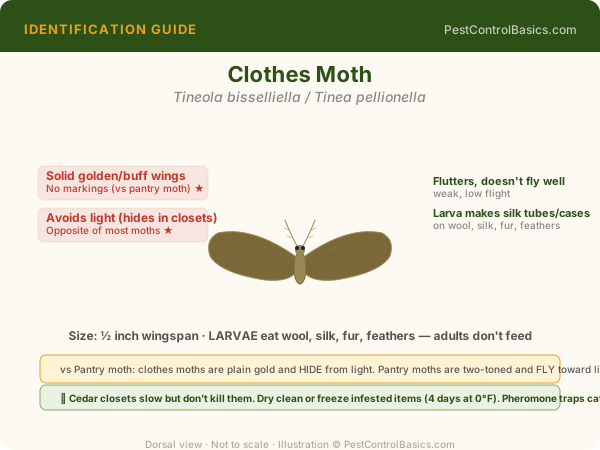
Clothes Moth (Tineola bisselliella) identification illustration with labeled anatomical features — PestControlBasics.com

Original illustration by PestControlBasics.com. Use anatomical labels above to confirm your identification.

🔄 Stages

🥚Egg
🐛Larva
🫘Pupa
🦋Adult
🥚
Egg
40-50 Eggs on Fabric
Females lay 40-50 tiny white eggs on or near natural fiber fabrics — wool, cashmere, silk, feathers. Eggs hatch in 4-10 days depending on temperature.
🐛
Larva
The Damaging Stage — 2-30 Months
Larvae are the ONLY stage that causes damage. Cream-colored, 1-10mm; spin silk webbing on fabric; feed continuously on natural fibers. Duration highly temperature-dependent: 2 months in warm conditions, up to 30 months in cold.
🫘
Pupa
2-4 Weeks in Silk Case
Larvae spin a silk case and pupate. Adults emerge in 2-4 weeks. Pupation can occur within fabric folds, in carpet, or in cracks.
🦋
Adult
1-3 Weeks — Adults Don't Feed
Adults live 1-3 weeks, don't feed (no mouthparts), and don't damage fabric. They avoid light, preferring dark closets.

🔬 Key Facts

🎯Treatment target: Larvae in dark undisturbed areas — not the adults you see flying
🌡️Temperature: Cool conditions dramatically extend larval development — infested items stored in unheated areas may have active larvae for years
🔍Male trap: Pheromone traps catch only males — they confirm presence but don't indicate severity

📅 Seasonality

Year-round indoors. Populations build slowly in undisturbed stored items. Infestations often not discovered until significant damage has occurred.

⏰ Treatment Window

Find and remove all infested sources (most critical). Freeze or dry clean affected items. Permethrin spray to closet surfaces. Pheromone trap placement for monitoring. Zero catches for 3+ consecutive weeks = elimination confirmed.

✅ Target the most vulnerable stage.

Clothes Moth Stage Vulnerability

Only the larval stage of clothes moths damages fabric — adult moths don't feed at all (they survive on energy stored from larval feeding and live 2–4 weeks). This is the central insight for control: spraying or trapping flying adults is essentially cosmetic. The damage is being done by larvae you can't see, hidden inside fabric folds, garment pockets, and the underside of carpet edges where dust collects. Effective treatment must reach these hidden larval feeding sites.

Larvae have a strong preference for soiled fabric — sweat, food spills, body oils, and pet hair are nutritional supplements that vastly increase larval survival and growth rates. A wool sweater with no organic soiling is much less attractive than a wool sweater with a single underarm sweat residue. This is why dry cleaning before long-term storage is the single highest-impact preventive measure — it removes the organic supplements that larvae need.

Clothes Moth Treatment Timing

The control timeline is dictated by lifecycle stage: eggs are protected for 4–10 days, larvae feed for 1–3 months (depending on temperature and food quality), pupae are protected in spun silk cocoons for 8–20 days, and adults live 2–4 weeks. A complete treatment cycle must account for the full sequence — single-event treatments inevitably miss whichever stage was protected at the time.

The effective protocol: Day 1 — empty closets/dressers, vacuum thoroughly (corners, baseboards, carpet edges), launder or dry-clean all washable items, freeze non-washable items (-4°F for 4 days kills all stages), inspect every garment for active larvae or cast skins. Day 1 also — apply CimeXa or food-grade DE to closet floor cracks, carpet edges, behind baseboards. Days 30 and 60 — repeat inspection and vacuuming. Hang pheromone traps (Trécé clothes moth traps) for monitoring only — they catch males but don't control populations. After 90 days with no new damage and zero trap catches, infestation is controlled.

🎯 Life Cycle Stage × Treatment Effectiveness

Understanding life cycle stages allows you to target the most vulnerable period and plan follow-up treatments to catch individuals that survived as eggs or pupae.

StageDurationTreatment Approach
Egg/PupaVariableOften resistant to insecticides. Target adults and larvae while preventing egg-laying.
Larva/NymphVariableOften the most susceptible stage to IGRs and targeted treatments.
AdultVariablePrimary treatment target. Elimination of adults stops reproduction.

⏰ Why Timing and Follow-Up Matter

Most treatment failures happen because of two mistakes: treating only once, and treating only the visible population. Life cycles mean there are always individuals in a pesticide-resistant stage (eggs, pupae, or protected cases) that will emerge after your first treatment.

💡 Key principle: You're not treating today's population — you're breaking the reproductive cycle.

❓ Life Cycle FAQ

How does knowing the life cycle help me treat this pest?
Life cycle knowledge tells you which stages are present and which are vulnerable. Treating when only adults are present misses eggs that will hatch in days. Timing treatments to coincide with the vulnerable stages — and planning follow-ups for resistant stages — dramatically improves outcomes.
Why do pests come back even after a thorough treatment?
Eggs, pupae, and protected life stages (like cockroach egg cases) are resistant to most insecticides. They hatch or emerge after treatment and rebuild the population. The solution is scheduled follow-up treatments timed to catch each new cohort as it becomes vulnerable.
How long does a complete life cycle take?
Cycle duration varies by species and temperature — warmer temperatures accelerate all stages. At typical indoor temperatures (70°F), most common household pest cycles complete in 4–12 weeks. This is why 6-week treatment protocols are the standard minimum for most infestations.
Published: Jan 1, 2025 · Updated: Apr 7, 2026

Why life cycle understanding improves treatment timing

Treatment that targets the wrong life stage either fails entirely or produces a short-term effect that lets the population rebound. Egg stages are protected by chorion or oothecae and resist most chemical treatments — IGRs prevent emergence but don't kill eggs already laid. Larval stages are typically the most chemically vulnerable but are often hidden in harborage. Pupal stages have variable vulnerability depending on species — flea pupae are extremely resistant; cockroach pupae are non-existent (cockroaches don't pupate). Adult stages are visible but often the smallest portion of the population. The practical implication: treatment programs that hit multiple life stages — typically through residual products that catch emerging adults plus IGRs that prevent maturation — produce more durable control than single life-stage treatments.

How resistance develops and how to slow it down

Pesticide resistance is now common enough across major pest categories — cockroaches, bedbugs, mosquitoes, certain ant species, some flies — that treatment recommendations have shifted to account for it. Resistance develops through repeated exposure to a single active ingredient class; the surviving population reproduces, and over generations the population shifts toward resistance. Slowing resistance development requires rotating active ingredient classes (not just brands), using full label rates rather than reduced rates, and avoiding routine prophylactic spraying when it isn't needed. The EPA mode-of-action (MoA) classification on product labels helps with rotation: alternating between products in different MoA classes is more effective than alternating brand names within the same class. For homeowners, the practical translation is: don't use the same product month after month; if you're spraying regularly, rotate among at least two unrelated chemistries; and don't spray when monitoring suggests no active population.

Why integrated pest management produces better outcomes

Integrated Pest Management (IPM) is the framework most pest management professionals follow and the framework the EPA recommends for residential and commercial settings. IPM is not anti-pesticide; it's a sequencing approach that uses cultural controls (sanitation, exclusion, moisture management) first, mechanical controls (traps, vacuuming, physical removal) second, biological controls (beneficial insects, microbial agents) where applicable, and chemical controls last and targeted. The benefit isn't ideological — it's empirical. IPM-treated sites have lower long-term pest pressure than chemical-only treated sites, because chemicals address the visible population without addressing why the population developed. Homeowners who adopt IPM principles see longer intervals between treatments, lower total pesticide use, and better outcomes during the times when chemicals are appropriate. The shift from 'spray when I see them' to 'fix the conditions, monitor, treat targeted' is the single highest-leverage change most DIY practitioners can make.

The economics of pest control: where money is best spent

Pest control budgets get distorted by emotional intensity — the spend follows fear, not optimization. Looking at the categories where money produces the most durable risk reduction: exclusion work (one-time, durable, low ongoing cost), moisture management (fixing leaks, gutters, grading — removes the conditions pests need), and annual inspection (catches problems before they become expensive). Recurring treatment contracts produce real value in high-pressure situations (heavy termite zones, severe rodent pressure, commercial settings) and less value in moderate-pressure suburban settings where quarterly DIY would handle the same load. Equipment investments — a quality pump sprayer, a hand duster, a UV flashlight for fluorescent residue checks — pay back quickly. Premium products usually don't outperform mid-priced products with the same active ingredient at the same label rate. The right mental model: spend on prevention, structure, and information; spend less on recurring reactive treatment.

Seasonal life cycle phases and pressure timing

Most pest populations have predictable seasonal life cycle phases. Overwintering forms (eggs, pupae, hibernating adults) are protected and minimally susceptible to treatment during cold months but emerge into vulnerable life stages in spring. Spring is the highest-leverage treatment window for many pests because the population is starting from low numbers and emerging from protected forms into susceptible activity. Summer is the peak reproductive period for most species — populations grow rapidly and treatment is mostly catching up to growth. Late summer and early fall are when populations peak before declining; treatment now reduces overwintering population that determines next year's starting point. This pattern explains why preventive treatment in spring and fall outperforms reactive treatment in midsummer for many species.

Why life-cycle stage matters for treatment selection

Pest treatment products generally target specific life stages and miss others, which means understanding the life cycle of a target pest is essential for choosing the right product or product combination. Adulticides kill adults but typically don't kill eggs or affect larvae and pupae; if eggs hatch over a 10-day window, single-application adulticide produces incomplete control and requires re-application. Insect growth regulators (IGRs) interrupt larval development but don't kill adults; they're powerful long-term tools but produce slow control because adults must die naturally before population declines. Ovicides specifically kill eggs but require contact application to oothecae or egg masses. The practical implications across pest types: bed bug treatment needs adulticide plus follow-up treatment timed to egg hatch (or ovicide plus adulticide combination); flea treatment combines adulticide on the pet, IGR in the environment, and physical removal of eggs and larvae through vacuuming; cockroach baiting combines adult and nymph mortality (because bait carriers feed bait to other colony members) but requires multiple weeks for full effect. Matching treatment to life cycle produces dramatically better results than single-stage interventions.

The role of caulk, sealant, and exclusion in long-term pest control

Sealing entry points is the most underrated pest control activity in residential settings, partly because it produces no immediate visible result and partly because it feels like home repair rather than pest control. The yield is substantial: a thoroughly sealed structure with appropriate exterior caulking, intact weatherstripping, sealed utility penetrations, and screen integrity has dramatically lower pest pressure than the same structure without those interventions. Specific high-yield targets include gaps around dryer vents, electrical and plumbing penetrations through exterior walls, gaps where siding meets foundation, mortar joints in older brick, weep holes in newer brick (which should be screened, not sealed), garage door bottom seals (where rodents commonly enter), and the gap above door thresholds where many ants and small insects pass. Materials matter: silicone-based caulk for moisture areas, polyurethane sealant for foundation cracks, copper mesh for rodent exclusion at utility penetrations (steel wool degrades), and 1/4-inch hardware cloth for larger openings. A weekend of methodical sealing in spring or fall — when activity is moderate and weather permits exterior work — produces lasting reduction that no single treatment matches.

The cost of doing nothing: implicit pest tolerance and its hidden expenses

Pest control discussions usually frame the costs of treatment without quantifying the costs of non-treatment, but the latter are often larger and almost always less visible. Cockroach allergens add measurable healthcare costs in homes with asthma. Rodent activity in attics damages insulation (reducing R-value and adding seasonal heating and cooling costs) and creates fire risk through wire chewing that doesn't show up until something fails. Termite damage in unmonitored properties produces structural repair bills in the five-figure range, often discovered during unrelated renovation. Stored-product pests destroy food inventory at rates that aren't tracked because items are discarded individually rather than tallied. The cumulative cost of doing nothing isn't a single line item but a sum of small chronic losses across years. The framing that helps: pest control isn't a luxury expense layered onto a working baseline; it's a maintenance expense that competes with the slow accumulating cost of allowing a problem to continue. Households running the comparison honestly almost always find that modest preventive spending is the cheaper path.

Treatment timing relative to life cycle stages

Most household pests are vulnerable to specific control approaches at specific life cycle stages, and treatments timed to those stages produce dramatically better results than untimed treatments. For most insect pests, the larval stage is more vulnerable to growth regulators and biological controls than the adult stage; the egg stage is largely impervious to most chemical treatments; and the pupal stage, when one exists, is often well-protected by the cocoon. For pests with discrete generation cycles — fleas, mosquitoes, flies — treatment that targets the population at multiple stages of the cycle simultaneously is more effective than treatment that addresses only one stage. For pests with overlapping generations and continuous reproduction, like cockroaches and bed bugs, treatment has to continue long enough to span the full development time of any eggs present at the start of treatment, which is typically several weeks to a couple months depending on conditions. The mismatch between treatment cadence and life cycle is one of the most common reasons that initially successful treatment is followed by population rebound; understanding the cycle of the specific pest, and timing follow-up to its biology, addresses this problem at the source.

Coordinating pest control with renovation and construction work

Renovation work is one of the highest-value moments for pest intervention, and it's also one of the most consistently missed. When walls are open, when slabs are exposed, when crawlspaces are accessible, when sill plates are visible — these are the windows during which exclusion work, soil treatment, perimeter sealing, and harborage elimination can be done at a fraction of their normal cost and with dramatically better completeness. The same caulk-and-foam exclusion job that takes hours of awkward work after the fact can be done in minutes when the wall cavity is open. A pre-construction termite soil treatment is dramatically more effective than any post-construction equivalent, but it has to happen before the slab is poured. Even non-structural renovations like flooring replacement, kitchen rework, or basement finishing create windows during which the home's pest-relevant geometry can be improved. The cost of pulling in a pest professional during the renovation envelope, even just for an inspection and recommendations, is almost always recovered in reduced future treatment costs and avoided structural damage. The conversation to have with general contractors is whether they're willing to coordinate with a pest specialist during the open-wall phase, and most reputable contractors are, particularly on larger jobs where the small additional scheduling complexity is offset by the value-add for the homeowner.

Annual pest control budgets: planning versus reactive spending

Most households treat pest control as an emergency expense rather than a line item, and the resulting spend is almost always higher than what a planned program would have cost. A property that allocates a modest annual budget toward inspections, preventive perimeter work, and one or two scheduled treatments at high-pressure times of year typically spends a fraction of what a comparable property spends on crisis response to a single major infestation. The math is straightforward: a moderate cockroach, rodent, or bed bug job typically costs more than a year of preventive service, and the labor and disruption costs to the household are not trivial either. Building a budget also forces the kind of structured thinking that catches problems early — when a homeowner has already decided to allocate funds, they're more willing to call for an inspection at the first ambiguous sign, rather than waiting until the situation is unambiguous and more expensive. The shift from reactive to planned spending is one of the highest-leverage changes a household can make in this category.