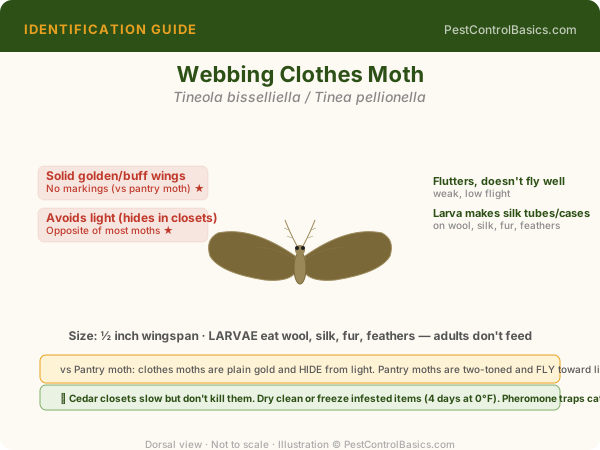
Webbing clothes moths are rarely seen — they avoid light completely. Most infestations are only discovered when damage to a favorite garment is found.
MothFabric PestTineidaeCashmereWoolNo Light
🦋
Risk Level
Fabric Pest
📐 FIELD GUIDE ILLUSTRATION
Original illustration by PestControlBasics.com. Use anatomical labels above to confirm your identification.
🔬
PestControlBasics Editorial Team
Reviewed by Derek Giordano · Updated 2026
🔍 Identification
Adults: 12-16mm wingspan; uniformly buff/golden with no markings; weak flyers; immediately hide when disturbed; NEVER fly to lights (opposite of food moths). Larvae: 6-10mm; creamy white with brown head; produces flat silk webbing on and around food source. Damage: irregular holes in natural fibers with characteristic flat silk webbing around the edges.
🧬 Biology & Behavior
Females lay 40-50 tiny white eggs on natural fiber fabrics — wool, cashmere, silk, angora, fur, feathers. Larvae hatch and immediately begin feeding and producing webbing. Complete development: 2-6 months in warm conditions, up to 2 years in cold. Adults live 1-3 weeks; adult females don't feed. Life cycle entirely dependent on natural protein fibers — they cannot develop on synthetic fabrics.
⚠️ Damage & Health Risk
Holes in wool, cashmere, silk, fur, and feather-filled items; silk webbing on damaged fabrics; loss of irreplaceable or high-value garments; museum collection damage.
🔧 DIY Treatment
Monitor with pheromone traps (catches males, confirms presence). Inspect all natural fiber items thoroughly — including unlikely sources like piano felts and natural fiber rugs. Freeze confirmed items (0°F, 72 hours). Dry-clean high-value items. Permethrin spray to storage surfaces. Store in airtight sealed bags.
👷 When to Call a Pro
Rarely warranted — the protocol can be completed effectively by homeowners with the right approach.
❓ FAQ
Why don't I ever see clothes moth adults if I have an infestation?
Webbing clothes moth adults avoid light completely — they hide in the darkest areas of closets and storage spaces. Unlike food moths that fly around kitchens, clothes moths run for cover when disturbed. Their extreme light avoidance makes visual detection very difficult. Pheromone traps are the most reliable detection method.
Can I prevent clothes moths with cedar and lavender?
Cedar and lavender are traditional deterrents but have minimal scientific support as standalone prevention. Cedar oil repels some textile pests slightly but loses effectiveness as the wood dries (refreshing with cedar oil restores some activity). The only reliable prevention is storing natural fiber items in sealed airtight containers.
DG
Derek Giordano
Certified Pest Control Operator · Former Business Owner
Derek ran his own pest control company in Florida for several years, servicing thousands of regular customers. All content is based on hands-on field experience and current EPA & university extension guidelines.
Confirming a Webbing Clothes Moth infestation in the field
Misidentification is the most common reason home treatment fails for Webbing Clothes Moth. Look-alike species often respond to completely different active ingredients, so a 30-second confirmation step before any spraying or baiting saves the most time over a season. The practical workflow begins with where you found the specimen — kitchen, bathroom, garden, attic — because habitat narrows the candidate list faster than morphology alone.
Specific cues for Webbing Clothes Moth include body proportions, leg count, antenna shape, and any wing structure if present. Adults are usually the easiest stage to identify, but most real-world infestations show juveniles or evidence (frass, shed skins, webbing, damage patterns) more often than adults themselves. Photograph the specimen against a ruler or coin for scale, then compare against a regional reference rather than a global one — range maps from state Extension services beat generic online identification sites.
When two species look genuinely similar, the deciding factor is often where they congregate at dusk versus dawn, or whether they leave a visible trail. A test of three common DIY treatments — one bait, one residual spray, one mechanical barrier — applied in different areas can also confirm identity by which works.
When to escalate Webbing Clothes Moth control beyond DIY
Most Webbing Clothes Moth situations are within the range of a careful homeowner, but a handful of scenarios genuinely warrant a licensed applicator. Multi-unit buildings are at the top of that list — shared walls, plumbing, and ductwork mean a localized treatment in one unit often just relocates the population to a neighbor. Any infestation that involves wall voids, attic insulation, or sub-slab plumbing is also harder to reach with consumer products and benefits from professional equipment and labeled product concentrations.
Health-sensitive situations are the second escalation trigger. Pregnancy, infants, immunocompromised residents, and pets with known sensitivities all narrow the available product list considerably. A licensed professional can apply restricted-use products and reduced-risk reformulations that achieve control with lower household exposure than over-the-counter alternatives. The cost difference is usually less than two seasons of DIY spending once the time investment is factored in.
The third escalation point is recurrence. If the same pest returns within six weeks of an apparently successful treatment, the source is usually structural or environmental rather than chemical, and a professional inspection often finds the cause faster than a second round of self-treatment.
Why timing changes everything with Webbing Clothes Moth
The same product applied two weeks apart can produce a complete kill or near-zero effect depending on where the Webbing Clothes Moth population sits in its life cycle. Egg-stage pests are nearly immune to contact sprays, so a perfectly applied treatment during a major hatch event will leave the next generation completely unaffected. The professional standard is two applications spaced 10 to 14 days apart for most household pests — the first kills the active adults, the second catches anything that emerges from eggs in the interim.
Temperature also drives treatment success. Most residual sprays lose efficacy above 90°F or below 50°F, and pyrethroid products in particular can repel rather than kill when applied during high heat. The best window is early morning when surface temperatures are still moderate and target pests are moving but not yet at peak activity. Indoor treatment is less weather-dependent but still benefits from being applied when household air movement is low — running ceiling fans during application redistributes droplets away from the intended surface.
Seasonal pressure for Webbing Clothes Moth usually has two or three predictable peaks per year. A treatment calendar built around those peaks costs less and works better than reactive spraying after a problem is already established.
Prevention strategies that actually reduce Webbing Clothes Moth pressure
Most pest pressure traces back to one or two environmental conditions that are easier to fix than the infestation itself is to spray. For Webbing Clothes Moth, the highest-leverage changes typically involve moisture management, food access, and exclusion at structural entry points. Reducing standing water within 20 feet of the foundation eliminates more pest problems than any single chemical application, and the effect persists year over year rather than requiring a rebuy every quarter.
Exclusion work is unglamorous but durable. A common entry-point audit covers door sweeps, weep holes, utility penetrations, dryer vents, soffit gaps, and the base of siding. Most homes have between five and fifteen openings larger than the minimum required for the target pest to enter, and sealing even half of them measurably reduces indoor sightings within one season. Stainless steel mesh, copper wool, and exterior-grade sealant cover most situations; expanding foam alone is not sufficient because rodents and some insects chew through it.
Storage practices matter too. Pantry pests, fabric pests, and overwintering insects all exploit cardboard, paper, and natural-fiber storage in basements and garages. Switching to sealed plastic bins for seasonal storage removes a significant amount of harborage that is otherwise impossible to spray effectively.
Published: Jan 1, 2025 · Updated: Apr 7, 2026
Pantry moth elimination: comprehensive approach
Pantry moth (Indianmeal moth, Mediterranean flour moth, and related species) infestations require comprehensive pantry remediation rather than spot treatment. The treatment protocol that consistently works: remove every food item from the pantry; inspect each container for active infestation (larvae, webbing, frass) and discard any infested items in a sealed bag taken out of the house immediately; vacuum the pantry thoroughly including all corners, shelf undersides, and edge crevices; wipe shelves with a damp cloth to remove eggs adhered to surfaces; place pheromone traps to catch surviving adult males and monitor for re-emergence; restock with items in sealed glass or hard plastic containers rather than original packaging (cardboard and plastic bags are vulnerable to entry). The pheromone traps confirm whether treatment was complete — catches dropping to zero over 4-6 weeks indicates success; sustained catches indicate missed infestation source still present. Cardboard and paper packaging are the entry route for many pantry moth infestations, often from infested packaging at the grocery store.
Reading reviews of pest control products critically
Online reviews of pest control products are noisier than reviews in most categories because outcomes depend heavily on application and identification — both of which are usually wrong when DIY treatment fails. A one-star review saying "didn't work on bedbugs" often reflects insufficient coverage, untreated harborage, or a misidentified pest, not product failure. Reviews are most useful when they describe specific application conditions (substrate, dilution, target pest stage, environmental conditions) and least useful when they're brief judgments without context. Independent testing from Consumer Reports, university entomology trial publications, and the EPA's BEAD (Biological and Economic Analysis Division) reports give more reliable efficacy data than aggregated retailer reviews. For consumer products, the EPA registration alone confirms basic safety and that the product does what the label claims; outperformance among registered products is usually a matter of formulation choice for the specific substrate and pest.
Pantry moths: source identification before treatment
Indian meal moths and similar pantry pests are nearly impossible to eliminate without identifying and discarding the source product, and most failed pantry moth treatments fail because the source product was missed. The diagnostic approach: empty the entire pantry, inspect every package of dried goods (flour, cereal, rice, grain products, dried fruit, nuts, pet food, birdseed, candy, even spices), and look specifically for webbing in the corners of packages, small caterpillars on or in the food, or the small flat-headed moths themselves. Any package showing evidence is discarded, ideally in a sealed bag taken immediately to outdoor trash. Pheromone traps (which use Plodia interpunctella pheromone) catch male moths and help confirm whether elimination has been achieved; ongoing catches after pantry cleanup indicate a remaining source. After source elimination, vacuum pantry shelves thoroughly (paying particular attention to corners, shelf-track joints, and any seams), wipe with mild soap solution, and store new dried goods in sealed glass or hard plastic containers rather than original packaging. Routine inspection of bulk-bin and warehouse-store purchases at intake (these are common introduction sources) prevents most recurrences.
How structural moisture issues drive pest problems most homeowners miss
A surprising fraction of pest problems are downstream of moisture issues that go uncorrected because they don't produce obvious damage. Subterranean termites require moist soil contact; correcting drainage and downspouts often reduces termite pressure more than any chemical treatment. Carpenter ants nest in damp or previously-damp wood; the colony moves in only after moisture has softened the substrate. Drain flies, fungus gnats, and springtails are all moisture-driven and resolve when the moisture source resolves. Mold mites and booklice indicate humidity that exceeds about 70%, often in unventilated bathrooms or basements. Even rodent activity correlates with moisture: rodents need accessible water and follow water-supply intrusions to bring themselves into structures. The diagnostic question worth asking on any chronic pest problem: is something wet that shouldn't be? Common offenders are clogged gutters, downspouts that drain near the foundation rather than away from it, condensate lines from HVAC systems and water heaters, slow plumbing leaks under sinks, sweating cold-water pipes in unconditioned spaces, and crawlspaces without adequate vapor barriers. Fixing the underlying moisture issue typically yields permanent improvement that chemical treatment alone cannot match.
Clothes moth treatment and the role of cleaning
Clothes moths — primarily webbing clothes moths and casemaking clothes moths — feed specifically on protein fibers including wool, cashmere, silk, fur, feathers, and pet hair accumulations. Treatment depends on cleaning more than on chemical application because adult moths don't damage textiles; damage is done by larvae feeding on protein fibers, often with the larvae concealed in case-fragments that look like lint. Effective treatment: launder or dry-clean all protein-fiber items in the affected area (heat from drying kills all life stages); vacuum thoroughly including under furniture, in closet corners, along baseboards, and inside storage containers that held affected items; address protein debris that supports populations (pet hair accumulation, dead insect collections in window sills, bird nests in eaves, animal hair carpets); store cleaned wool and protein items in sealed containers (cedar chests, sealed plastic bins) rather than open shelving. Pheromone traps for webbing clothes moths help monitor remaining adult populations and confirm treatment success. Mothballs (naphthalene or paradichlorobenzene) work by sublimation in sealed enclosures but produce indoor air quality concerns and are inappropriate for open storage.
Pantry inventory rotation as preventive practice
Pantry moth infestations begin in specific products and spread from there, and the products responsible are nearly always grain-based items that have been in the pantry longer than they should have been. Flour, rice, cereals, baking mixes, pasta, dried fruit, and pet food are the typical primary sources. Items purchased and consumed within a few months almost never harbor active infestations; items that have been in the pantry for a year or more frequently do, particularly if they're in original packaging that allows moth entry through paper seams or thin plastic. Inventory rotation — first-in-first-out use of dry goods, dating items at purchase, periodic culling of items past their reasonable freshness window — is a preventive practice that addresses the source of most pantry moth problems rather than the symptom. Combined with storage of high-risk items in airtight glass or hard plastic containers, inventory rotation prevents the conditions under which pantry moths establish in the first place. The behavioral commitment is small but consistent, and households that adopt it generally have no further pantry moth issues, while households that rely on reactive treatment cycle through repeated infestations.
The economics of preventive versus reactive treatment
Preventive treatment costs money in a year when nothing is happening, which is precisely why most households avoid it. The decision to spend on prevention requires a willingness to compare what you actually spend against a counterfactual you never directly observe — the infestations you would have had without it. This is a hard mental move, and it's why preventive pest control consistently underconsumed relative to its economic value. The way to think about it more clearly is to compute the expected annual cost of treatment for a property like yours given local pest pressure, then compare that against the cost of a preventive program. In most regions and for most property types, a preventive program comes in lower in expected value, sometimes substantially. The variance is also lower: instead of a year with zero pest spending followed by a year with a large unexpected expense, you have a small consistent line item that smooths out the cash flow. For households where unexpected expenses are particularly painful, that variance reduction is itself worth something even before counting the expected-value benefit.
Pheromone traps: useful for monitoring, weak for control
Pantry moth and clothes moth pheromone traps are sometimes marketed as control devices, but they're substantially more useful for monitoring than for actual population reduction. The traps attract adult males via species-specific pheromone, which makes them useful for detecting the presence of an infestation and for tracking its trajectory over time, but they don't affect females, eggs, or larvae, and they don't reduce the breeding population enough to control an established infestation. Used correctly, pheromone traps are diagnostic tools placed in pantries and closets to detect activity early — when one or two adults appear in a trap, the response is to inspect carefully and find the source product or fabric — rather than treatment tools relied on as the primary intervention. Households that buy pheromone traps and expect them to solve the problem usually experience continued infestation; households that use them as part of a broader program of source identification, disposal of infested materials, and storage practice changes get the diagnostic value the traps actually offer.
🗺️ US Distribution — Webbing Clothes Moth
Common Occasional Not Present
States Present
49
Occasional
2
Primary Region
All agricultural regions
📊 Source: University extension services, USDA, CDC vector data, and published entomological surveys.