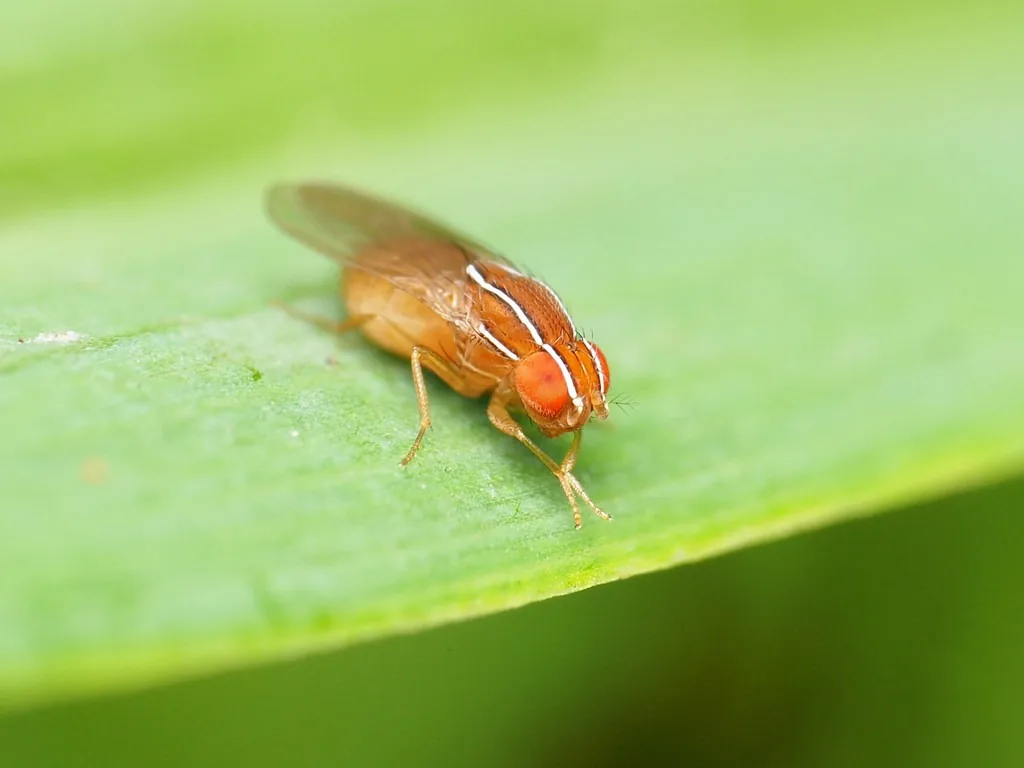
How to identify it
Look-alikes
| Look-alike | How to tell them apart |
|---|---|
| Spotted-wing drosophila | The African fig fly is slightly larger, has white stripes and often shows up in fruit SWD has already damaged.[1] |
Where it lives
Originally from Africa, it reached the U.S. through Florida in 2005 and Kentucky in 2012.[1]
Biology and life cycle
It's linked to more than 80 plants; larvae turn up in blackberries, raspberries, grapes, strawberries, figs and tomatoes.[1]
It can't cut into intact fruit skin, so it often uses fruit damaged by other insects.[1]
Damage and signs
- Infested fruit becomes leaky and soft.[1]
Health risk
It feeds on fruit; UK Extension mentions no risk to people.[1]
Control
Prevention
Grow early-ripening varieties, since numbers stay low until fall, and refrigerate fruit after harvest.[1]
Sanitation
Remove old and damaged fruit, and seal discards in a plastic bag in the sun or freezer for 24 hours before composting.[1]
Common questions
Sources
- University of Kentucky Entomology (ENTFACT), “African Fig Fly (ENTFACT-232).” entomology.mgcafe.uky.edu/ef232 (accessed 2026-10-06)
- iNaturalist, “Zaprionus indianus taxon page (order and family).” www.inaturalist.org/taxa/333873 (accessed 2026-10-06)