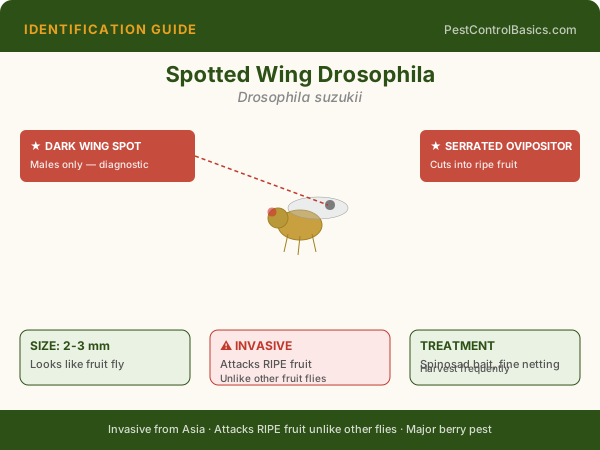
Common fruit flies attack overripe fruit. Spotted wing drosophila has a serrated ovipositor that cuts through intact ripe fruit skin — making it a devastating berry and soft fruit pest.
Fruit FlyDipteraBerry PestInvasiveDrosophilidaeCrop Pest
🪰
Risk Level
Fruit Crop Pest
📐 FIELD GUIDE ILLUSTRATION
Original illustration by PestControlBasics.com. Use anatomical labels above to confirm your identification. For photo references, see the identification section below.
🔬
PestControlBasics Editorial Team
Reviewed by Derek Giordano · Updated 2026
🔍 Identification
3-4mm; similar to common fruit fly but males have a distinctive BLACK SPOT on each wing — the definitive ID feature. Females have a serrated, saw-like ovipositor visible under magnification. Found on healthy ripe fruit; common fruit flies require damaged or rotting fruit. Range: now established throughout the US, particularly destructive in Pacific Coast states and Northeast berry regions.
🧬 Biology & Behavior
Females cut into ripe or ripening fruit with their serrated ovipositor and lay eggs inside. Larvae hatch inside the fruit, rendering it unmarketable within days. A single female can deposit 350 eggs over her lifetime. Multiple generations per season; populations build rapidly in cool, wet conditions. Major pest of: strawberries, blueberries, raspberries, cherries, grapes, figs.
⚠️ Damage & Health Risk
Fruit becomes soft, watery, and inedible as larvae feed inside. Infested fruit is unmarketable. Losses of 20-40% in berries are common in high-pressure years; complete crop losses documented in severe infestations.
🔧 DIY Treatment
Exclude with fine mesh berry netting (covers plants during ripening). Spinosad spray (most effective, OMRI listed) applied weekly beginning when first fruit colors. Pyrethrin spray as backup. Kaolin clay reduces egg-laying. Harvest frequently — don't leave ripe fruit on plant. Remove overripe and dropped fruit immediately.
👷 When to Call a Pro
Commercial berry operations use IPM monitoring programs with SWD-specific pheromone traps to time weekly spray applications.
❓ FAQ
How do I know if my berries have SWD?
Place ripe berries in a clear bag with some water for 1-2 days. If tiny white maggots emerge from the berries, SWD is present. The float test: place berries in salt water — SWD larvae float to the surface. Males on yellow sticky traps have the distinctive wing spot.
Is spotted wing drosophila in my area?
SWD is now established throughout the US. It arrived on the Pacific Coast around 2008 and spread to all berry-producing regions by 2012. Monitoring programs in your county can provide population pressure data — contact your county Cooperative Extension office.
DG
Derek Giordano
Certified Pest Control Operator · Former Business Owner
Derek ran his own pest control company in Florida for several years, servicing thousands of regular customers. All content is based on hands-on field experience and current EPA & university extension guidelines.
When to escalate Spotted Wing Drosophila (SWD) control beyond DIY
Most Spotted Wing Drosophila (SWD) situations are within the range of a careful homeowner, but a handful of scenarios genuinely warrant a licensed applicator. Multi-unit buildings are at the top of that list — shared walls, plumbing, and ductwork mean a localized treatment in one unit often just relocates the population to a neighbor. Any infestation that involves wall voids, attic insulation, or sub-slab plumbing is also harder to reach with consumer products and benefits from professional equipment and labeled product concentrations.
Health-sensitive situations are the second escalation trigger. Pregnancy, infants, immunocompromised residents, and pets with known sensitivities all narrow the available product list considerably. A licensed professional can apply restricted-use products and reduced-risk reformulations that achieve control with lower household exposure than over-the-counter alternatives. The cost difference is usually less than two seasons of DIY spending once the time investment is factored in.
The third escalation point is recurrence. If the same pest returns within six weeks of an apparently successful treatment, the source is usually structural or environmental rather than chemical, and a professional inspection often finds the cause faster than a second round of self-treatment.
Prevention strategies that actually reduce Spotted Wing Drosophila (SWD) pressure
Most pest pressure traces back to one or two environmental conditions that are easier to fix than the infestation itself is to spray. For Spotted Wing Drosophila (SWD), the highest-leverage changes typically involve moisture management, food access, and exclusion at structural entry points. Reducing standing water within 20 feet of the foundation eliminates more pest problems than any single chemical application, and the effect persists year over year rather than requiring a rebuy every quarter.
Exclusion work is unglamorous but durable. A common entry-point audit covers door sweeps, weep holes, utility penetrations, dryer vents, soffit gaps, and the base of siding. Most homes have between five and fifteen openings larger than the minimum required for the target pest to enter, and sealing even half of them measurably reduces indoor sightings within one season. Stainless steel mesh, copper wool, and exterior-grade sealant cover most situations; expanding foam alone is not sufficient because rodents and some insects chew through it.
Storage practices matter too. Pantry pests, fabric pests, and overwintering insects all exploit cardboard, paper, and natural-fiber storage in basements and garages. Switching to sealed plastic bins for seasonal storage removes a significant amount of harborage that is otherwise impossible to spray effectively.
Why timing changes everything with Spotted Wing Drosophila (SWD)
The same product applied two weeks apart can produce a complete kill or near-zero effect depending on where the Spotted Wing Drosophila (SWD) population sits in its life cycle. Egg-stage pests are nearly immune to contact sprays, so a perfectly applied treatment during a major hatch event will leave the next generation completely unaffected. The professional standard is two applications spaced 10 to 14 days apart for most household pests — the first kills the active adults, the second catches anything that emerges from eggs in the interim.
Temperature also drives treatment success. Most residual sprays lose efficacy above 90°F or below 50°F, and pyrethroid products in particular can repel rather than kill when applied during high heat. The best window is early morning when surface temperatures are still moderate and target pests are moving but not yet at peak activity. Indoor treatment is less weather-dependent but still benefits from being applied when household air movement is low — running ceiling fans during application redistributes droplets away from the intended surface.
Seasonal pressure for Spotted Wing Drosophila (SWD) usually has two or three predictable peaks per year. A treatment calendar built around those peaks costs less and works better than reactive spraying after a problem is already established.
Confirming a Spotted Wing Drosophila (SWD) infestation in the field
Misidentification is the most common reason home treatment fails for Spotted Wing Drosophila (SWD). Look-alike species often respond to completely different active ingredients, so a 30-second confirmation step before any spraying or baiting saves the most time over a season. The practical workflow begins with where you found the specimen — kitchen, bathroom, garden, attic — because habitat narrows the candidate list faster than morphology alone.
Specific cues for Spotted Wing Drosophila (SWD) include body proportions, leg count, antenna shape, and any wing structure if present. Adults are usually the easiest stage to identify, but most real-world infestations show juveniles or evidence (frass, shed skins, webbing, damage patterns) more often than adults themselves. Photograph the specimen against a ruler or coin for scale, then compare against a regional reference rather than a global one — range maps from state Extension services beat generic online identification sites.
When two species look genuinely similar, the deciding factor is often where they congregate at dusk versus dawn, or whether they leave a visible trail. A test of three common DIY treatments — one bait, one residual spray, one mechanical barrier — applied in different areas can also confirm identity by which works.
Published: Jan 1, 2025 · Updated: Apr 7, 2026
The role of local cooperative extension in pest decisions
State cooperative extension services — university-based educational and advisory programs in every state — are dramatically underused resources for residential pest decisions. Most state extensions employ entomologists who answer homeowner questions free of charge through county offices, online query forms, or scheduled call hours. The information available is specific to the state's pest pressure, climate, and recommended practices, and is typically much more locally accurate than national resources. Extension publications cover identification, life cycle, treatment options, and specific product recommendations for state conditions; the publications are peer-reviewed by university scientists and updated periodically based on current research. For any pest situation where identification is uncertain or treatment options are unclear, a clear photograph submitted to the state extension produces an identification, a brief biological explanation, and one or more treatment options within typically a few days. The benefit beyond any single inquiry is building familiarity with the local resource — extension contacts become a reference for future situations and produce better decisions than aggregated online advice.
The role of caulk, sealant, and exclusion in long-term pest control
Sealing entry points is the most underrated pest control activity in residential settings, partly because it produces no immediate visible result and partly because it feels like home repair rather than pest control. The yield is substantial: a thoroughly sealed structure with appropriate exterior caulking, intact weatherstripping, sealed utility penetrations, and screen integrity has dramatically lower pest pressure than the same structure without those interventions. Specific high-yield targets include gaps around dryer vents, electrical and plumbing penetrations through exterior walls, gaps where siding meets foundation, mortar joints in older brick, weep holes in newer brick (which should be screened, not sealed), garage door bottom seals (where rodents commonly enter), and the gap above door thresholds where many ants and small insects pass. Materials matter: silicone-based caulk for moisture areas, polyurethane sealant for foundation cracks, copper mesh for rodent exclusion at utility penetrations (steel wool degrades), and 1/4-inch hardware cloth for larger openings. A weekend of methodical sealing in spring or fall — when activity is moderate and weather permits exterior work — produces lasting reduction that no single treatment matches.
Choosing a pest control company: questions worth asking
Pest control companies vary substantially in approach, training, and pricing, and the questions to ask before signing a contract often aren't the obvious ones. Worth asking: what's the technician's training and certification (state pest control certification is the floor; advanced training in IPM, structural inspection, or specific pest specialties is meaningful additional credentialing); what does the service include beyond visiting and spraying (inspection, monitoring, exclusion recommendations, follow-up scheduling); what guarantees apply if pests return between visits; what's the protocol for hard-to-resolve issues (some companies escalate to senior technicians or supervisors; others repeat the same approach); what active ingredients are used and whether the company will use specific products on request (homeowners with chemical sensitivities, pollinator gardens, or other concerns may want specific products); and what's the contract structure (per-visit, annual, multi-year). Worth less than expected: brand recognition and advertising spend (large national chains and small local operators both produce excellent and mediocre service); 'green' or 'organic' labels (which mean different things to different companies and often don't correspond to specific product or practice differences); price alone (typical pricing variance is modest, and the floor of cheap options often includes poor service).
Finding regional pest data sources worth trusting
The quality of pest information available to homeowners varies enormously by source, and finding the reliable sources for your specific region is a one-time investment that pays off across years of pest management decisions. Cooperative extension services associated with land grant universities in each state are usually the highest-quality regional resource, producing fact sheets, identification guides, and treatment recommendations specifically calibrated to local conditions, pest species, and regulatory environments. State department of agriculture pest fact sheets are typically similar in quality and orientation. Local pest control company blog content varies in quality but can be useful when produced by experienced practitioners writing about their actual work rather than generic SEO content. National pest control sites tend to be less useful for the specific reason that they average across regions and don't address the conditions you're actually facing. Bookmarking two or three high-quality regional resources at the outset, and consulting them before making significant pest management decisions, raises the average quality of your decisions dramatically without much ongoing effort.
The role of inspection in long-term cost reduction
An inspection is the cheapest tool in pest management, and homeowners systematically underspend on it. The economics are unambiguous: an annual or semiannual inspection costs a small fraction of what any moderate treatment costs, and it catches problems while they're still cheap to address. Termite damage detected in its first season requires perimeter treatment; the same damage discovered three years later may require structural repairs running into five figures. Rodent activity detected through droppings before nesting establishes requires sealing and a few traps; the same activity discovered after a multi-generation infestation has set up in wall voids requires removal, exclusion, sanitation, and sometimes drywall work. The pattern repeats across nearly every pest category. Even households that don't engage a regular pest service should treat the annual inspection as a baseline expense — equivalent to the way they probably treat HVAC tune-ups, gutter cleaning, or smoke detector battery changes. The marginal cost of one trained set of eyes on the property each year is one of the most defensible expenses in home maintenance.
Understanding pest forecast reports and what they signal
Pest forecast reports — issued by some state agricultural agencies, cooperative extension services, and commercial pest control companies — are an underutilized resource for homeowners who want to anticipate rather than react to seasonal pest activity. These reports typically combine historical pest data, current weather conditions, and growing degree day calculations to predict when specific pests will emerge or peak in specific regions. A tick forecast for an upcoming spring season, a mosquito pressure forecast after a wet winter, a termite swarm prediction for a specific week in the Southeast — these aren't speculation but reasonably calibrated predictions based on biological timing. For homeowners, the value is in scheduling preventive treatment and personal protection to match the predicted high-pressure windows rather than reacting after problems have established. Subscribing to a regional pest newsletter from a cooperative extension service or state agriculture department is free or low cost and produces these forecasts during relevant seasons. The information is dramatically more actionable than generic pest control content because it's calibrated to your specific region and current conditions.
🗺️ US Distribution — Spotted Wing Drosophila
Common Occasional Not Present
States Present
49
Occasional
2
Primary Region
Continental US
📊 Source: University extension services, USDA, CDC vector data, and published entomological surveys.