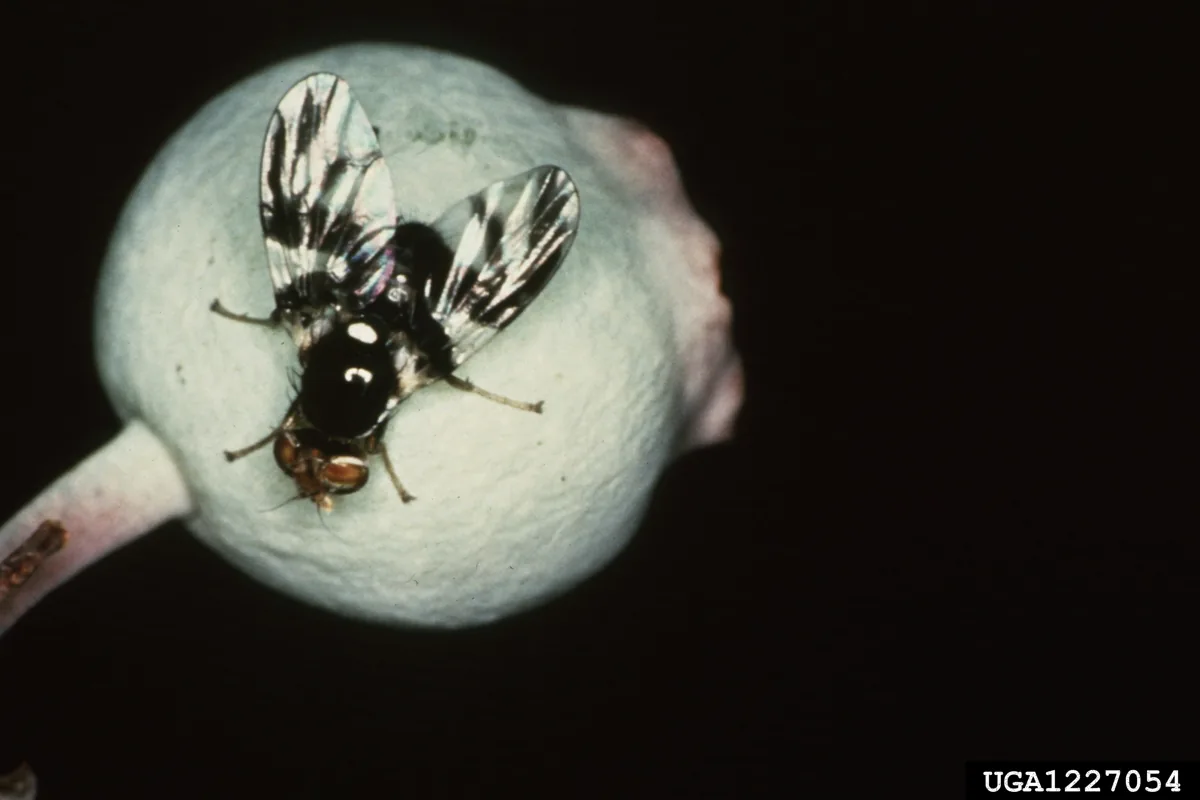
How to identify it
Look-alikes
| Look-alike | How to tell them apart |
|---|---|
| Apple maggot | Adults are virtually identical in size and wing pattern, but apple maggot does not feed on blueberries.[1] |
Where it lives
It has damaged blueberries in the eastern and southern US and eastern Canada; Wisconsin first detected it in 2016, and UNH covers it in New England wild (lowbush) blueberries.[1][2]
Biology and life cycle
Adults fly from June or July through August; females feed for about a week, then lay single eggs under the skin of nearly ripe berries, up to 100 each.[1]
Eggs hatch within a week; each maggot feeds two to three weeks in one berry, then drops to overwinter as a pupa in the top few inches of soil, and some pupae wait two or three years to emerge.[1]
In wild blueberry fields, the flies are weak fliers that come in low from forest edges.[2]
Damage and signs
Health risk
Control
Prevention
Starting a few weeks before berries ripen (usually early June), hang yellow sticky cards baited with ammonium acetate or carbonate, folded in a V with the yellow facing down.[1][2]
To check fruit, crush 100 berries in salt water (1 part salt to 4 parts water); floating larvae give the percentage infested.[1]
Sanitation
Harvest thoroughly, and heat to at least 120°F or freeze damaged fruit before composting; remove weeds and nearby wild blueberry and huckleberry plants, and clean soil off equipment moved between patches.[1]
Pesticides
Wisconsin starts sprays when traps average more than one fly for several days in a row, repeating every 7 to 10 days through harvest; UNH notes border treatments in wild blueberry fields.[1][2]
Common questions
- Why are there little white worms in my blueberries?
- Likely blueberry maggots, which feed inside ripening berries.[1]
- How can I tell if my blueberries are infested?
- Crush a sample of berries in salt water; larvae float to the surface.[1]
- Can I compost infested blueberries?
- Heat or freeze them first; pupae survive in compost and can reinfest the patch.[1]
Sources
- University of Wisconsin-Madison Extension (Wisconsin Horticulture), “Blueberry Maggot.” hort.extension.wisc.edu/articles/blueberry-maggot/ (accessed 2026-10-15)
- University of New Hampshire Extension, “Over-informed on IPM, Episode 015: SWD and Blueberry Maggot (August 2019).” extension.unh.edu/blog/2019/08/over-informed-ipm-episode-015-swd-blueberry-maggot (accessed 2026-10-15)
- iNaturalist, “Rhagoletis mendax taxon page (order and family).” www.inaturalist.org/taxa/52205 (accessed 2026-10-06)