The short answer
- Find out whether SWD is in your garden with a homemade vinegar or yeast trap hung in the shade near the fruit before it ripens. Males have one dark spot near the tip of each wing.[1][2][3]
- Pick fruit as soon as it ripens and don't leave ripe or overripe fruit hanging.[1][3][4]
- Gather fallen and damaged fruit, seal it in a plastic bag and put it in the trash or leave a clear bag in the sun. Don't compost or bury it.[1][2][4]
- Refrigerate fruit right after picking. Cold slows or stops the maggots, and longer, colder storage kills many of them.[4][3][5]
- Cover berry bushes, canes and small trees with very fine netting before the fruit starts to ripen.[1][4][2]
- Most sprays only stop adult flies before they lay eggs and don't kill maggots already in the fruit. Spray only after traps or fruit checks confirm SWD, and wait out the label's pre-harvest interval.[1][2][3]
SWD and other flies in fruit
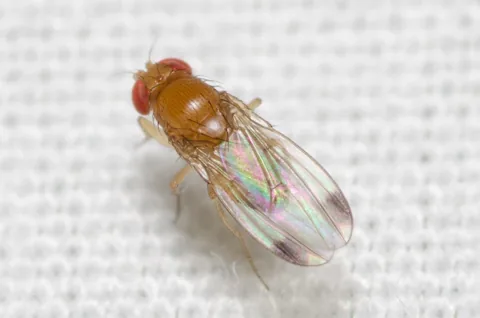 Spotted-Wing Drosophila
Drosophila suzukii
Spotted-wing drosophila is a small fruit fly native to Asia that attacks healthy, ripening soft fruit such as raspberries, blackberries, blueberries, strawberries and cherries. Most vinegar flies only go after rotting or damaged fruit.
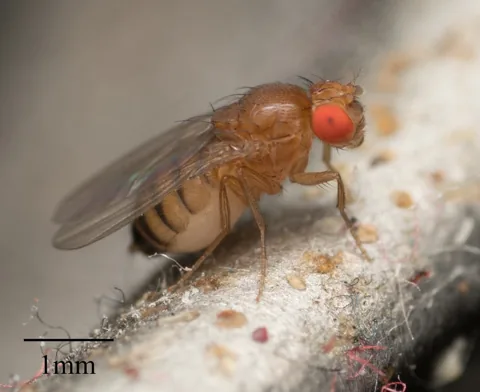 Fruit Fly
Drosophila melanogaster
Fruit flies, also called vinegar or pomace flies, are tiny flies drawn to ripe and fermenting fruits and vegetables. They can show up any time of year, but they are most common from summer into fall.
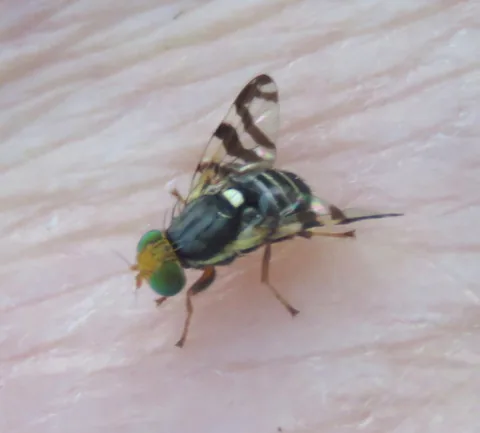 Western Cherry Fruit Fly
Rhagoletis indifferens
The western cherry fruit fly is a small fly, about 1/5 inch long with dark-banded wings, whose white maggots feed inside ripening sweet, tart and wild cherries in the western United States.
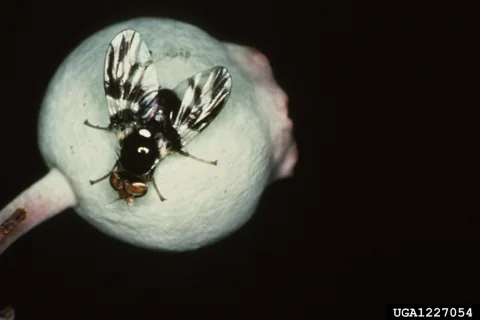 Blueberry Maggot
Rhagoletis mendax
The blueberry maggot (blueberry fruit fly) is a small black fruit fly with white markings and dark zigzag-banded wings. Its white, legless maggots feed inside ripening blueberries.
How SWD differs from ordinary fruit flies
Vinegar flies (family Drosophilidae) usually breed in rotting or damaged fruit and leave healthy fruit alone. SWD is the exception: the female has a serrated, saw-like egg-laying organ that cuts into sound fruit, so it attacks ripe and ripening fruit that is in good condition. Once the skin is broken, ordinary vinegar flies may lay eggs in the same fruit.[3][1]
SWD is native to Asia. It has been established in Hawaii since the 1980s and was first found in the continental United States in California in 2008. Wisconsin Extension says at least 45 states have reported it, and Utah State says it has spread to nearly every state.[3][4][2]
Small flies around a fruit bowl or a drain indoors are a different problem, covered in our guide to fruit flies and drain flies. Berries carried in from an SWD-infested garden are the one indoor link: Minnesota Extension says maggots in berries kept at room temperature can keep developing after picking, and mature larvae often crawl out of fruit left on the counter.[2]
- Adults: very small. UC IPM and Wisconsin give 1/16 to 1/8 inch, Minnesota 1/12 to 1/8 inch (2-3 mm) and Utah State 1/12-1/7 in (2-3.5 mm). They have red eyes and a pale or yellowish-brown body with dark bands on the abdomen.[1][3][2][4]
- Males: a single dark spot near the tip of each wing, and two dark bands on each front leg. Utah State points out that many flies have wing spots; a small fly with only one spot per wing is the one to look at closely.[3][4][1]
- Females: clear wings with no spots. They can only be told apart from other vinegar flies by the saw-toothed egg-laying organ at the tip of the abdomen, which takes magnification to see.[2][3][4]
- Maggots: white to cream, legless and cylindrical, about 1/8 inch long when full grown. One to several can be in a single fruit.[1][3][2]
- A lookalike in cherries: western cherry fruit fly is a different family of fly, about 3/16 inch long, with dark bands across its wings.[1]
Which fruit is at risk, and when
SWD prefers thin-skinned, soft fruit. Raspberries, blackberries and other cane berries, blueberries, strawberries and cherries are the main targets in home gardens. Wisconsin Extension adds currants, grapes, peaches, nectarines, plums and Asian pears, and UC IPM has seen it occasionally attack plums, plumcots, nectarines and figs.[3][1][2]
Among berries, UC IPM says raspberries appear to be the most susceptible, and all blueberry varieties appear susceptible. Minnesota Extension says SWD does not attack healthy apples, pears or cherry tomatoes and does not appear to attack cranberries, but it can infest those fruits once they are damaged.[1][2]
The sources put grapes in different places. Minnesota lists grapes with the soft fruits SWD attacks, Utah State groups grape with firmer-skinned fruits that become attractive when overripe or damaged, and Wisconsin says damage on grapes varies by variety.[2][4][3]
Wild and ornamental plants keep populations going near gardens. Wisconsin lists snowberry, pokeweed, dogwood, honeysuckle and bittersweet nightshade, and Utah State has trapped SWD in riparian areas with river hawthorn, serviceberry, wild rose, Russian olive, elderberry, golden currant and dogwood.[3][4]
- Upper Midwest: Minnesota Extension says SWD first appears in late June or early July and is most numerous in August and September. Wisconsin says activity begins in early summer and builds through early fall.[2][3]
- Northern Utah: trap catches peak from late September to early November, so late-ripening soft fruit is most at risk.[4]
- California: flies can be caught through much of the year on the coast. In the inland valleys adults are most active in spring and fall, when highs are between 60° and 80°F.[1]
- Because numbers build all season, fall-bearing raspberries and other late fruit take the most damage. For new plantings, Wisconsin suggests earlier fruiting crops such as June-bearing strawberries and black raspberries, and notes some research suggests yellow or golden raspberries may be less attractive than darker ones.[3][4]
Signs of SWD in fruit
The first sign is a tiny puncture, or "sting", where a female laid eggs just under the skin. UC IPM says each sting holds 1 to 3 eggs, and several females may lay in the same fruit. The stings are hard to see on raspberries, blackberries and strawberries, so early infestations in those crops are easy to miss.[1][3]
As the maggots feed, the flesh turns soft and brown with sunken spots, and the fruit may leak juice when squeezed. Minnesota Extension says infested fruit often smells fermented or sour, because egg-laying can bring in a bacterium that rots fruit. Eggs may show two tiny hair-like filaments sticking out of the skin, and pupae may cling to the outside of the fruit.[1][2][4]
The numbers build fast. Minnesota says females can start laying eggs one day after they emerge and the life cycle can take as little as seven days; Wisconsin says eight to nine days. Wisconsin gives more than 300 eggs per female and Utah State over 350, with eggs hatching in 12-72 hours. UC IPM says SWD can have as many as 10 generations a year in California, and Utah State's degree-day models allow 3-16 in Utah.[2][3][4][1]
Trapping: confirm SWD and time your response
Traps tell you whether SWD has arrived and when to start protecting fruit. UC IPM, Wisconsin and Utah State all say they don't catch enough flies to control the population.[1][3][4]
The sources disagree on bait. Wisconsin says a sugar and yeast bait works better than apple cider vinegar. Utah State says both baits are effective and which one catches more has varied between studies and places.[3][4]
- Container: a clear plastic cup or tub with a lid. Minnesota and Wisconsin use a 32-ounce container, UC IPM a 1-quart yogurt tub, and Utah State a 16 to 32 oz cup.[2][3][1][4]
- Holes: drill or melt holes 3/16 inch across around the upper side; UC IPM says 10 to 16 holes and Wisconsin says ten. Small holes let SWD in and keep larger insects out. Minnesota says to leave a 3- to 4-inch section without holes to hold the bait, and Utah State leaves part of the cup unpunched for easy pouring.[1][3][2][4]
- Vinegar bait: plain apple cider vinegar, not a flavored one. UC IPM says 1 to 2 inches deep, Minnesota one inch and Wisconsin a two inch layer.[1][2][3]
- Yeast bait: Wisconsin uses one tablespoon active dry yeast and four tablespoons sugar in twelve ounces of water. Utah State uses 2 tsp yeast and 4 tsp sugar in 12 oz warm water, enough for two to three traps.[3][4]
- Add one or two drops of unscented dish soap so flies sink and drown. Minnesota suggests a small yellow sticky card inside the trap instead, if you have one.[1][3][2][4]
- Hang the trap in a shady spot in the plant canopy near the fruit. For strawberries, Wisconsin says to set it on the ground.[1][2][3][4]
- When to start: UC IPM says early May or well before fruit begins to ripen; Minnesota says as soon as fruit sets, continuing to the end of harvest; Wisconsin says when fruit begins to ripen, until harvest is done.[1][2][3]
- Check and refresh the bait at least once a week. Look with a hand lens for small flies with a dark spot near each wingtip. Pour the old bait out away from the trap, not on the ground beside it, which makes the trap less effective.[1][2][3][4]
Checking fruit for maggots
UC IPM says to start looking at cherries and blueberries as soon as the fruit shows any pink color. Use a magnifying glass to look for stings, squeeze gently to see if juice leaks from tiny holes, and break open suspect fruit to look for small white larvae. If you find infested fruit, UC IPM says to pick everything immediately or spray before the damage spreads, because infestations climb quickly in fruit that is left on the plant.[1]
For berries, where stings are hard to see, a salt float works. Wisconsin Extension's method: put a sample of fruit in a sealed plastic bag or glass dish, crush it lightly to break the skins, add a mix of 1/4 cup salt in four cups of water and let it stand for one hour. Larvae float out into the liquid; holding the bag or dish up to a light makes them easier to spot. Utah State notes sugar solutions can be used the same way.[3][4]
Pick often and chill the harvest
The longer ripe fruit stays on the plant, the longer SWD has to lay eggs in it. Start picking as early as you can and keep picking fruit as it ripens. Utah State also suggests early-maturing varieties, which ripen before late-season populations build.[1][3][4]
Get picked fruit cold quickly. Utah State Extension says to chill fruit right after harvest to 34°F to 38°F for at least 12 hours and up to 3 days, which stops development and kills many eggs and older larvae. Wisconsin says refrigerating harvested fruit right away helps arrest any further SWD activity, and Minnesota says chilling slows and can stop larval development.[4][3][2]
Research gives a sense of how much cold it takes. A 2017 North Carolina State study found no eggs or young larvae survived 72 hours at 1.1 °C, while shorter storage generally didn't affect larval survival and 24 hours at that temperature was needed to reduce it. In blueberries held at 1.67 °C for 72 hours no eggs survived to pupation, but survival of third-stage larvae was reduced by 41%. A 2020 follow-up found storage at 0.0-2.2°C for 3-5 days cut adult emergence from field-infested berries, with freshly laid eggs the most vulnerable and flies in cane berries surviving better at the warmer, shorter settings.[5][6]
Chilled fruit is safe to eat. Minnesota Extension says there is no known risk to human health from eating SWD. Wisconsin suggests eating or preserving fruit soon after harvest, and Minnesota says lightly infested fruit can still go into jelly or wine; badly infested fruit is too rotten to use.[2][3]
Clean up fallen and damaged fruit
Fruit left on the ground or on the plant keeps feeding maggots that become the next round of flies, for this season's later fruit and next year's crop. A container for damaged fruit at picking time makes this easier.[1][3][2]
- Collect fallen, damaged and leftover fruit, including what's left after harvest ends, and seal it in a sturdy plastic bag for the trash.[1][2][4][3]
- Or put it in a clear plastic bag and leave it in the sun; the heat kills the flies inside. UC IPM notes this solarizing method worked well in preliminary Oregon studies.[2][1][4]
- Don't compost it: composting doesn't reliably kill SWD, and Wisconsin warns flies emerging from a nearby compost pile can fly back to the crop.[1][2][3]
- Don't bury it. Minnesota Extension says SWD can survive burial to depths of 18 inches.[2][1]
- Remove wild hosts nearby where you can. Wisconsin suggests clearing wild raspberries and blackberries, wild plums and wild grapes.[3][4]
- Keep the planting less humid and shady: Utah State suggests open canopies, less overhead watering and fixing irrigation leaks, since SWD prefers humid, shady spots.[4]
Fine-mesh netting
Netting physically keeps the flies off the fruit. Cover whole bushes or canes, or slip a sleeve over the branches of a small fruit tree, and secure the edges so flies can't get underneath; Wisconsin says to fasten it to the ground. Floating row cover or netting over a small tunnel can also be used.[1][4][3][2]
The mesh has to be much finer than bird netting. UC IPM and Utah State say 0.98 mm mesh or smaller, the size used to screen out no-see-ums. Minnesota Extension says 80-gram insect netting has given good results and that coarser netting lets SWD through. Minnesota adds that the netting also keeps out birds and hail.[1][4][2]
Timing matters. UC IPM says to put netting on before fruit starts to ripen so you don't trap flies inside; Utah State says after flowering, so pollinators can reach the blooms, but before ripening and before traps catch SWD. Netting doesn't suit every plant: Wisconsin notes it may not work for plants that need insect pollination or for thorny canes, and Minnesota points out you have to open it to pick, which can let flies in. Raspberries still set fruit under netting because their flowers can self-pollinate.[1][4][3][2]
- Kentucky raspberries, 2023: netting put up early in fruit development cut SWD trap catches by 75% and infested fruit weight by 48% and raised marketable yield by 63% compared with no management, but it also increased poorly pollinated fruit. Netting put up later reduced infestation but didn't significantly raise marketable yield.[7]
- Kentucky blackberries, 2019: rows covered at the end of flowering had fewer SWD emerging from harvested fruit and twice the marketable yield of rows sprayed with organic spinosad.[8]
- Minnesota fall raspberries, 2015: 2% of berries were infested under plastic-covered tunnels, 35% under netted tunnels, 60% in sprayed open plots and 81% in untreated open plots. Minnesota Extension suggests heat and low humidity under the plastic held SWD back.[2]
- Minnesota wine grapes, 2017-2018: netting applied when the grapes began to ripen and removed at harvest significantly reduced infested berries compared with untreated vines.[9]
If you decide to spray
Sprays protect fruit only by killing adult flies before they lay eggs. UC IPM, Minnesota and Wisconsin say they won't control maggots already in fruit, and Minnesota says that once fruit is infested, sanitation is the only effective control left. Confirm SWD with a trap or fruit check first; Utah State doesn't recommend control unless SWD is caught in traps or found in fruit. SWD and its damage often aren't noticed in backyard fruit until harvest, and spraying then is too late.[1][2][4][3]
UC IPM says the first spray should go on as the fruit just begins to turn from yellow to pink, about 2 to 3 weeks before harvest, with a second one 7 to 10 days later if needed. Everbearing raspberries and strawberries may need repeat sprays through summer and fall. Wisconsin notes that many products don't last long on the plant while SWD stays active for months, so protection takes regular monitoring and repeat treatments.[1][3]
- Active ingredients: UC IPM calls spinosad effective with the least environmental harm of the products available, and Wisconsin says spinosad has outperformed pyrethrins in university trials. Minnesota lists carbaryl, malathion, spinosad and pyrethrin as readily available for home use, but its commercial advice notes the Midwest fruit spray guide rates pyrethrins poor against SWD.[1][3][2]
- What doesn't work well: Wisconsin says insecticidal soaps and horticultural oils such as neem work poorly because they don't last, and Minnesota calls neem's efficacy poor.[3][2]
- The sources disagree on neonicotinoids. Wisconsin says they are not effective against SWD and should not be used; Utah State says systemic insecticides such as neonicotinoids and diamides may kill eggs and larvae inside fruit.[3][4]
- Protect bees. UC IPM warns that malathion is very toxic to bees and natural enemies. Minnesota says to spray in the evening, and Utah State says not to spray while pollinators are active.[1][2][4]
- Rotate insecticide classes between generations; SWD's short life cycle makes it prone to resistance.[2][4]
- Read the label: the fruit you're treating must be listed, and you must wait the pre-harvest interval on the label before picking.[1][3][2]
Common questions
- Is it safe to eat berries that might have SWD larvae in them?
- Minnesota Extension says there is no known risk to human health from eating SWD and that chilled fruit is safe to eat. Lightly infested fruit can go into jelly or wine.[2]
- Will vinegar traps get rid of spotted-wing drosophila?
- No. UC IPM, Wisconsin and Utah State say traps don't reduce SWD populations in a meaningful way. Use them to find out when the flies arrive.[1][3][4]
- What size netting keeps SWD out?
- UC IPM and Utah State say 0.98 mm mesh or smaller; Minnesota Extension says 80-gram insect netting. Ordinary bird netting is far too coarse.[1][4][2]
- Can I compost or bury infested fruit?
- No. Composting doesn't reliably kill SWD, and Minnesota Extension says it can survive burial to 18 inches. Seal the fruit in a bag for the trash or leave a clear bag in the sun.[1][2][4]
- How long should I refrigerate berries to kill SWD?
- Utah State says 34°F to 38°F for at least 12 hours and up to 3 days. In a North Carolina State study, no eggs or young larvae survived 72 hours at 1.1 °C, but older larvae were harder to kill.[4][5]
Photo credits
- Spotted-Wing Drosophila: (c) Justin Williams, some rights reserved (CC BY) — via iNaturalist, CC BY 4.0
- Fruit Fly: Jesse Rorabaugh, public domain (CC0), via iNaturalist
- Western Cherry Fruit Fly: Steve Wells, public domain (CC0), via iNaturalist
- Blueberry Maggot: Blueberry maggot by Jerry A. Payne, USDA Agricultural Research Service — via Wikimedia Commons, CC BY 3.0
Sources
- University of California Statewide IPM Program, “Pest Notes: Spotted-Wing Drosophila, UC ANR Publication 74158.” ipm.ucanr.edu/home-and-landscape/spotted-wing-drosophila/ (accessed 2026-11-10)
- University of Minnesota Extension, “Spotted wing drosophila (reviewed 2026).” extension.umn.edu/garden-and-home/yard-and-garden/yard-and-garden-insects/spotted-wing-drosophila (accessed 2026-11-10)
- University of Wisconsin-Madison Extension, Wisconsin Horticulture, “Spotted Wing Drosophila (C. Guédot and P.J. Liesch).” hort.extension.wisc.edu/articles/spotted-wing-drosophila/ (accessed 2026-11-10)
- Utah State University Extension, “Spotted Wing Drosophila fact sheet.” extension.usu.edu/planthealth/research/spotted-wing-drosophila (accessed 2026-11-10)
- Journal of Economic Entomology, abstract via PubMed, “Aly, Kraus and Burrack 2017, Effects of postharvest cold storage on the development and survival of immature Drosophila suzukii in artificial diet and fruit.” pubmed.ncbi.nlm.nih.gov/28039427/ (accessed 2026-11-10)
- Journal of Economic Entomology, abstract via PubMed, “Kraft, Yeh, Gómez and Burrack 2020, Determining the effect of postharvest cold storage treatment on the survival of immature Drosophila suzukii in small fruits.” pubmed.ncbi.nlm.nih.gov/32914843/ (accessed 2026-11-10)
- Journal of Economic Entomology, abstract via PubMed, “Kuesel et al. 2023, Fine-mesh exclusion netting reduces Drosophila suzukii infestation and improves organic fall-bearing raspberry yields.” pubmed.ncbi.nlm.nih.gov/37548438/ (accessed 2026-11-10)
- Insects, abstract via PubMed, “Kuesel et al. 2019, Effects of fine-mesh exclusion netting on pests of blackberry.” pubmed.ncbi.nlm.nih.gov/31416215/ (accessed 2026-11-10)
- Journal of Economic Entomology, abstract via PubMed, “Ebbenga, Burkness and Hutchison 2019, Evaluation of exclusion netting for spotted-wing drosophila management in Minnesota wine grapes.” pubmed.ncbi.nlm.nih.gov/31143945/ (accessed 2026-11-10)