The short answer
- Use netting. Hang it over a frame or other support so it doesn't sit on the plants, and bury or anchor the edges so birds can't get in underneath.[2][3][1][6]
- Put it up when the fruit begins to color (Clemson nets blueberries near the end of flowering) and leave it on until harvest is finished. Oregon State notes that birds often peck blueberries before they're ripe.[3][2][1][6]
- For strawberries, Washington State University calls for mesh 1/4 inch or smaller, held up off the plants so birds can't stand on them and eat through the net.[4]
- Scarecrows, plastic owls, balloons, rubber snakes and pie pans work only briefly. Set them out when fruit ripens, move and swap them often, and remove them after harvest.[2][5][4][1][6]
- Most fruit-eating birds are protected by the federal Migratory Bird Treaty Act or state laws, which limits your options. The federal law covers only native species, and starlings, house sparrows and pigeons are exempt from it, though state rules vary.[5][10][9]
Fruit-eating birds with PCB profiles
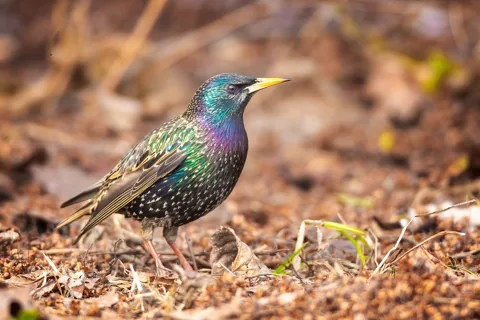 European starling
Sturnus vulgaris
The European starling is a stocky, short-tailed, non-native bird that now lives across most of North America. Pairs nest in building cavities and vents in spring, and fall and winter flocks of thousands foul roost sites with noise and droppings. The Missouri Department of Conservation lists it as invasive.
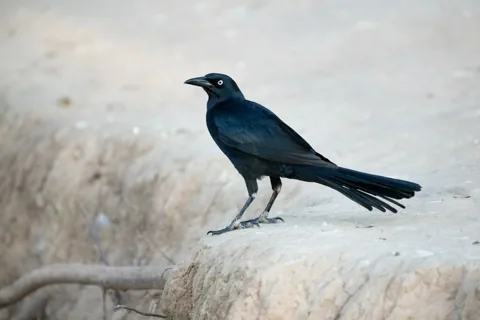 Great-tailed grackle
Quiscalus mexicanus
The great-tailed grackle is a big, loud blackbird of open country, farms, parks and suburbs. Complaints usually come from large fall and winter roosts in town trees and on powerlines, where noise can last all night in well-lit areas and droppings coat cars and pavement below.
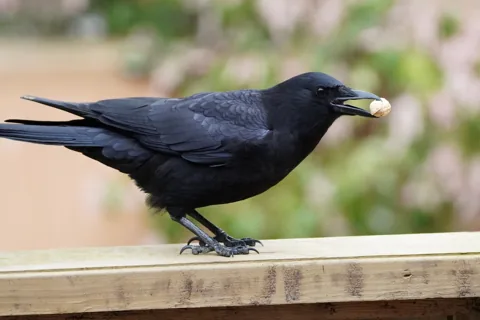 American crow
Corvus brachyrhynchos
The American crow is a large, all-black, highly intelligent bird that thrives around people. Most complaints involve big fall and winter roosts in towns, with noise and droppings, plus raided garbage and some crop damage.
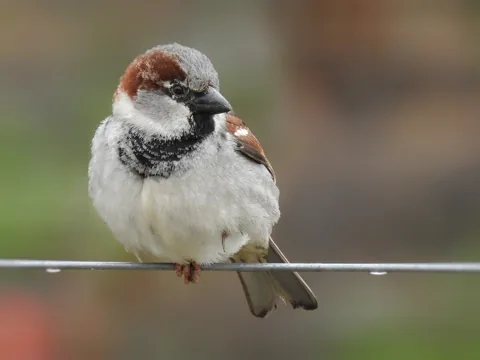 House sparrow (English sparrow)
Passer domesticus
The house sparrow is a small, chunky, non-native bird that thrives wherever people build farms, towns and cities. It packs messy nests into any sheltered gap on buildings, leaves droppings where it roosts, and drives native birds from nest boxes.
Which birds, and why timing matters
Birds are the biggest threat to a home blueberry crop, and they also damage strawberries, other small fruit and tree fruit. Visiting flocks of starlings, cedar waxwings, grackles and blackbirds do some of the damage; resident pairs that claim a territory, defend it and raise their young there cause other problems. Oregon State says birds can eat an entire blueberry crop if they aren't controlled, either pecking the fruit or taking whole berries.[3][5][6]
Visiting flocks are usually easier to scare off than birds that have established and defended a territory. UNH adds that starlings, a flocking species, are easier to scare than robins.[5]
Start before the damage does. It is much easier to prevent a feeding problem than to stop it once a strong pattern of activity develops, and birds are hard to control because they're so mobile: scared from one patch, they gather in another and often follow a daily route between feeding spots.[5][4]
When the trouble starts depends on the crop. UNH reports that blueberry problems begin as the first fruit turns blue, cherry problems when the fruit starts to color, strawberry problems when berries show red, and grape attacks soon after ripening begins, with dark varieties hit harder than green ones and a vulnerable period of about six weeks in northern New England. Oregon State points out that blueberries aren't fully ripe when they first turn blue and ripen over a two- to five-week period, so protection has to stay up through the whole picking season. Minnesota's grape calendar says to watch for bird damage as the fruit ripens.[5][6][7]
Cedar waxwings strongly prefer berries and like nearby perches when feeding. Removing nearby stands of berry plants such as red cedar, shadbush, glossy buckthorn, crabapple, mulberry and wild cherry can reduce future waxwing problems, and plantings far from perches suffer fewer attacks.[5]
Damage varies with how much wild food is around that year. Many of the birds that eat fruit also eat insects and can be beneficial.[5]
Pick promptly. Minnesota Extension says birds and rodents may cause more trouble than insects in home strawberry beds, and advises picking fruit as soon as it's ripe to limit the damage.[8]
Netting
Netting is the most effective way to keep birds out. Draped directly on bushes it works, but it tangles fruit clusters, including unripe berries, which get ripped off when the net comes off. A simple frame over the planting avoids that. Oregon State recommends a light plastic net with a small mesh over a frame of wood or PVC pipe, tall enough to allow for more growth and an easy picking height.[1][2][6]
Make the frame about a foot bigger than the plants on all sides and tall enough for them to grow. Clemson's example for mature rabbiteye blueberries kept at about 6 feet is a frame at least 7 feet high, built from 1/2-inch PVC conduit set into 12-inch pieces of 1-inch metal conduit driven 8 inches into the ground; only the metal sleeves stay in year-round, and the unglued PVC comes down after harvest.[1]
In commercial highbush blueberry plantings, posts are usually set 9 feet above the ground around the planting, wire is run between them to form a grid, and extra poles at grid intersections keep the netting from drooping. UNH says northern New England growers typically put it seven or eight feet high, or higher, because netting set at seven feet sags to about five and a half feet in spots.[2][5]
The netting has to reach the ground on all sides. Bury or anchor the edges, for example with sod staples every 2 to 3 feet, and leave no gaps, or birds will get in underneath and become trapped.[1][2][3][6]
To pick, pull a few staples and harvest from beneath the net rather than taking it off before the harvest is over. Oregon State suggests leaving a section that's easy to open for picking.[1][6]
Common bird netting is lightweight extruded black plastic with 3/4-inch mesh, which holds up well in sunlight and doesn't rot. Putting it up just before the berries turn blue and taking it down promptly at the end of the season extends its life; store it in a cool, dry place.[5][2]
Strawberries need finer netting. Washington State University says the mesh should be 1/4 inch or smaller with no holes. Pile loose soil on the edges if birds work their way under, and suspend the net above and away from the plants, or birds will walk across them and take fruit through the mesh. UNH calls netting less practical for a short-season crop like strawberries, but says it can be done on a small plot with arches of plastic pipe holding it up.[4][5]
Cherries need a taller support system, which makes netting them harder, though UNH still calls netting the most reliable way to cut bird damage on cherries. On grapes, netting draped directly over the vines gets grown into and tears on removal; one grower UNH describes instead fastens netting about 4 feet high to each side of the trellis and joins it at the bottom, which protects the fruit and leaves the top foliage uncovered. Minnesota Extension calls netting over the ripening fruit the only foolproof protection for grapes.[5][7]
If spotted-wing drosophila is also a problem, Oregon State says fine exclusion netting put over blueberry bushes before any fruit shows color keeps out both the flies and the birds.[6]
Reflective tape for strawberry rows
Bird tape is a 1/2-inch-wide mylar ribbon with red and silver reflective surfaces that flashes as it turns in the wind. Set up properly, Washington State University calls it the least expensive, most effective way to scare birds off a strawberry planting. Oregon State lists flashing tape among the scare devices to combine and rotate around blueberries.[4][6]
- Drive a stout stake at the end of each row on each side of the plants, or one stake between rows if they're close together. Keep stakes less than 30 feet apart.[4]
- Tie a cord to each stake 3 or 4 inches above the ground and fasten the tape to the cord with a loop of fiberglass strapping tape. Mylar breaks quickly where it's knotted or wrapped around a hard object such as a stake.[4]
- Stretch the tape tight, twist it 3 or 4 times, and let it sag to between 3 and 5 inches above the ground without touching the plants, so it moves freely.[4]
- Run it along the rows, not as streamers or across the tops of the plants. Birds land between the plants and eat from the ground, so tape strung overhead barely changes their flight path.[4]
- Check it often: retighten it if it stretches, trim leaves that get in its way, and replace tape that has been in the sun more than six weeks, because the coating wears off.[4]
- Tape is harder to use around bushes. UNH reports that it tangles in them, and that children at pick-your-own farms often tear it down.[5]
Scare devices, and why they stop working
Scarecrows, balloons, kites, rubber snakes and stuffed or plastic owls may work on certain birds in certain places, but none is dependable everywhere. Birds quickly learn they aren't real threats, and a scarecrow can become a roost within a few days. Oregon State likewise says scare tactics have limited effectiveness on berry-eating birds.[2][1][4][6]
To get the most from them, put them out only when fruit begins to ripen, move them at least once a day, alternate different devices, and remove them as soon as harvest is over so birds don't get used to them.[2][4][5][6]
A realistic owl model in a natural position works reasonably well for a short time, and moving it once or twice a day greatly increases its effect; one tipped over has little or none. Scare-eye balloons on high poles repel birds for roughly 6 to 20 yards, and their effect usually fades after 10 to 14 days. Because each balloon covers so little, UNH says it takes several per acre; UMass recommends six per acre in blueberries.[5][2]
Visual and sound devices together work better than either alone. The UMass guide found noise deterrents such as alarms and recorded distress calls had the least effect in blueberries and noted they can greatly annoy neighbors. UNH says programmable distress-call devices that vary the calls can be very effective, though in tests birds got used to nearly every sound.[5][2]
Aluminum pie pans and old CDs hung to flash are cheap, but growers usually rate them as having low effectiveness. Ultrasonic devices haven't been proven in the field.[5][4]
Hawks may help in some settings. Oregon State suggests improving raptor habitat, since raptors deter berry-eating birds by preying on them or just scaring them. UNH says kestrels readily use nest boxes of the right size and several growers saw bird problems drop when kestrels or red-tailed hawks settled on their farms, but it doubts this helps in berry fields, where hawks and owls won't sit close by while people are working.[6][5]
Taste repellents
Methyl anthranilate, a grape-flavor compound used in food, is the active ingredient in bird repellents registered for fruit such as blueberries, cherries and grapes. Results have been disappointing. UMass says efficacy data don't support recommending it. UNH says it's volatile enough that effectiveness drops two or three days after spraying, that rain washes taste repellents off, and that a 1995 blueberry trial replicated in Washington, Michigan and Oregon found it not very effective, though its seven-day spray interval was probably too long. UNH also cites research in which it burned the foliage of some plants. If you use it, follow the label.[2][5]
Check which birds the label covers. One current EPA-accepted methyl anthranilate label for home use on tree fruit, berries and small fruit lists the birds it may be used against, among them starlings, blackbirds including grackles, pigeons, house sparrows, house finches and American crows, and says it can't be applied when birds not on that list, or threatened or endangered birds, may be present. Robins and cedar waxwings, which UNH names among the main blueberry and strawberry pests, aren't on that list, although UNH, writing in 2010, described an earlier product whose label did list robins, starlings and cedar waxwings. That current label also says not to spray fruit that is wet or when rain is expected.[11][5]
What the law allows
Most birds are protected by the federal Migratory Bird Treaty Act or by state laws, which limits what you can do about them. The federal law prohibits killing or capturing protected species without authorization from the U.S. Fish and Wildlife Service, and it applies only to species native to the United States. Iowa State says house sparrows, pigeons and European starlings are exempt from state and federal protection because they're exotic. State rules differ, though: UNH notes that in Vermont pigeons are the only birds not protected.[5][10][9]
Shooting generally isn't recommended for fruit problems even where it's permitted: lead shot can lodge in fruit, migratory bird permits require non-toxic shot, and shot can badly damage the plants.[5]
UNH says trapping birds that attack fruit rarely makes sense, and that trapping any migratory bird requires a U.S. Fish and Wildlife Service permit.[5]
Common questions
- When should I put netting on blueberries?
- Iowa State and UMass say to net when the fruit begins to color; Clemson puts its frame and netting up near the end of flowering because netting gets harder to place as the berries grow. Leave it on until harvest is finished. If you're using fine netting against spotted-wing drosophila, Oregon State says to cover the bushes before any fruit shows color.[3][2][1][6]
- Do fake owls keep birds off fruit?
- For a short time, if they look realistic and are moved once or twice a day. Birds soon learn they aren't a threat, and an owl left in one spot, or tipped over, has little effect.[5][1]
- Can I use blueberry netting on strawberries?
- Washington State University's strawberry advice calls for mesh 1/4 inch or smaller, held up off the plants. Typical bird netting used over blueberry plantings has 3/4-inch mesh.[4][5]
- Can I spray a bird repellent on my berries?
- Methyl anthranilate products are registered for some fruit, but UMass says efficacy data don't support recommending them, and UNH says effectiveness drops within two or three days. One current label also bars use when birds not listed on it may be present, and robins and cedar waxwings aren't listed. Read the label before buying.[2][5][11]
Photo credits
- European starling: (c) egorbirder, some rights reserved (CC BY) — via iNaturalist, CC BY 4.0
- Great-tailed grackle: Adam Jackson, public domain (CC0), via iNaturalist
- American crow: Steven Smethurst, public domain (CC0), via iNaturalist
- House sparrow (English sparrow): (c) Esteban Poveda, some rights reserved (CC BY) — via iNaturalist, CC BY 4.0
Sources
- Clemson Cooperative Extension, Home & Garden Information Center, “Protecting Berries from Birds (Cory Tanner).” hgic.clemson.edu/protecting-berries-from-birds/ (accessed 2026-11-10)
- UMass Amherst Center for Agriculture, Food, and the Environment, “New England Small Fruit Management Guide: Highbush Blueberries, Vertebrate Pests.” www.umass.edu/agriculture-food-environment/fruit/ne-small-fruit-management-guide/highbush-blueberries/vertebrate-pests (accessed 2026-11-10)
- Iowa State University Extension and Outreach, Yard and Garden, “How do I stop birds from eating my blueberries?.” yardandgarden.extension.iastate.edu/faq/how-do-i-stop-birds-eating-my-blueberries (accessed 2026-11-10)
- Washington State University Extension, “EB1641: Protecting Strawberries from Birds (Leonard R. Askham; revised 1992, reviewed by USDA APHIS).” wpcdn.web.wsu.edu/wp-extension/uploads/sites/2056/2023/05/Protecting-Strawberries-from-Birds.pdf (accessed 2026-11-10)
- University of New Hampshire Cooperative Extension, “Bird Damage Prevention for Northern New England Fruit Growers (Alan T. Eaton).” extension.unh.edu/resources/files/Resource001797_Rep2514.pdf (accessed 2026-11-10)
- Oregon State University Extension Service, “Growing Blueberries in Your Home Garden, EC 1304 (revised May 2025).” extension.oregonstate.edu/catalog/ec-1304-growing-blueberries-your-home-garden (accessed 2026-11-10)
- University of Minnesota Extension, “Growing grapes in the home garden.” extension.umn.edu/fruit/growing-grapes-home-garden (accessed 2026-11-10)
- University of Minnesota Extension, “Growing strawberries in the home garden.” extension.umn.edu/fruit/growing-strawberries-home-garden (accessed 2026-11-10)
- Iowa State University Extension and Outreach, Natural Resource Stewardship, “Nuisance Birds: Damage Management.” naturalresources.extension.iastate.edu/encyclopedia/nuisance-birds-damage-management (accessed 2026-11-10)
- U.S. Fish and Wildlife Service, “Migratory Bird Treaty Act of 1918.” www.fws.gov/law/migratory-bird-treaty-act-1918 (accessed 2026-11-10)
- U.S. EPA Pesticide Product Label System, “Methyl anthranilate 20% bird repellent label, EPA Reg. No. 88889-1 (EPA-stamped, Jan. 2023).” www3.epa.gov/pesticides/chem_search/ppls/088889-00001-20220103.pdf (accessed 2026-11-10)