The short answer
- Identify the bird before you act. Native sparrows, blackbirds and mourning doves can be confused with house sparrows, starlings and pigeons, and the natives are protected.[1][3][6]
- Block openings into lofts, vents and eaves with 1/4-inch rust-proofed wire mesh or netting, screen bathroom and exhaust vents with 1/2-inch mesh, and close any gap wider than 3/4 inch where house sparrows get in.[2][1][5]
- Keep birds off ledges with spikes, coils or tightly stretched wires, or slope the ledge to 45 degrees or more.[2][1][5]
- A protected bird's nest can be destroyed without a permit only when it isn't in use, meaning no viable eggs or dependent young, and you can't keep it. The Fish and Wildlife Service recommends doing this work outside the nesting season.[3][4][7]
- Skip ultrasonic devices: there's no reliable evidence they work. Other scare devices rarely help for long, because birds get used to anything that doesn't change. Iowa State Extension says repellents and scare tactics usually have only a short-term effect.[1][5]
Birds on buildings
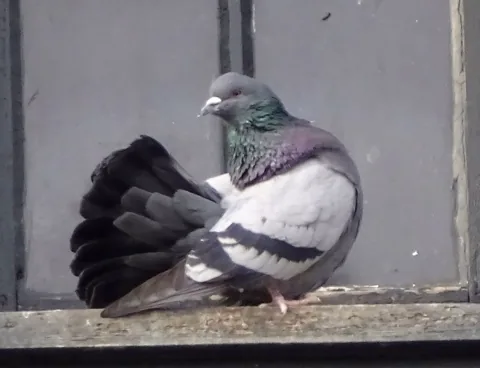 Pigeon (feral rock pigeon)
Columba livia
Feral pigeons are non-native birds that depend on people for food and nesting sites. Flocks on ledges, eaves and rooftops leave heavy, acidic droppings that deface buildings, clog gutters and can carry disease risks.
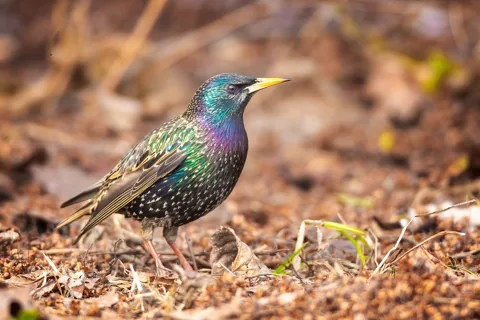 European starling
Sturnus vulgaris
The European starling is a stocky, short-tailed, non-native bird that now lives across most of North America. Pairs nest in building cavities and vents in spring, and fall and winter flocks of thousands foul roost sites with noise and droppings. The Missouri Department of Conservation lists it as invasive.
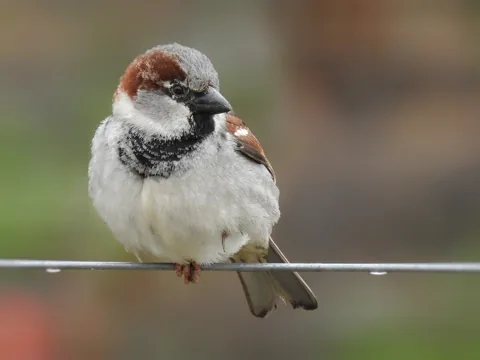 House sparrow (English sparrow)
Passer domesticus
The house sparrow is a small, chunky, non-native bird that thrives wherever people build farms, towns and cities. It packs messy nests into any sheltered gap on buildings, leaves droppings where it roosts, and drives native birds from nest boxes.
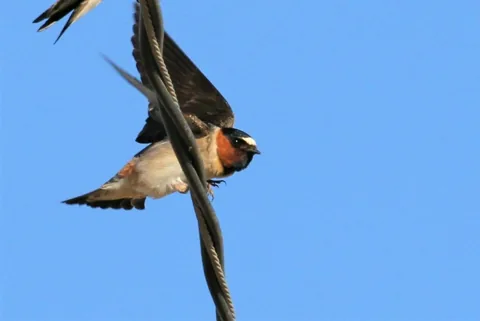 Cliff swallow
Petrochelidon pyrrhonota
Cliff swallows are small migratory birds that plaster colonies of mud nests under the eaves of buildings, bridges and overpasses. They are protected under the Migratory Bird Treaty Act, so timing matters: active nests can't be touched without a permit, and exclusion before nesting is the long-term fix.
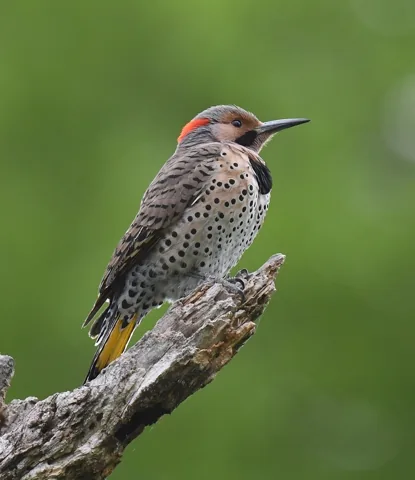 Woodpeckers
Family Picidae (shown: northern flicker, Colaptes auratus)
Woodpeckers come into conflict with people when they peck buildings looking for insects, drum on loud surfaces to claim territory, or carve out nest holes. All are protected under the federal Migratory Bird Treaty Act, but they can legally be kept off a house.
Which bird is it, and is it protected?
The Migratory Bird Treaty Act protects migratory birds, including any part, nest or egg, and its list of protected species at 50 CFR 10.13 includes more than 1,100 species. It prohibits possessing, selling, transporting and taking them, where take means to pursue, shoot, wound, kill, trap, capture or collect, or attempt to.[3]
A 2004 amendment limited the act to native species, those present through natural processes, and the Fish and Wildlife Service publishes a list of nonnative, human-introduced birds the act doesn't cover; the latest update came out in 2020.[8]
House sparrows, starlings and pigeons are not protected by the act. University of Nebraska-Lincoln Extension notes that Nebraska law doesn't protect them either, and Iowa State Extension says all three are exempt from state and federal protection in Iowa, where every other bird has state protection. Their nests, eggs, young and adults aren't protected by federal law.[1][2][5][6]
Other laws can still apply. Endangered species and eagles have their own federal protections, state, tribal and local laws may add more, and most towns and cities ban firing guns within city limits. Iowa State suggests calling a state wildlife conservation officer if protected birds are the problem.[3][2][5]
- House sparrow: messy nests of grass, string, paper and twigs stuffed into a crevice or small cavity, and a sharp, repeated cheep. Nebraska's native sparrows, such as chipping and song sparrows, are beneficial. Iowa State describes the nest as a bulky, untidy wad of dried plant fibers decorated with feathers, string, paper and plastic, much messier than the nests of native songbirds nearby.[1][5]
- European starling: a robin-sized, short-tailed black bird about 8 inches long that nests in cavities, often with a fan-shaped spray of droppings on the wall below the hole. Up close it is purplish-green in summer and brown with white spots in winter, with a long, slender bill. Native red-winged and yellow-headed blackbirds can be confused with it, and Illinois Extension adds common grackles and brown-headed cowbirds.[1][6]
- Pigeon: the largest of the three, about 12 inches long, usually gray with two black wing bars. Its nest is a pile of sticks, plant stems and straw, with hardened droppings, on a flat, sheltered ledge. Don't confuse it with the native mourning dove.[1][5]
- Swallows: all swallows are protected by state and federal law. Cliff swallows nest in colonies that can number several hundred birds (UC IPM says several hundred pairs) and build enclosed, gourd-shaped mud nests; barn swallows nest alone and build open mud cups. A cliff swallow is 5 to 6 inches long with a square tail, a pale orange-brown rump and a white forehead, while a barn swallow has a long, deeply forked tail.[4][7]
Nests: what the law allows
The Fish and Wildlife Service's 2025 nest memorandum sorts nests into two kinds. An in-use nest holds viable eggs or nestlings, from the first egg until the young fledge and no longer depend on it. A nest still being built before any eggs are laid, or one the young have left for good, is inactive.[3]
- You can destroy an inactive nest of a protected bird without a permit, as long as nobody keeps the nest or anything in it. Moving a nest, active or not, needs federal authorization, because it means possessing the nest.[3]
- Destroying an in-use nest requires authorization under the act. The Service says it doesn't issue permits for bird nuisance issues; nest or bird removal requests need strong reasons, such as a health or safety hazard or property damage. UC IPM adds that a permit request made while eggs or young are in the nest will probably be denied, so apply well before spring.[3][4][7]
- It's your responsibility to be sure a nest is inactive. The Service warns that colonial, burrowing and secretive birds make that hard to judge, and it recommends doing nest work outside the nesting season.[3]
- Swallows can fool you. The Fish and Wildlife Service says young swallows keep returning to the nest for several weeks after they fledge; UC IPM's figure for cliff swallows is shorter, 2 to 3 days of returning to be fed, then about a week near the colony. The Service gives the swallow breeding season as March through September, while California's wildlife agency treats February 15 to September 1 as the swallow nesting season.[4][7]
- Nests of house sparrows and pigeons are easy to spot and pull down, which cuts their breeding; starling nests are hidden in cavities. Use a ladder or a pole with a hook, take care around overhead wires, and wear gloves and bag the material to avoid nest mites and lice.[1][2]
- Expect to repeat it. ICWDM says pest birds are quick to rebuild, often in the same spot, and suggests removing pigeon nests and eggs at 2-week intervals along with other methods; Iowa State likewise says to clear nests from building cavities and bird boxes every two weeks through the nesting season and get rid of the material so it can't be reused.[2][5]
Close the way in
- Block openings to lofts, steeples, vents and eaves with wood, metal, glass, masonry, 1/4-inch rust-proofed wire mesh, or plastic or nylon netting.[2]
- House sparrows fit through smaller gaps. Iowa State says to close every opening larger than 3/4 inch on buildings, and to make sure any mesh used over bigger openings, such as old windows in a chicken coop, has holes no larger than that.[5]
- Screen bathroom and exhaust vents with 1/2-inch mesh. Be careful with dryer vents: lint can build up behind a screen and catch fire.[1]
- Box out the spaces under dormers and porches with 1/2-inch hardware cloth, netting or other ledge exclusion products, and cap chimneys with professionally made stainless steel screens.[1]
- In sheds, barns and other open buildings, staple nylon netting to the underside of the rafters so birds can't roost or nest there. Panels cut into the netting with hook-and-loop fasteners let you reach lights and equipment.[2][5]
- Ornamental architecture can be screened with 1-inch UV-stabilized polypropylene netting. It can be painted to match the building, though ICWDM says black is often best, and it can last as long as 10 years.[2]
- Take away the cover sparrows roost in: Iowa State suggests removing vines on building walls and dense ornamental shrubs that attract roosting flocks, or covering plants you want to keep with plastic mesh or nylon netting.[5]
- Where birds fly in through a large doorway, UC IPM says hanging netting or vinyl strip doors across it like a curtain can keep swallows out while still letting people and vehicles through; Iowa State suggests hanging 4- to 6-inch-wide flexible plastic strips around food storage, which birds treat as a solid barrier.[7][5]
Ledges, beams and rooflines
Ledge products come in nonelectric types (spikes, coils and wires) and electric ones. UNL Extension says the nonelectric products are easy to install and have a high rate of success against pigeons.[1]
- Slope it: changing a ledge's angle to 45 degrees or more discourages roosting. Sheet metal, wood, foam blocks, plexiglass, stone and other materials can be shaped and fastened on to make the slope.[2][5]
- Spikes: stainless steel prongs pointing out at all angles make a surface uncomfortable to land on, and can go on sills, ledges, eaves, roof peaks and ornamental features. For smaller birds, choose a spike strip with more tines per foot, or an electric product.[2][1][5]
- Spikes are less reliable against swallows. UC IPM says needle-like projectors along ledges and windowsills don't always stop them; in one case cliff swallows learned to land on the spines and built nests attached to them.[7]
- Coils and wires: stainless steel coils mount on a base strip like spikes. On cables, conduit and narrow ledges, tightly stretched 16- to 18-gauge steel wire or 80-pound-plus monofilament, tensioned with turnbuckles between L-brackets, keeps birds off; persistent pigeons will likely get through wire systems.[2]
- Electric strips give a pulsing shock that repels birds without killing them. UNL says no license is needed to install one if the outlet already exists or it runs on solar power.[2][1]
- Keep them clean. Birds drop nesting material and droppings onto spikes, wires and other ledge products, which stops them working, so check and clean them regularly.[1][2]
Sticky repellents and fogging
- Sticky tactile repellents, which are polybutenes, aren't toxic to pigeons; they leave a tacky surface birds dislike. Don't apply them straight onto the building: clean the surface and cover it with waterproof tape, wood or plastic first, or the repellent may be hard to remove and may stain.[2][1]
- Follow the label. Over-application can trap small birds that land on the gel, and on sun-exposed ledges you need a gel suited to temperatures above 110 degrees.[1]
- Their limits: they're unsightly, nesting pigeons may drop sticks and straw over them and keep nesting, heat can make them run down walls, and cold can make them too stiff to work. ICWDM says they suit small and medium jobs.[2]
- Methyl anthranilate, a grape-derived compound, irritates birds when it's fogged. UNL says it's most useful for dispersing birds roosting in trees and in confined spaces such as warehouses and hangars.[1]
Scare devices
- Frightening devices rarely give long-term relief, because birds become used to anything that doesn't change. Iowa State says repellents and scare tactics such as air cannons usually work only briefly and nearly always cost more time, money and effort than they return. They work best when several tactics are used before birds settle in, with the timing, placement and type varied.[1][5]
- Options include distress calls, reflective tape, balloons, predator kites and owl effigies. Pyrotechnics are among the most effective but are limited in towns; check with local authorities before using them.[1]
- Avoid ultrasonic devices. There's no reliable evidence they work.[1]
- Against cliff swallows, UC IPM lists hawk, owl and snake models, taped alarm calls, noisemakers, revolving lights and chemical roost repellents among methods with little success or no proof they work.[7]
Swallows and other protected birds on the house
Barn and cliff swallows often nest under the eaves, and they may build new nests or rebuild on the traces of mud left by old ones. UC IPM says returning swallows are strongly attracted to old nests and usually claim them on the first day back. The Fish and Wildlife Service suggests working on two fronts.[4][7]
- Before the birds return: remove old nests and every trace of mud, and put physical barriers over likely nest sites. The Service lists corrugated plastic board, PTFE, plexiglass, plastic sheeting and silicone-based paint, and says barriers can be a permanent deterrent.[4][7]
- Netting is the standard fix. UC IPM recommends 1/2- to 3/4-inch mesh (1-inch has also worked), put up before the birds arrive and pulled taut with no loose pockets that could tangle a bird, running from the outer edge of the eaves down the wall. Net every part of the building that suits nesting, because swallows shut out of one spot often move to another on the same structure.[7]
- Other barriers: UC IPM notes reports that a netting curtain hung 3 to 4 inches from the wall and 18 inches or more down from the eave prevents nesting, that 6-inch fiberglass panels fitted between eave and wall leave a smooth, concave surface that makes nest attachment difficult, and that smooth materials or a fresh, slick coat of paint where nests would go can discourage them.[7]
- After they arrive: wash away mud nests often while they're being built, and the birds may give up on the site. Only nests with no eggs or chicks may be destroyed, and UC IPM says that during nest building removal takes many days because cliff swallows keep rebuilding. The Fish and Wildlife Service also suggests recordings of swallow alarm and distress calls to disrupt nest building, but UC IPM lists taped alarm calls among methods with little success against cliff swallows.[4][7]
- Repellents don't work on swallows, and no toxicants are registered with EPA to control them. UC IPM adds that shooting, trapping or harming swallows isn't permitted.[4][7]
- Swallow nests can hold mites and swallow bugs, close relatives of bed bugs. The sources differ on the risk: the Fish and Wildlife Service says swallow bugs are not a threat to people, while UC IPM says they will bite humans, although people aren't their usual host.[4][7]
Food, water and roost trees
- Keep trash in covered containers rather than bags, don't feed birds on your property, and clean up spilled grain and seed. Iowa State credits the drop in open grain around livestock operations for house sparrows being much less numerous in Iowa than a century ago.[1][2][5]
- Fix leaky faucets, clear drains, keep air conditioner water from pooling on roofs or the ground, and angle gutters so they drain. Pigeons in particular need water.[1][2]
- Birds like dense trees for winter roosts; UNL says regular pruning of up to a third of the branches can discourage them, and Iowa State says thinning a dense stand of trees by one-third will break up big starling roosts. Call the electric company if the trees are near power lines.[1][5]
Baits, traps and restricted products
- The frightening bait containing 4-aminopyridine and the avicide sold for starling control can be bought and applied only by certified pesticide applicators, who must follow a series of procedures that includes prebaiting.[1][2]
- A fertility-control bait for pigeons is a general use pesticide. It shrinks a flock slowly, so it suits sites that don't need a quick reduction. The sources give different rates: UNL says treated populations can decline by 5 percent a month under ideal conditions, and ICWDM reports a decline of about 50% a year under typical conditions.[1][2]
- Traps can work where other methods aren't practical or could harm protected birds. Put them where birds can easily see them, such as rooftops, give any decoy birds food, water and shelter, and check traps every day.[1][5]
- Iowa State suggests putting out seed or grain for a few days before setting traps, moving traps and changing how they're presented so house sparrows don't become trap-shy, and checking traps often so other birds can be released unharmed. It says decoy traps can catch large numbers of starlings.[5]
- Electric ledge systems are usually labor intensive or expensive to install, but ICWDM says their effectiveness sometimes justifies the cost, and they last about 8 years on homes.[2]
Droppings and health
- These three birds carry a range of diseases, including some that can affect people, such as the fungus that causes histoplasmosis. Pigeons can spread cryptococcosis, and house sparrows can carry salmonellosis.[1]
- Reduce your risk by staying out of contaminated areas, or by wearing proper protection while you do bird control or clean up droppings. Our guide to cleaning up bird and bat droppings covers the precautions.[1]
- Droppings are acidic and can degrade marble and other building materials, and pigeon droppings can clog the downspouts on gas station canopies, leading to collapse during rain. Iowa State and Illinois Extension both say the droppings corrode buildings and structures, and Illinois adds that starling nests can block airflow.[1][5][6]
- Nests bring their own problems. Iowa State says the nests of these three birds are highly flammable and can be a fire threat to buildings, and that the birds harbor fleas, mites and lice that can spread to poultry and occasionally bite people. UNL calls mite bites rare, though they happen near active roosts.[5][1]
Common questions
- Can I knock down a bird's nest on my house?
- For pigeons, starlings and house sparrows, yes; their nests aren't federally protected. For protected birds, only an inactive nest, with no viable eggs or dependent young, may be destroyed without a permit, and you can't keep it. When in doubt, wait until the nesting season ends.[1][3][5]
- Do ultrasonic bird repellers work?
- UNL Extension says to avoid them: there's no reliable evidence they're effective.[1]
- Will sticky bird gel hurt birds?
- The polybutene gels aren't toxic to pigeons, but over-applied gel can trap small birds that land in it. Apply it to tape or another removable surface and follow the label.[2][1]
- Why do swallows keep coming back to the same spot?
- Swallows reuse old nests and build on traces of mud from earlier ones, and UC IPM says adults have a strong homing tendency to colonies where they nested before. Remove old nests and mud before they return in spring and cover the site with netting or another physical barrier.[4][7]
- How small a gap can a house sparrow get through?
- Iowa State Extension says to close every opening on a building larger than 3/4 inch to keep house sparrows out, and to use mesh with holes no bigger than that.[5]
- Do plastic owls or hawk decoys keep birds away?
- Not for long. UNL lists owl effigies and predator kites among frightening devices that rarely give long-term relief because birds get used to them, and UC IPM says hawk, owl and snake models have shown little success against cliff swallows.[1][7]
Photo credits
- Pigeon (feral rock pigeon): (c) cornwallcen, some rights reserved (CC BY) — via iNaturalist, CC BY 4.0
- European starling: (c) egorbirder, some rights reserved (CC BY) — via iNaturalist, CC BY 4.0
- House sparrow (English sparrow): (c) Esteban Poveda, some rights reserved (CC BY) — via iNaturalist, CC BY 4.0
- Cliff swallow: (c) Xochitl Zambrano, some rights reserved (CC BY) — via iNaturalist, CC BY 4.0
- Woodpeckers: Chrissy McClarren and Andy Reago, public domain (CC0), via iNaturalist
Sources
- University of Nebraska-Lincoln Extension, “G2024 Urban Pest Birds: Controlling Damage (issued 2010).” extensionpubs.unl.edu/publication/g2024/html/view (accessed 2026-11-10)
- Internet Center for Wildlife Damage Management, “Pigeon Damage Control and Prevention Methods.” icwdm.org/species/birds/pigeons/pigeon-damage-control-and-prevention-methods/ (accessed 2026-11-10)
- U.S. Fish and Wildlife Service, “Migratory Bird Permit Memorandum MBPM-2-02: application of the MBTA to the take of migratory bird nests (January 15, 2025).” www.fws.gov/sites/default/files/documents/2025-01/mbpm-2-nest-memorandum-2025.pdf (accessed 2026-11-10)
- U.S. Fish and Wildlife Service, “Nuisance swallows.” www.fws.gov/story/nuisance-swallows (accessed 2026-11-10)
- Iowa State University Extension and Outreach, Natural Resource Stewardship, “Nuisance Birds: Damage Management.” naturalresources.extension.iastate.edu/encyclopedia/nuisance-birds-damage-management (accessed 2026-11-10)
- University of Illinois Extension, “European Starlings.” extension.illinois.edu/invasives/european-starlings (accessed 2026-11-10)
- University of California Statewide IPM Program, “Pest Notes: Cliff Swallows.” ipm.ucanr.edu/home-and-landscape/cliff-swallows/ (accessed 2026-11-10)
- U.S. Fish and Wildlife Service, “Migratory Bird Treaty Act of 1918.” www.fws.gov/law/migratory-bird-treaty-act-1918 (accessed 2026-11-10)