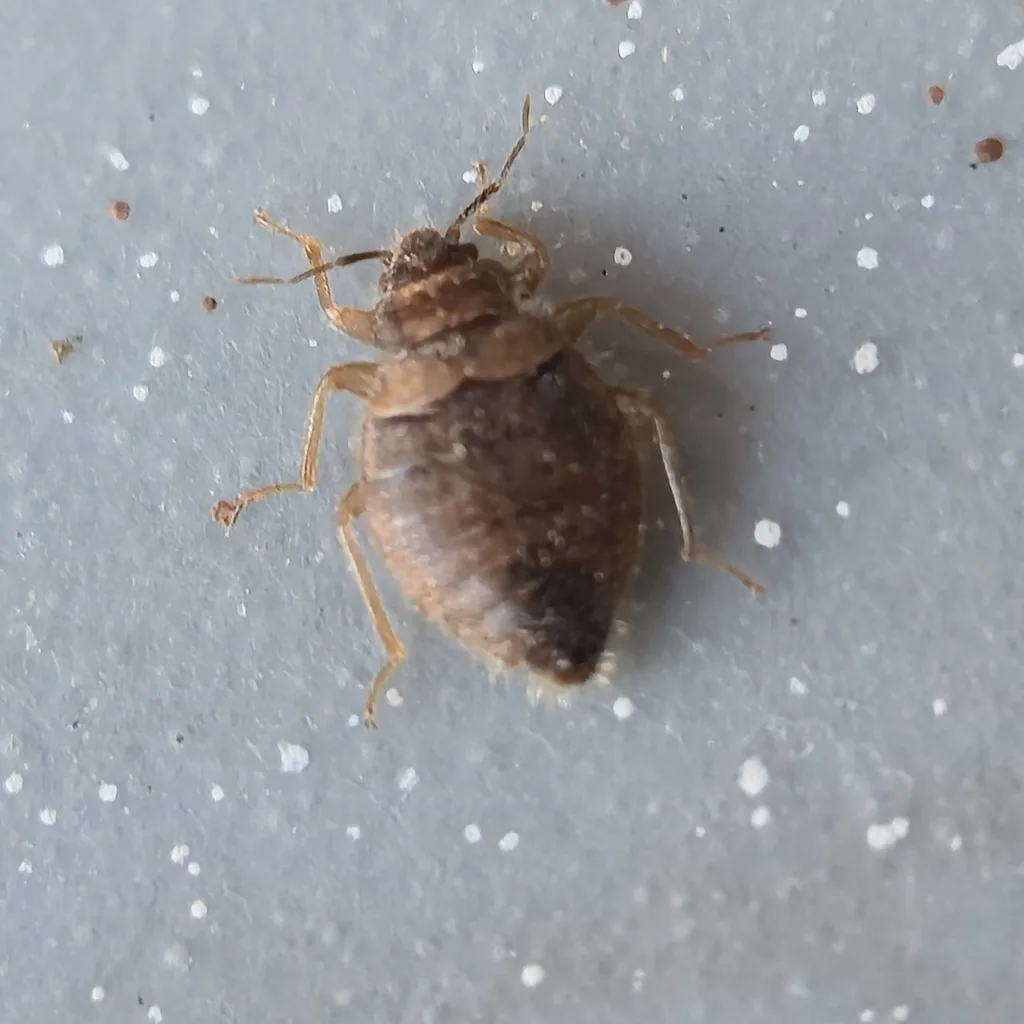
How to identify it
- Full-grown swallow bugs are red-brown to gray-brown, wingless and oval, about 3/8 inch long; the body is flat when unfed and swells after a blood meal.[1][2]
- They look so much like bed bugs that a hand lens or microscope is needed to separate them.[1][4]
- Under magnification, the last two antenna segments of a swallow bug are nearly equal in length.[1]
Look-alikes
| Look-alike | How to tell them apart |
|---|---|
| Bed bug | Only bed bugs breed on human blood and live near beds and sofas; their last antenna segment is about half as long as the one before it.[1] |
| Bat bug | Bat bugs live with roosting bats in attics, walls and chimneys, and the fringe hairs behind their head are longer than the eye is wide.[1] |
Where it lives
Swallow bugs live with cliff swallows, which build mud nests on cliffs and on overhangs of buildings; Colorado State lists them among bed bug relatives found in Colorado homes.[1]
Biology and life cycle
Cliff swallows are the main host; their jug-shaped mud nests can be reused for several years, so bug populations carry over.[1][2]
Eggs are laid in cracks near the nest; nymphs fill up on blood in a few minutes, hide to digest, and molt several times before becoming adults.[1]
After swallows leave in summer, the bugs move into nearby cracks and stay largely dormant for months without feeding.[1][2]
They become active again in late winter and spring, ahead of the swallows' return, and are badly starved by then.[2][1]
Damage and signs
Health risk
Swallow bugs bite people even though humans aren't their usual host, and their bites are said to be especially itchy. They can't reproduce on human blood.[3][2][1]
Control
Prevention
Remove nests before egg laying and screen nesting areas before swallows return in spring. Swallows are federally protected, and disturbing active nests is illegal.[2][3]
Keep them out
Keeping swallows from nesting on the building is the long-term fix; without their hosts, swallow bug infestations die out.[1]
UC IPM recommends netting with 1/2- to 3/4-inch mesh, pulled taut, put up before birds arrive or after they leave; in California no permit is needed then.[3]
Seal cracks around windows, gaps around electrical outlets and other wall openings to keep wandering bugs out of living areas.[1]
Sanitation
When removing old nests outside the nesting season, scrape off all traces of mud, because swallows are strongly drawn back to nest remnants.[3]
When to call a professional
Residual insecticide dusts or sprays in cracks and crevices can speed things up; Colorado State recommends professional application.[1]
Common questions
- Why do we get bites every spring near the swallow nests?
- Swallow bugs wake from winter dormancy before the swallows return. Starved, they may aggressively seek another host, including people indoors.[2][1]
- Can I knock down the swallow nests?
- Only when they aren't active. California treats February 15 to September 1 as nesting season, when completed nests can't be touched without a federal permit.[3][2]
- Will swallow bugs take over my bedroom like bed bugs?
- No. They may bite, but they can reproduce only on bird blood, so once swallows are kept away the remaining bugs eventually starve.[1]
Sources
- Colorado State University, Department of Agricultural Biology, “Bed bug look-alikes (bat bugs, swallow bugs and relatives).” agsci.colostate.edu/agbio/ipm-pests/bed-bug-look-alikes/ (accessed 2026-10-06)
- Colorado State University Extension, “Bat Bugs, Bed Bugs and Relatives, Fact Sheet No. 5.574 (revised December 2013).” www.extension.colostate.edu/docs/pubs/insect/05574.pdf (accessed 2026-10-06)
- University of California Statewide IPM Program, “Pest Notes: Cliff Swallows, UC ANR Publication 7482 (T. P. Salmon and W. P. Gorenzel).” ipm.ucanr.edu/home-and-landscape/cliff-swallows/ (accessed 2026-10-06)
- University of California Statewide IPM Program, “Pest Notes: Bed Bugs, Publication 7454 (May 2013).” ipm.ucanr.edu/legacy_assets/PDF/PESTNOTES/pnbedbugs.pdf (accessed 2026-10-06)
- iNaturalist, “Oeciacus vicarius taxon page (order and family).” www.inaturalist.org/taxa/453995 (accessed 2026-10-06)