The short answer
- Act at the first tap. Penn State and Cornell Cooperative Extension both say control works best when it starts right away, before the bird becomes persistent.[6][7]
- Hang lightweight bird netting with 3/4-inch mesh from the eaves down over the pecked area, at least 3 inches out from the wall so the bird can't reach through. UC IPM calls netting the most effective way to stop damage to a building.[5][4]
- For one or two small spots, fasten sheet metal, aluminum flashing or 1/4-inch hardware cloth over the area and paint it to match.[5][4]
- Hang shiny, moving strips (reflective tape, foil strips, old CDs) from the eaves over the spot. Plastic owls, hawks and snakes don't work.[4][5][7]
- Fill holes promptly, since existing holes draw more pecking, and check the siding for insects.[4][5][7]
- Don't kill, trap or harm the bird or disturb a nest with eggs or young. Woodpeckers are protected by the Migratory Bird Treaty Act; scaring them off is legal without a permit, but killing one takes a U.S. Fish and Wildlife Service depredation permit.[1][10][11]
Related profiles
 Woodpeckers
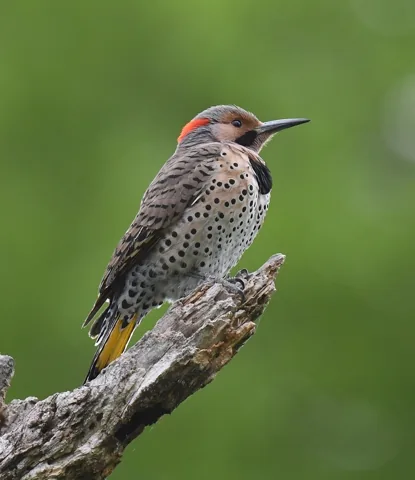
Family Picidae (shown: northern flicker, Colaptes auratus)
Woodpeckers come into conflict with people when they peck buildings looking for insects, drum on loud surfaces to claim territory, or carve out nest holes. All are protected under the federal Migratory Bird Treaty Act, but they can legally be kept off a house.
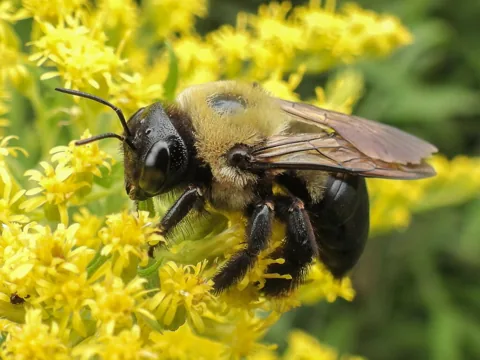 Eastern Carpenter Bee
Xylocopa virginica
Carpenter bees are large, solitary bees that bore round tunnels into bare, weathered wood to rear their young; they rarely cause severe damage but can weaken wood that is reused year after year.
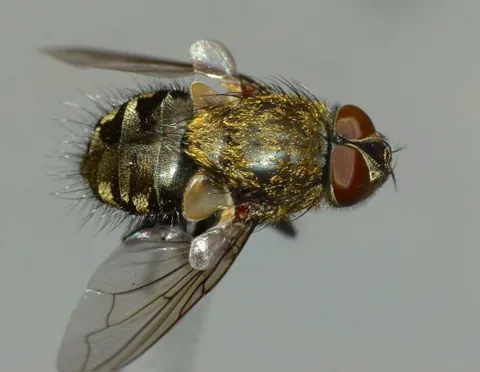 Cluster Fly
Pollenia species (e.g., P. rudis)
Cluster flies gather on the sunny sides of buildings in fall to find places to overwinter and then appear indoors, often in large numbers, on warm days through winter and spring. They do not breed indoors.
Why woodpeckers peck on houses
A study of 1,185 houses in Ithaca, New York, found that woodpeckers make holes in homes mainly to build nest and roost cavities, to drum and to forage for insects. Each reason calls for a slightly different fix, so it helps to know which one you're dealing with.[8]
- Drumming: a rhythmic burst of pecking that woodpeckers use to claim territory and attract mates, much as a songbird uses song. Both males and females drum. They pick surfaces that resonate loudly and often skip wood for metal gutters, downspouts, chimney caps and rooftop vents. Drumming leaves little damage but is loud, and often starts at dawn.[5][1][7][6]
- Feeding: woodpeckers drill siding, eaves and trim to reach insects. UC IPM says feeding leaves a characteristic row of small holes. Cornell Cooperative Extension lists carpenter bees and cluster flies among the insects that live behind siding, and Penn State says that if more than one woodpecker is visiting your home, you should suspect an insect infestation.[5][7][6]
- Nesting and roosting: woodpeckers peck larger holes to make nests in the wall cavity. Cornell Cooperative Extension says some find soft cedar siding with insulation behind it suits them, that nest holes are dug at the start of the breeding season, usually late April and May, and that roosting holes are made in late summer and fall. These holes are only slightly wider than the bird and round, rectangular or gourd-shaped.[5][7]
- Exploring: UC IPM says exploratory pecking is commonplace. Clusters of tiny holes at corners, on eaves and on corner boards are often the result of drumming, per Cornell Cooperative Extension.[5][7]
- Why houses at all: Penn State says biologists believe woodpeckers often pick houses for drumming because houses act as resonators and amplifiers. Damage is most common on houses in or near wooded areas, in suburban or rural settings.[6][5]
Which woodpeckers cause the trouble
Woodpeckers, sapsuckers and flickers are all in the family Picidae and live throughout the US, with different species causing damage in different regions. ICWDM says most are 7 to 15 inches long, and UC IPM gives about 7 to 14 inches. Males of most species have red on the head. ICWDM lists these as the species most often involved in damage to homes and other wooden structures:[1][5]
- Downy and hairy woodpeckers: small black-and-white birds with a white back; males have a red patch on the back of the head. Penn State gives the downy 6 to 7 inches and the hairy 8.5 to 10.5 inches, and says the hairy's beak is as long as its head is wide while the downy's is shorter. ICWDM calls both common suburban residents, and Cornell Cooperative Extension says hairy and downy woodpeckers cause most fall damage in the Northeast.[6][2][7]
- Northern flicker: 12 to 14 inches, per Penn State, with a black patch across a spotted breast and flashes of yellow under the wings and tail in flight. Flickers often feed on ants on the ground. Cornell Cooperative Extension says migrating flickers and downy woodpeckers cause most spring damage in the Northeast, starting with flickers in mid-April, and that flickers like to drum on eaves, downspouts and old antennas.[6][2][7]
- Red-bellied woodpecker: 8 to 9 inches, with a zebra-striped back and red on the crown and nape (nape only in females). Penn State says it has adapted well to wooded suburbs.[6][1]
- Red-headed woodpecker: 8.5 to 9.5 inches and the only eastern woodpecker with an entirely red head, per Penn State.[6][1]
- Pileated woodpecker: about the size of a crow, with a solid black back and a flaming red crest. Penn State says carpenter ants are a mainstay of its diet and that it cuts large oval to rectangular holes in dead trees, live conifers and utility poles.[6][1]
- Acorn woodpecker (West and Southwest): drills closely spaced holes, each sized for one acorn, in buildings, fence posts and poles, and wedges acorns under roof shakes and into unscreened rooftop plumbing vents. UC IPM says one can store hundreds to thousands of acorns in a season.[3][5]
- Also listed by ICWDM: golden-fronted and ladder-backed woodpeckers. Sapsuckers mostly damage trees rather than houses (see below).[1]
The law: Migratory Bird Treaty Act and USFWS permits
ICWDM says all woodpecker species are classified as migratory nongame birds and are protected by the federal Migratory Bird Treaty Act. The US Fish and Wildlife Service says the Act prohibits the take of protected migratory birds without prior authorization from the Service, where take includes killing, capturing, selling, trading and transport.[1][9]
- Scaring is allowed: USFWS says you don't need a federal depredation permit to harass or scare birds, except eagles and federally listed threatened or endangered species. ICWDM likewise says hazing woodpeckers needs no permit if the species is not endangered, and UC IPM says woodpeckers can be legally excluded.[10][1][5]
- Killing or trapping needs a permit: USFWS form 3-200-13 is the permit an individual or business needs to capture or kill migratory birds that damage property. Penn State says woodpeckers can be legally killed only under permits from USFWS and, in Pennsylvania, the Game Commission, and ICWDM says the relevant state wildlife agency may also need to authorize lethal control.[10][6][1]
- Permits are not easy to get: USFWS requires documentation that you tried nonlethal measures such as scare devices first, plus a Wildlife Services Permit Review Form from USDA. It also charges an application processing fee, lower for an individual with damage to a personal residence than for businesses and homeowner associations. UC IPM says there generally must be a good case to justify a permit and the process is time-consuming; Penn State says killing woodpeckers should be a last resort and is almost never warranted.[10][5][6]
- Nests: USFWS's 2025 nest memorandum says the Act protects nests and eggs. A nest becomes in use when the first egg is laid and stays in use until the young fledge and no longer depend on it. Destroying an in-use nest requires authorization; an inactive nest can be destroyed without a permit, but it's your responsibility to make sure no birds, chicks or viable eggs are harmed, and the Service recommends doing such work outside nesting season.[11]
- Endangered species: the red-cockaded and ivory-billed woodpeckers are federally endangered, per ICWDM. In California, UC IPM says the Gila woodpecker and gilded flicker are state-listed endangered species that can't be harassed at all, though exclusion installed before they arrive is allowed.[1][5]
Timing: act at the first tap
Penn State says damage peaks twice a year, in spring and fall, and that control should start as soon as damage is noticed because the birds become very persistent and hard to move. ICWDM gives the same advice for scare devices: use them as soon as the problem shows up, before territories are well established.[6][4]
- Spring: drumming and nest digging. Cornell Cooperative Extension says spring activity in the Northeast runs from mid-April through mid-May, until most birds have paired and settled into nesting.[7]
- Fall: Cornell Cooperative Extension says fall damage starts as the year's young leave the nest and numbers rise, and goes on over a long period as birds disperse and settle for winter; roost holes are dug then.[7]
- Nesting season: ICWDM says woodpeckers breed in spring, commonly lay 2 to 6 eggs, incubate for 11 to 14 days in most species, and the young leave the nest in 20 to 30 days. Two broods a year are common. If a woodpecker is already nesting in your wall, wait until the young have left before you seal the hole, so you don't take an in-use nest.[2][11]
- Keep going after the bird leaves: Cornell Cooperative Extension says to continue the measures after the woodpecker has gone so it doesn't come back.[7]
- Vacation homes: ICWDM says damage to houses empty part of the year can go unnoticed for a long time, and UC IPM suggests checking vacation homes in wooded areas several times during spring and fall.[3][5]
Netting: the method that works most reliably
UC IPM calls bird netting the most effective way to stop damage to a building, and ICWDM says netting is gaining popularity because it is reliable. Properly installed, it is barely visible from a few yards away.[5][4]
- Mesh: lightweight plastic bird netting with 3/4-inch mesh.[5][4]
- Gap: keep the net at least 3 inches from the wall so the bird can't peck or grip the siding through it. Penn State gives the same 3-inch spacing for plastic, nylon webbing or plastic storm-window material.[5][4][6]
- Hanging it: attach the net to the overhanging eaves or gutters and run it down and back to the wall below the damage. UC IPM says it should extend down to where the eaves stop protecting the wall from weather. Penn State notes a board sometimes has to go along the top of the wall to attach it to.[4][5][6]
- Tension: pull the net taut, with no loose pockets or wrinkles that could trap birds and no flapping in the wind. Close the edges so birds can't get behind it.[5][4]
- Fasteners: tape, staples or hooks. UC IPM says hooks let you take the net down for painting or repairs, and staples should be rust-resistant to avoid stains.[5]
- Cover enough: you may need to net a whole side of the house, because the bird may just move past the net's edge and keep going.[5][4]
- Two-story houses: UC IPM says it may be worth calling a bird control or pest control professional to fit the net.[5]
Metal, flashing and hardware cloth over the damage
- Sheet metal or hard plastic sheeting fastened over pecked areas gives permanent protection and works best when put up as soon as damage begins. ICWDM says aluminum flashing is easy to work with, though a woodpecker can peck through aluminum if it has a foothold.[4]
- 1/4-inch hardware cloth over the area, painted to match the house. ICWDM says it can go directly on the wood or be held out from the siding on 1-inch wood spacers.[4][5]
- Best for small spots: UC IPM says covering works best where only one or a few small areas are damaged, and the bird usually moves to a nearby spot, so you may need to protect a large area.[5]
- Drumming on metal: UC IPM suggests wrapping a chimney or metal vents with hardware cloth or chicken wire. For drumming on wood, Cornell Cooperative Extension says you may be able to remove loose boards or pad behind the area to deaden the resonance, and Penn State suggests adding insulation behind replaced panels for the same reason.[5][7][6]
Scare tape, decoys and sound devices: what the evidence says
Scare devices are legal without a permit, but they are less reliable than netting. UC IPM says frightening devices fail more often than not, and ICWDM says nets may have to go up when they fail. Cornell University researchers tested several products on homes; Penn State reports that all reduced damage somewhat, none stopped it completely, and reflective scare ribbon was the most effective.[5][4][6]
- Reflective ribbon and tape: ICWDM reports that reflective repellent ribbon eliminated damage at 50% of homes tested in the northeastern US. Stretch strips across the damaged area or hang them from the eaves.[4][6]
- Other shiny, moving things: 1-inch strips of aluminum foil, brightly colored plastic strips, pie pans, CDs hung on string, pinwheels and plastic twirlers on the eaves. Cornell Cooperative Extension says the strips should hang down below the damaged area, and that you only need to cover the affected spots.[4][5][7]
- Motion is the point: ICWDM says devices that combine sight and movement are thought to work better than stationary ones, and it mentions motion-activated spiders as having some success.[4]
- Decoy predators: UC IPM and ICWDM both say models of hawks, owls and snakes are ineffective, and ICWDM says owl-eye balloons failed in trials. Cornell Cooperative Extension says decoys might help only if they are moved regularly.[5][4][7]
- Mirrors: ICWDM says round magnifying mirrors near the damage can frighten woodpeckers, but a bird seeing its reflection in a window frame may peck harder in territorial defense.[4]
- Sound: ICWDM says ultrasonic devices rarely work as advertised because most birds can't hear those frequencies, and portable radios have had little success around homes. In the Cornell tests, a system broadcasting distress calls was the most expensive and least effective product, per Penn State. ICWDM, on the other hand, says distress calls may be effective. It also says loud noises like hand-clapping, repeated each time the bird returns, may make it move on for good.[4][6]
- Persistence: UC IPM says a gadget can only work if the woodpecker hasn't become attached to the spot; once established, woodpeckers are not easily driven off.[5]
Sticky and taste repellents
- No toxicants are registered for woodpecker control, per ICWDM and Penn State.[4][6]
- Sticky polybutene gels: birds dislike the tacky footing. Penn State says they're hard to use on siding but can work on gutters, antennas and chimney caps. ICWDM advises putting the gel on tape or a thin board rather than straight onto the house because it can stain, and says small birds can get stuck in it. UC IPM notes they can coat feathers and harm birds.[6][4][5]
- Methyl anthranilate: ICWDM says it will repel woodpeckers but is hard to apply, and its label says it must be used before eggs or young are present.[4]
- Taste and odor chemicals in general: UC IPM and ICWDM say most have been tested with little or no success.[5][4]
Repairing the holes
Fix holes quickly. ICWDM says the sight of existing holes may prompt woodpeckers to make more, and Penn State says other woodpeckers are drawn to damaged spots.[4][6]
- Plug and finish: ICWDM says to cut wood plugs to fit snugly, then caulk and finish them to blend in. UC IPM says to fill holes with putty or replace damaged siding, and Cornell Cooperative Extension suggests putty or copper wool, then paint or stain.[4][5][7]
- Check before sealing a big hole: if it's a nest or roost cavity, make sure no bird is inside and no eggs or young are present.[11][7]
- Scare first, then repair: ICWDM says to fill or cover holes after the woodpecker has been discouraged.[4]
Fix the insect problem, if there is one
Insects are sometimes, not always, the reason. Penn State says infestation is occasionally the cause of woodpecker damage to houses, and ICWDM warns that woodpeckers often attack sound siding with no insects in it.[6][4]
- Look first: Penn State says to check for insects whenever wood is damaged. Grooved plywood exposes tunnels inside the panel where insects can lay eggs, and some insects overwinter in siding gaps or bore into the wood.[6]
- Carpenter bees and others: Cornell Cooperative Extension says carpenter bees and cluster flies are among the creatures that live behind siding, and that widespread damage, not limited to one or two spots, results when a woodpecker finds such a food supply. Its advice is to block insects' access to those protected spaces.[7]
- Rot: Cornell Cooperative Extension says woodpecker damage may signal rotted wood that needs repair.[7]
- Maintenance: UC IPM says to keep wood finish, trim and decking in good condition, caulk holes and cracks, and for cedar siding or log homes, check for insects and treat as necessary.[5]
- Insecticides: ICWDM says treating siding only makes sense where wood is actually infested, and any insecticide should be chosen for its safety to birds. Penn State suggests calling a pest control professional if you suspect an infestation.[4][6]
Siding types and colors woodpeckers favor
The Ithaca survey found that the type of siding strongly predicted damage, and that damage became more likely as the number of trees in the yard went up.[8]
- Cedar and redwood: ICWDM and UC IPM say these are preferred, especially rough-hewn plywood with cedar or redwood veneer. Pine, fir and cypress also get damaged. Cornell Cooperative Extension says cedar shakes and other wooden shingles make excellent drumming sites, particularly when dry.[3][5][7]
- Grooved plywood: the Ithaca study found grooved plywood more likely to be damaged than tongue-and-groove, board-and-batten, clapboard and nonwood siding. UC IPM says reverse board-and-batten plywood is especially prone because manufacturing gaps hide insects.[8][5]
- Stain versus paint: ICWDM says natural or stained wood is preferred over painted wood, and that houses with earth-toned stain had the highest risk (97%) in the Northeast. The Ithaca study found stained houses had higher damage odds in all wooded yards. ICWDM suggests painting rather than restaining at the next maintenance.[3][4][8]
- Synthetic stucco and foam: ICWDM shows holes made by a downy woodpecker in synthetic stucco, with reflective tape put up when the damage began, and mentions a hard-shell coating product for foam-sided buildings.[4]
- Resistant materials: ICWDM says hard compressed wood or wood-fiber siding can't be damaged by woodpeckers, and suggests aluminum siding as an alternative to wood. For new homes in wooded sites it recommends clapboards or synthetic siding over grooved plywood, wood shakes, tongue-and-groove and board-and-batten.[4]
- Other targets: ICWDM notes woodpeckers have damaged plastic on rooftop solar panels.[3]
What doesn't help, or can backfire
- Suet and nest boxes: UC IPM says research shows they don't consistently reduce damage and may attract more woodpeckers. ICWDM says suet may draw birds away in cold weather but can mat head feathers in warm weather.[5][4]
- Year-round feeders: Cornell Cooperative Extension suggests temporarily emptying feeders if you want to discourage woodpeckers, since feeding can build up local numbers.[7]
- Dead trees: Cornell Cooperative Extension suggests removing dead wood from trees, but UC IPM notes some advise against removing dead trees near the house, and ICWDM says it is often costly and reduces biodiversity.[7][5][4]
- Live trapping: ICWDM says no live trap has worked well for relocating woodpeckers.[4]
- Creosote and wood preservatives as repellents: ICWDM says they don't solve woodpecker problems and aren't registered as repellents.[4]
Woodpeckers on trees (sapsuckers)
- Rows of small holes in bark are usually a sapsucker feeding on sap. ICWDM says the holes are 1/4 to 3/8 inch, and Penn State says the yellow-bellied sapsucker is usually the culprit when healthy trees are damaged.[3][6]
- Wrap the favored spot with 1/4-inch hardware cloth, plastic mesh or burlap. ICWDM notes that in orchards and woods it may be better to let sapsuckers keep a favorite tree, since chasing them off can spread damage to others.[4][6]
Common questions
- Is it illegal to kill a woodpecker?
- Yes, without a federal permit. Woodpeckers are protected by the Migratory Bird Treaty Act, and killing or capturing one requires a U.S. Fish and Wildlife Service depredation permit, which needs proof that nonlethal methods were tried first. Scaring them away needs no permit unless the species is endangered.[1][9][10]
- Why does a woodpecker drum on my gutter or chimney cap?
- To claim territory and attract a mate. Woodpeckers pick surfaces that resonate loudly, and metal gutters, downspouts, chimney caps and vents are ideal. UC IPM suggests wrapping chimneys and vents with hardware cloth or chicken wire, and Penn State says sticky repellents can work on gutters and chimney caps.[5][6]
- Do fake owls keep woodpeckers away?
- Usually not. UC IPM and ICWDM say hawk, owl and snake models are ineffective. Reflective tape did best in Cornell's tests and stopped damage at half the homes in one northeastern trial.[5][4][6]
- Does woodpecker damage mean I have bugs in my siding?
- Sometimes. Penn State says insect infestation is occasionally the cause, and more than one woodpecker visiting points to insects. But ICWDM says woodpeckers often peck sound siding with no insects at all, especially when drumming or digging a nest.[6][4]
- Can I seal a woodpecker hole in my house?
- Yes, once no nest with eggs or young is inside. Under the USFWS nest policy an inactive nest can be destroyed without a permit, but an in-use nest needs authorization. Fill the hole with a wood plug, putty or copper wool and paint or stain it to match.[11][4][7]
Photo credits
- Woodpeckers: Chrissy McClarren and Andy Reago, public domain (CC0), via iNaturalist
- Eastern Carpenter Bee: Erik Schiff, public domain (CC0), via iNaturalist
- Cluster Fly: (c) Steve Kerr, some rights reserved (CC BY) — via iNaturalist, CC BY 4.0
Sources
- Internet Center for Wildlife Damage Management, “Woodpeckers: Identification and Legal Status.” icwdm.org/species/birds/woodpeckers/ (accessed 2026-11-10)
- Internet Center for Wildlife Damage Management, “Woodpecker Biology.” icwdm.org/species/birds/woodpeckers/woodpecker-biology/ (accessed 2026-11-10)
- Internet Center for Wildlife Damage Management, “Woodpecker Damage Identification.” icwdm.org/species/birds/woodpeckers/woodpecker-damage-identification/ (accessed 2026-11-10)
- Internet Center for Wildlife Damage Management, “Woodpecker Damage Prevention and Control Methods.” icwdm.org/species/birds/woodpeckers/woodpecker-damage-prevention-and-control-methods/ (accessed 2026-11-10)
- University of California Statewide IPM Program, “Pest Notes: Woodpeckers.” ipm.ucanr.edu/home-and-landscape/woodpeckers/ (accessed 2026-11-10)
- Penn State Extension, “Woodpeckers.” extension.psu.edu/woodpeckers (accessed 2026-11-10)
- Cornell Cooperative Extension of Rockland County, “Deterring Woodpeckers (Hort 212, from the Cornell Lab of Ornithology).” rocklandcce.org/resources/deterring-woodpeckers (accessed 2026-11-10)
- Human-Wildlife Interactions 3(1), abstract via Utah State University Digital Commons, “Harding, Vehrencamp and Curtis 2009, External characteristics of houses prone to woodpecker damage.” digitalcommons.usu.edu/hwi/vol3/iss1/18/ (accessed 2026-11-10)
- U.S. Fish and Wildlife Service, “Migratory Bird Treaty Act of 1918.” www.fws.gov/law/migratory-bird-treaty-act-1918 (accessed 2026-11-10)
- U.S. Fish and Wildlife Service, “3-200-13: Migratory Bird - Depredation (permit).” www.fws.gov/service/3-200-13-migratory-bird-depredation (accessed 2026-11-10)
- U.S. Fish and Wildlife Service, “Migratory Bird Permit Memorandum MBPM-2-02: Authorizations to take migratory bird nests and contents (2025).” www.fws.gov/sites/default/files/documents/2025-01/mbpm-2-nest-memorandum-2025.pdf (accessed 2026-11-10)