Wood Damage — Easy Prevention🐝
Carpenter Bee
Xylocopa virginica & western species
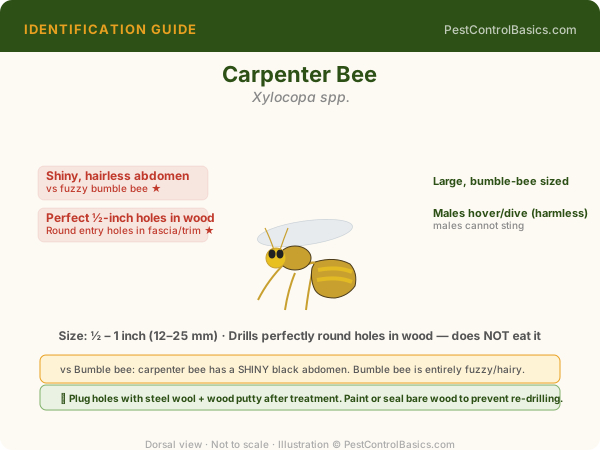
Large, shiny-black abdomen hovering around wooden structures. Males dive-bomb aggressively but are completely unable to sting — no stinger. Females can sting but almost never do. They bore perfect 1/2-inch holes in unfinished wood causing structural damage over years. Prevention is cheap; repair after years of damage is not.
Males sting?NO — no stinger; harmless
Females sting?Rarely — only if handled
DamageStructural boring over years; woodpecker attraction
PreventionPaint or stain all bare wood
Best treatmentDust in holes at night + fill later
🔮Reviewed by Derek GiordanoContent on PestControlBasics.com is developed with input from certified pest management professionals and cross-referenced against EPA, CDC, and university extension guidance. Last reviewed: April 2026.
Identifying wasp species and when each matters
Different stinging insects have different temperaments and treatment urgency. Paper wasps (umbrella-shaped open-cell nests, often under eaves) are generally non-aggressive away from the nest but defend it strongly; nests in low-traffic areas can often be left alone. Yellowjackets (ground nests, wall void nests, large enclosed paper nests) are aggressive defenders and warrant prompt treatment near human activity areas. Bald-faced hornets (large gray football-shaped hanging nests, very aggressive) require careful treatment, often by professionals if the nest is large or near activity. Mud daubers (clay tubes on walls) are solitary, non-aggressive, and don't need treatment. Cicada killers (large solitary wasps with tan and brown coloring) look fearsome but rarely sting. Honeybees should be left alone or relocated by a beekeeper, not exterminated.
How professional pest control programs differ from one-off treatments
A single treatment — DIY or professional — addresses what's visible today, but most pest pressure is cyclical. Professional pest control programs that work long-term are structured around inspection, monitoring, treatment, and follow-up as a recurring cycle rather than discrete events. The inspection phase identifies conducive conditions (moisture, harborage, food access, exclusion gaps) that one-time treatments don't address. The monitoring phase uses sticky traps, bait stations, or visual sweeps to catch population rebounds early, before they become visible infestations again. The treatment phase targets the specific life stages active during that visit — different than blanket spraying everything. The follow-up phase verifies treatment efficacy and adjusts. Homeowners can replicate this structure on a quarterly or seasonal schedule without buying expensive equipment, and the underlying logic — track, treat targeted, verify — produces consistently better results than reactive treatment after problems become obvious.
Anaphylaxis risk and household preparedness
Approximately 3-5% of adults have severe allergic reactions to insect stings, and the proportion experiencing sting-related anaphylaxis is significant enough that any household with known allergy should keep emergency response planned. EpiPen prescription with current expiration date, training for all household members on its use, and emergency action plan including immediate 911 contact and a known route to the nearest ER. Even without known allergy, large numbers of stings (50+ from social insects) can produce systemic toxic effects; awareness of nest locations before yard work and avoiding aggressive nest disturbance reduces this risk. For known-allergic individuals, professional treatment of nests rather than DIY is reasonable insurance — the risk of a sting during DIY treatment outweighs the cost of professional service.
Wasp nest treatment timing and technique
Wasp and hornet nest treatment is safest at dusk or after dark when foragers have returned and the colony is less active. Temperatures below 50°F further reduce activity but most stinging insects remain capable of defending the nest. Treatment products: residual aerosols labeled for wasps and hornets reach 15-20 feet, allowing treatment from a safe distance; for ground-nesting yellowjackets, liquid insecticides poured into the entrance at night work well; for wall-void or roof-line nests, dust formulations injected at the entrance allow workers to track the dust into the nest. Wait 24-48 hours after treatment to confirm no surviving activity before removing the nest. Don't reuse nest locations — wasps don't return to last year's nests, but the same favorable conditions often attract new queens.
How environmental conditions affect treatment efficacy
Pesticide efficacy is highly sensitive to the conditions at application and immediately after. Temperature affects both vapor pressure (volatility) and residual binding — products applied above ~90°F often volatilize before binding to surfaces, while applications below ~50°F can fail to spread properly. Surface porosity changes residual duration: a residual that lasts eight weeks on a sealed concrete slab might last three weeks on bare wood. Rainfall within four hours of an outdoor application typically washes off most surface deposits, though microencapsulated products are more rain-fast. UV exposure degrades many pyrethroids within days to weeks on sunny surfaces, which is why fence-line applications often fail mid-summer. Indoor humidity affects bait acceptance — dry baits perform worse in high humidity as they absorb moisture and lose palatability. Reading conditions correctly explains many otherwise mysterious treatment failures.
Yellow jackets vs. paper wasps vs. hornets: what you're dealing with
Three commonly-confused wasp groups have meaningfully different behavior and require different management approaches. Paper wasps build open umbrella-shaped nests with visible cells, typically under eaves, in soffit corners, in shrubs, or under deck railings; colonies are smaller (typically 20-50 wasps), workers are less aggressive, and stings are typically defensive rather than offensive. Yellow jackets build enclosed papery nests, often underground in old rodent burrows or in wall voids, soffit cavities, and similar concealed locations; colonies are larger (often several hundred to several thousand), workers are aggressive particularly in late summer when populations peak and food sources change, and ground-nest disturbance produces serious sting events. Hornets (including bald-faced hornets, technically a yellow jacket species in the Vespidae family, and European hornets) build large enclosed aerial nests on tree branches or building exteriors. The identification matters because paper wasp nests can often be treated and removed by homeowners with caution, while yellow jacket and hornet nests are more dangerous and often warrant professional removal, particularly when nests are concealed in wall voids.
How treatment thresholds change what 'success' should mean
Most homeowners frame pest control as elimination — zero individuals seen — but professional programs operate on threshold concepts that better match what's actually achievable and economically reasonable. A treatment threshold is the population level at which intervention is justified; below it, the cost and disruption of treatment outweigh the damage prevented. For aesthetic pests like the occasional ant or spider, the threshold is essentially zero only because tolerance is low, not because zero is biologically realistic. For pests with health implications (cockroaches, rodents) or property damage potential (termites, carpenter ants), thresholds are set well below visible damage to allow time for response. The implication for self-evaluation: a program that drops a cockroach population by 95% without reaching zero may be functioning correctly, and pushing for the last 5% may require disproportionate effort or treatment intensity that creates other problems. Reframing 'success' as durable reduction below threshold rather than absolute zero produces saner program design, more reasonable expectations of paid services, and less wasted DIY effort chasing the long tail of a population that's already controlled in any practical sense.
Wasp nest removal: timing and the case for waiting
When a wasp nest appears on a property, the instinct is immediate removal, but timing and species considerations often justify a different approach. Paper wasps and many other social wasp species in temperate climates have annual colonies that die naturally at first hard frost; the queen overwinters separately and starts a new nest the following spring. A nest in a location that isn't a direct human conflict point (eave of a shed, branches of a far tree, post in a fence corner) can often simply be left until natural die-off, with the nest removed cosmetically in late fall after the colony has died. Nests in or near high-traffic areas — doorways, mailboxes, play structures, frequently-used outdoor seating — warrant removal for safety. Treatment timing within the season matters: evening application (when most workers have returned to the nest) maximizes effect, while daytime treatment leaves foragers that return to the nest later and produces incomplete results. Aerosol products labeled for wasp nests that produce a long-distance stream (rather than a foaming application) allow treatment from a safer distance.
Ground-nesting yellowjackets: a distinct problem requiring different handling
Yellowjacket species that nest in the ground present a substantially different management challenge from species that nest above ground. The nest entrance is often inconspicuous — a single small hole in turf, in a soil bank, or at the base of a retaining wall — and the nest itself can be quite large, with thousands of workers. The first sign of the nest is frequently a sting incident during mowing, landscape work, or recreational activity, because the nest is invisible until disturbed. Treatment of ground nests requires direct application of insecticide into the entrance, ideally at dusk or after dark when workers are inside, and follow-up to confirm activity has ceased. Pyrethroid dusts applied to the entrance are typically more effective than sprays, because the dust persists and is tracked into the nest by returning foragers. Sealing the entrance after dusting is sometimes recommended but should only be done after activity has confirmed ceased, because sealing a still-active nest can cause workers to emerge through alternate exits. For homeowners without experience, professional treatment of ground nests is often the right call given the population size and the consequences of incomplete treatment.
The role of inspection in long-term cost reduction
An inspection is the cheapest tool in pest management, and homeowners systematically underspend on it. The economics are unambiguous: an annual or semiannual inspection costs a small fraction of what any moderate treatment costs, and it catches problems while they're still cheap to address. Termite damage detected in its first season requires perimeter treatment; the same damage discovered three years later may require structural repairs running into five figures. Rodent activity detected through droppings before nesting establishes requires sealing and a few traps; the same activity discovered after a multi-generation infestation has set up in wall voids requires removal, exclusion, sanitation, and sometimes drywall work. The pattern repeats across nearly every pest category. Even households that don't engage a regular pest service should treat the annual inspection as a baseline expense — equivalent to the way they probably treat HVAC tune-ups, gutter cleaning, or smoke detector battery changes. The marginal cost of one trained set of eyes on the property each year is one of the most defensible expenses in home maintenance.
Paper wasp tolerance: when not to treat
Paper wasps are widely treated reflexively, but the cost-benefit assessment for treatment is often less favorable than homeowners assume. Paper wasps are valuable predators of caterpillars and other garden pests, they're typically non-aggressive unless the nest is disturbed within a few feet, and most nests in residential settings are in locations where they pose minimal risk to occupants. A nest under an eave on the unused side of the house is qualitatively different from a nest at the front door or near a children's play area. The right question to ask before treatment is whether anyone is actually going to be within the nest's defensive range during the rest of the season, and what the cost of accidental disturbance would be. For nests in low-traffic areas, leaving them alone often produces fewer wasp encounters across the season than treatment does, because the resident colony actively excludes other wasps and the natural cycle leads to nest abandonment by fall. For nests in genuinely high-conflict locations, prompt treatment is warranted, but the default of treating every visible nest underestimates the ecological role and overestimates the actual risk in most situations.