The short answer
- Perfectly round holes about a half inch wide on the underside of rails, fascia or joist ends are carpenter bees. Ohio State and Clemson both list decks among their usual nesting sites.[6][7][5]
- Coarse, stringy sawdust and smooth, clean galleries in damp or rotting wood point to carpenter ants. They excavate wood to nest but do not eat it.[8][9][10]
- Earthen shelter tubes running from the soil onto posts or framing point to subterranean termites. In California, drywood termites can infest dry deck and fence lumber, and dampwood termites attack posts that stay wet.[2][11][13]
- Wood that is cracked into cubes, bleached and spongy, or soft enough to scrape off with a probe is rotting. Decay fungi need wet wood, and mushroom-like growths on the wood mean the decay is advanced.[3][2]
- Rows of small holes or larger dug-out cavities, often in cedar or redwood, are woodpeckers. They are often hunting insects in the wood, including carpenter bee larvae.[17][18][7]
- Keeping wood dry is the common thread. Use ground-contact treated lumber or concrete footings where wood meets soil, keep sprinklers off posts, and keep exposed wood painted or sealed.[2][11][7][1]
Wood pest profiles on this site
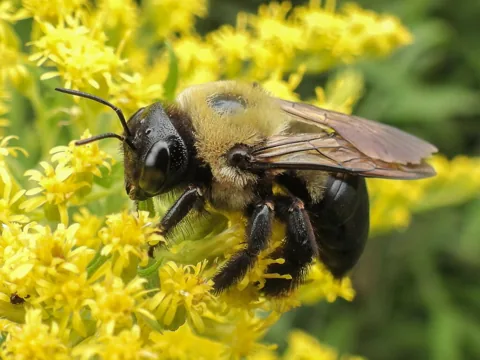 Eastern Carpenter Bee
Xylocopa virginica
Carpenter bees are large, solitary bees that bore round tunnels into bare, weathered wood to rear their young; they rarely cause severe damage but can weaken wood that is reused year after year.
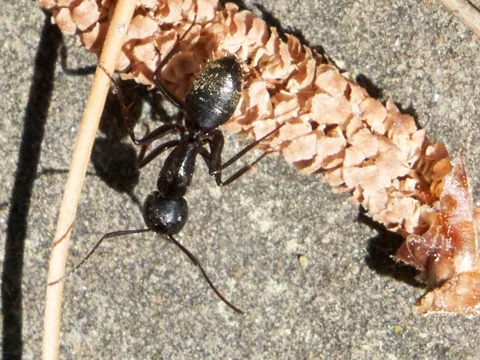 Carpenter Ants
Camponotus species
Carpenter ants don't eat wood the way termites do; they excavate it to nest, usually starting where wood is damp or decayed, and indoor nests are often satellites of a parent colony outdoors. Minnesota and Clemson extension both stress that they don't eat wood; they tunnel into it to make a nest.
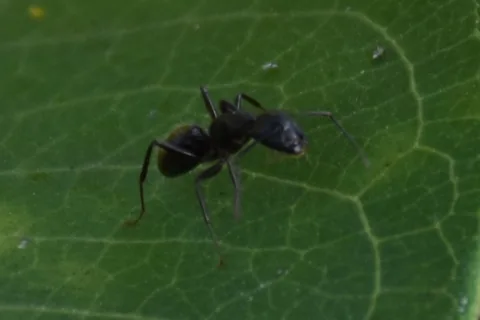 Black carpenter ant
Camponotus pennsylvanicus
The black carpenter ant is a common home invader in the northeastern United States and the most common carpenter ant in Ohio and Nebraska. Its large black workers come indoors looking for food, and colonies can set up satellite nests in moist or rotting wood and foam insulation inside the house.
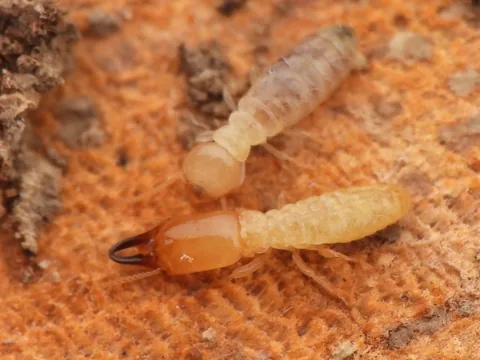 Eastern Subterranean Termite
Reticulitermes spp. (shown: R. flavipes)
Subterranean termites live in the soil and travel into buildings through earthen shelter tubes; they are the most destructive termites in most of the United States and usually warrant a professional.
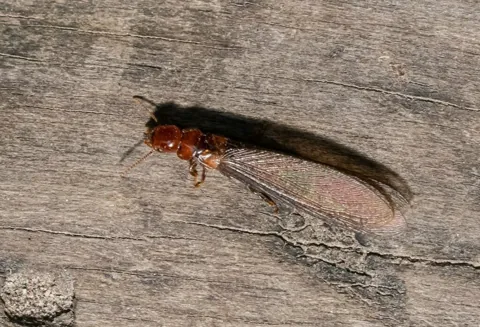 Western Drywood Termite
Incisitermes minor
Drywood termites live entirely inside wood without needing soil contact; the western drywood termite is California's second most important termite pest after subterranean termites. Clemson Extension says drywood termites get the moisture they need from humid air and are most common along humid coastal areas of South Carolina.
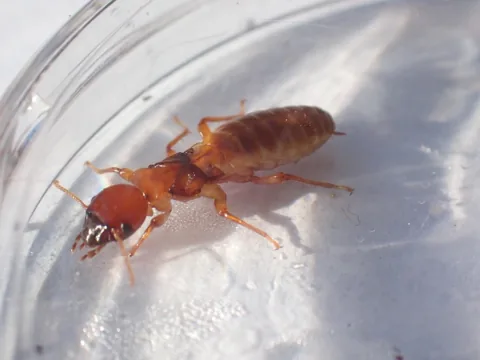 Dampwood Termites
Zootermopsis angusticollis
Dampwood termites live and feed in wet or rotting wood and don't nest in dry, sound lumber. Finding them in a building points to a leak, wood touching soil, or another moisture problem that needs fixing.
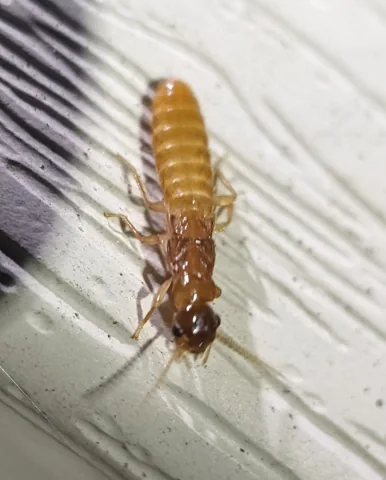 Formosan Subterranean Termite
Coptotermes formosanus
The Formosan subterranean termite is an invasive species from East Asia and one of the most aggressive and economically damaging termites in the world; its colonies are much larger than those of native subterranean termites. EPA lists it among the less common termites in the U.S., behind the native subterranean termite.
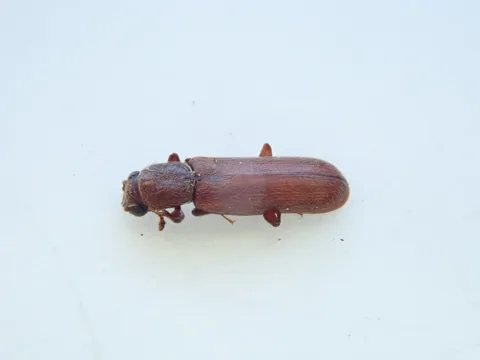 Powderpost Beetles
Lyctinae (e.g., Lyctus brunneus, Lyctus planicollis)
Powderpost beetles are small brown beetles whose larvae tunnel through dry, seasoned hardwood. Often the first clues are tiny round exit holes and little piles of flour-fine dust on floors, furniture or paneling.
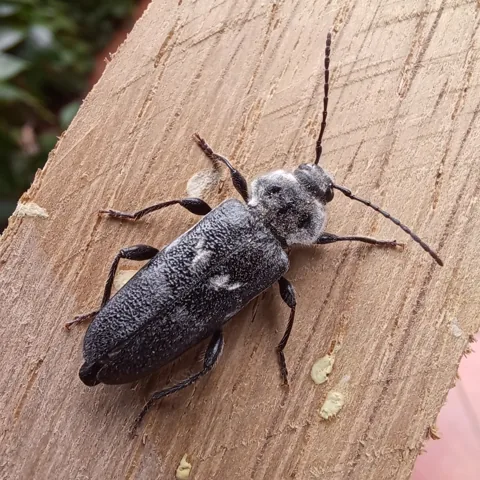 Old House Borer
Hylotrupes bajulus
Despite its name, the old house borer most often turns up in fairly new buildings. Its larvae tunnel inside pine, spruce, fir and other softwood framing for years, and damp, poorly ventilated spaces let infestations spread.
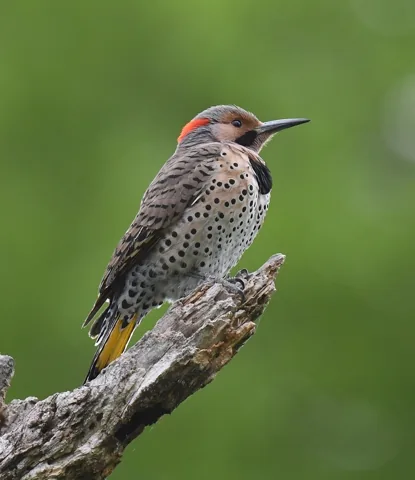 Woodpeckers
Family Picidae (shown: northern flicker, Colaptes auratus)
Woodpeckers come into conflict with people when they peck buildings looking for insects, drum on loud surfaces to claim territory, or carve out nest holes. All are protected under the federal Migratory Bird Treaty Act, but they can legally be kept off a house.
Wet wood is the starting point
Most of the damage to outdoor wood comes back to moisture. A Forest Products Laboratory review by Lebow and White says termites and decay fungi are the most destructive organisms in wood construction, that most wood-degrading insects prefer moist wood, and that carpenter ants first invade wood that is moist or decayed.[1]
Decay fungi need wet wood. NC State says wood saturated to about 30 percent moisture will rot and that brown and white rot fungi will not grow below 20 percent; the LSU AgCenter also says most rot-causing fungi will not attack wood below 20 percent. The Forest Products Laboratory puts the threshold slightly higher, saying decay fungi need free water in the wood, above 20 to 25 percent moisture content.[3][2][1]
The insects follow the same pattern. LSU says native subterranean termites need wood with more than 20 percent moisture, Minnesota Extension says carpenter ant nests in homes are found in moist or decayed wood, and the eXtension termite page says sprinklers regularly spraying a fence post can create the conditions dampwood termites need.[2][9][13]
So when you find one pest in a deck or fence, look for the water source as well: a post sitting in wet soil, boards that hold puddles, a sprinkler head aimed at the fence, or a gutter spilling onto the deck.[1][13][11]
Tell the culprits apart by the damage
Each of these leaves a different kind of hole, debris or texture. Match what you see, then go to the guide for that pest.[8][14][3][7]
- Carpenter bees: a clean, round entrance hole slightly less than a half inch wide, bored across the grain, then turning to run 4 to 6 inches along the grain. Ohio State says to look for yellowish to brownish fecal streaks below the hole. Ohio State lists decks, railings, porch ceilings, fence posts and arbors as nest sites, and Kentucky Entomology names the joist ends of decks as a favored spot. See how to get rid of carpenter bees.[7][6][5]
- Carpenter ants: no round entry holes. They hollow out galleries that are smooth with a well-sanded look, and push out piles of fibrous wood shavings that Texas A&M says are a sign of a nest nearby. Texas A&M lists fence posts and landscape timbers among their nest sites, and Minnesota Extension says outdoor parent nests are often in decaying boards lying on or buried in the ground. See how to get rid of carpenter ants.[9][8][10]
- Subterranean termites: UC IPM says they nest in soil and reach wood through earthen shelter tubes, and LSU says the tubes let them carry moisture to wood that is not touching the ground. UC IPM lists untreated fence posts and buried scrap wood near a house as things that can contribute to an infestation. The termite damage guide shows how their galleries differ from ant and beetle damage.[2][11]
- Drywood termites: UC IPM says California's drywood termites infest dry, sound wood, including decks, fences, utility poles and stored lumber, and that they nest in the wood itself without soil contact. The types of termites guide covers where each group lives.[11][12]
- Dampwood termites: the eXtension termite page says they are most often found in trees, fence posts and utility poles, because homes rarely stay wet enough for them. Fixing the moisture problem is the remedy it gives.[13]
- Powderpost beetles: small round exit holes, 1/16 to 1/8 inch across in Penn State's description, with powder as fine as flour sifting out. Kentucky Entomology and UC IPM say the adults lay eggs on bare, unfinished wood. See the section on powderpost beetles below before blaming them for deck damage.[15][14][16]
- Woodpeckers: UC IPM says feeding woodpeckers leave a series of small holes in a row, and some dig larger holes to nest in. The Internet Center for Wildlife Damage Management says similar damage to wooden fence posts can be a serious problem for some farmers and ranchers, and UC IPM says acorn woodpeckers store acorns in holes drilled in fence posts.[18][17]
- Wood rot: no holes or sawdust, just a change in the wood itself. The rot section below covers what each kind looks like.[3][2]
Wood rot and the stains that look like it
NC State describes brown rot as one of the most common wood-decaying fungi: the wood darkens, shrinks and twists, cracks form across the grain, and in the end it turns dry and powdery. White rot leaves wood bleached, fibrous and spongy. LSU says white rot is common on hardwoods and adds a third type, soft rot, in wood that stays moist for a long time; the surface turns dull brown or blue-gray and can easily be scraped off with a probe.[3][2]
Mushroom-like growths coming out of the wood are a warning sign. LSU calls a fungal fruiting body evidence of advanced decay and serious strength loss, and says such lumber is extremely dangerous as a walking surface on a deck or boat dock.[2]
Not every dark patch is rot. NC State says surface mold and mildew do not decay wood, and sapstain, which turns wood blue, black or gray deeper into the board, does not weaken it either. Sapstain shows the wood was wet at some point, and the fungus goes dormant once the wood dries.[3]
Rot and insects often go together. Carpenter ant galleries often begin where wood is already damaged by water or decay, according to UC IPM, and the Forest Products Laboratory says carpenter ants first invade moist or decayed wood.[8][1]
Posts and anything touching the ground
The ground line is where posts fail first. The Forest Products Laboratory says nondurable wood in contact with the ground decays fastest at the ground line, where soil moisture and oxygen in the wood both support decay fungi. LSU says a common cause of decay is untreated wood that goes through wet and dry cycles in ground contact.[1][2]
For anything that must touch soil, LSU says to use pressure-treated lumber approved for ground contact. The University of Kentucky wood preservation manual separates ground contact, a high decay hazard that needs a heavy-duty preservative, from above-ground use, a low hazard. UC IPM suggests termite-resistant wood or concrete footers for fences and other structures that must contact soil.[2][4][11]
Around the house, UC IPM advises removing untreated fence posts, wood piles and buried scrap wood near the structure. It also notes that most soil around a home holds buried wood such as roots, stumps or fence posts, so termites swarming in the yard don't necessarily mean the house is infested.[11]
Keep irrigation off fences and deck posts. The eXtension termite page suggests a sprinkler check to find fencing or play equipment at risk from dampwood termites.[13]
Deck boards, rails and joist ends
Cut ends soak up water. The Forest Products Laboratory says wood absorbs water through cut ends about 11 times faster than through its sides, which is why decay in above-ground construction starts at the joints. LSU recommends a water-repellent preservative applied liberally to end grain and around fasteners, and says a water repellent cuts down on the shrinking and swelling that come with wet and dry spells.[1][2]
Those same exposed ends draw carpenter bees. Ohio State says nail holes, exposed saw cuts and unpainted wood are attractive places for the bees to start a nest, and Clemson advises filling nail holes and saw cuts with wood putty or dowels and painting them.[7][6]
Water left standing on a deck or trapped by its design keeps the wood wet. The Forest Products Laboratory names roof drains, air conditioner condensate and flashing as details that control moisture on a structure.[1]
Wood choice, paint and stain
Some woods hold up better on their own. The Forest Products Laboratory says the heartwood of old-growth bald cypress, redwood, cedars and several white oaks is resistant or very resistant to decay, and that resisting decay doesn't always mean resisting termites. LSU and Kentucky's manual both say sapwood is less resistant than heartwood.[1][2][4]
Decay resistance does not keep carpenter bees away. Kentucky Entomology says they prefer unpainted, weathered wood, especially softer woods such as redwood, cedar, cypress and pine. It says painted or pressure-treated wood is much less susceptible.[5]
Paint is the best-supported deterrent for carpenter bees. Ohio State and Clemson recommend an oil-based or polyurethane paint, and Ohio State says to inspect painted surfaces because weathered coatings expose wood again. Sources differ on stain: Clemson says stains provide little repelling action, while Kentucky Entomology says stains and preservatives are less reliable than paint but may give some repellence compared with bare wood.[7][6][5]
A finish also protects against powderpost beetles, which need bare wood. Penn State says uninfested wood that is sanded and varnished is not normally attacked because the beetles can't find crevices for their eggs, and NC State says they prefer unfinished wood with no paint or stain.[15][3]
Color may matter for woodpeckers. UC IPM says some research suggests wood siding painted or stained in earth tones is more likely to be damaged than siding painted white or pastel colors; this was studied on houses, not fences.[18]
Are powderpost beetles a deck problem?
Less often than the other pests here. Extension sources describe powderpost beetles mainly in hardwood flooring, paneling, furniture and stored lumber. Kentucky Entomology says the worst infestations are in damp crawl spaces, basements, garages and unheated outbuildings, and that many serious cases come from reusing old barn or woodpile lumber.[15][3][14]
Lyctid powderpost beetles attack only hardwoods such as oak, ash, hickory and walnut, according to Kentucky Entomology and NC State. LSU says they are mainly pests of new hardwood lumber and that infestations are rare in dry wood that has been in use for more than five years. Anobiid powderpost beetles attack softwood such as pine and fir, and NC State ties many of their problems to damp wood in crawl spaces.[14][3][2]
If you do see flour-fine powder below tiny round holes in reclaimed wood, a hardwood bench or an outbuilding, the powderpost beetle guide explains how to tell whether the holes are active and what treatments fit each beetle.[14][15]
Woodpeckers on fences and decks
Woodpecker damage often means there is something to eat in the wood. Penn State says insect infestation is occasionally the cause of woodpecker damage to houses, and that more than one woodpecker visiting suggests insects. Ohio State says woodpeckers and flickers can riddle wood with holes while digging out immature and adult carpenter bees.[19][7]
The Internet Center for Wildlife Damage Management and Penn State both say cedar and redwood are damaged most often. UC IPM says woodpeckers are protected under the Migratory Bird Treaty Act, so the woodpecker guide covers what you can legally do about them.[17][19][18]
Is the deck still safe?
NC State says you can't judge whether wood damage needs repair just by looking, that probing the wood may show how far it goes, and that a general contractor or structural engineer should look at structural wood you're worried about. LSU's warning about decayed decking with fungal growths applies to any board or joist that feels soft or spongy under a probe.[3][2]
Replacing badly damaged wood is the standard fix across these pests. Texas A&M advises replacing damaged and decaying wood with solid, dry lumber for carpenter ants, and UC IPM says dampwood termite problems are best handled by correcting moisture problems, such as leaks in roofs and decks, and replacing damaged wood.[10][12]
Common questions
- What is making perfectly round holes in my deck?
- Round holes slightly less than a half inch wide on the underside of railings, joist ends or fascia boards are almost always carpenter bees. Ohio State lists decks, railings and fence posts among their nest sites. Look for yellowish fecal staining below the hole.[7][6][5]
- Can termites eat a wood fence?
- Yes. UC IPM lists untreated fence posts as wood that can feed subterranean termites near a house, and says California's drywood termites infest fences and decks. The eXtension termite page says dampwood termites are most often found in fence posts, trees and utility poles.[11][13]
- Why is my fence post rotting at the ground?
- The Forest Products Laboratory says wood in ground contact decays fastest right at the ground line, where moisture and oxygen both support decay fungi. LSU recommends pressure-treated lumber rated for ground contact for posts set in soil, and UC IPM suggests concrete footers.[1][2][11]
- Is the black or blue staining on my deck boards rot?
- Usually not. NC State says surface mold, mildew and sapstain fungi discolor wood without weakening it. Rot shows up as wood that cracks into cubes and turns powdery, goes bleached and spongy, or scrapes away easily under a probe.[3][2]
- Does pressure-treated wood stop carpenter bees?
- It helps but isn't a guarantee. Kentucky Entomology says painted or pressure-treated wood is much less susceptible to carpenter bees than unpainted, weathered wood. Ohio State and Clemson say a well-maintained oil-based or polyurethane paint is the best deterrent.[5][7][6]
Photo credits
- Eastern Carpenter Bee: Erik Schiff, public domain (CC0), via iNaturalist
- Carpenter Ants: (c) Linda Watson, some rights reserved (CC BY) — via iNaturalist, CC BY 4.0
- Black carpenter ant: (c) Zac Peterson, some rights reserved (CC BY) — via iNaturalist, CC BY 4.0
- Eastern Subterranean Termite: (c) Sam Kieschnick, some rights reserved (CC BY) — via iNaturalist, CC BY 4.0
- Western Drywood Termite: (c) Jeremiah Degenhardt, some rights reserved (CC BY) — via iNaturalist, CC BY 4.0
- Dampwood Termites: Ellyne Geurts, public domain (CC0), via iNaturalist
- Formosan Subterranean Termite: (c) ncb1221, some rights reserved (CC BY) — via iNaturalist, CC BY 4.0
- Powderpost Beetles: Karel Schoonvaere, public domain (CC0), via iNaturalist
- Old House Borer: (c) Johannes Schlagbauer, some rights reserved (CC BY) — via iNaturalist, CC BY 4.0
- Woodpeckers: Chrissy McClarren and Andy Reago, public domain (CC0), via iNaturalist
Sources
- USDA Forest Service, Forest Products Laboratory (Treesearch), “Durability of Wood in Construction (S. Lebow and R. White; chapter in Marks' Standard Handbook for Mechanical Engineers, 11th ed.).” research.fs.usda.gov/download/treesearch/34298.pdf (accessed 2026-11-10)
- LSU AgCenter, Louisiana Cooperative Extension Service, “Causes and Control of Wood Decay, Degradation & Stain, Pub. 2703 (T. Shupe, S. Lebow and D. Ring).” research.fs.usda.gov/download/treesearch/35536.pdf (accessed 2026-11-10)
- NC State Extension, “Powderpost Beetles and Wood-Inhabiting Fungi.” content.ces.ncsu.edu/powderpost-beetles-and-wood-inhabiting-fungi (accessed 2026-11-10)
- University of Kentucky Pesticide Education Program, “Wood Preservation (Category 17 pesticide applicator manual).” entomology.ca.uky.edu/files/cat17woodpreservation.pdf (accessed 2026-11-10)
- University of Kentucky Entomology, “ENTFACT-611: Carpenter Bees.” entomology.mgcafe.uky.edu/ef611 (accessed 2026-11-10)
- Clemson Cooperative Extension, Home & Garden Information Center, “Carpenter Bees (HGIC factsheet).” hgic.clemson.edu/factsheet/carpenter-bees/ (accessed 2026-11-10)
- Ohio State University Extension, Ohioline, “Carpenter Bees, HYG-2074 (S. C. Jones).” ohioline.osu.edu/factsheet/hyg-2074 (accessed 2026-11-10)
- University of California Statewide IPM Program, “Pest Notes: Carpenter Ants, Publication 7416 (August 2009).” ipm.ucanr.edu/legacy_assets/PDF/PESTNOTES/pncarpenterants.pdf (accessed 2026-11-10)
- University of Minnesota Extension, “Carpenter ants (Hahn and Kells; reviewed 2024).” extension.umn.edu/insects-infest-homes/carpenter-ants (accessed 2026-11-10)
- Texas A&M Urban and Structural Entomology Program, “Carpenter Ants, Camponotus sp..” urbanentomology.tamu.edu/urban-pests/ants/carpenter/ (accessed 2026-11-10)
- University of California Statewide IPM Program, “Pest Notes: Subterranean and Other Termites, Publication 7415 (May 2014).” ipm.ucanr.edu/legacy_assets/PDF/PESTNOTES/pntermites.pdf (accessed 2026-11-10)
- University of California Statewide IPM Program, “Pest Notes: Drywood Termites, Publication 7440 (August 2014).” ipm.ucanr.edu/legacy_assets/PDF/PESTNOTES/pndrywoodtermites.pdf (accessed 2026-11-10)
- eXtension Foundation, Pests in the Home, “How to Get Rid of Dampwood Termites.” pestsinthehome.extension.org/termites/how-to-get-rid-of-dampwood-termites/ (accessed 2026-11-10)
- University of Kentucky Entomology, “ENTFACT-616: Powderpost Beetles.” entomology.mgcafe.uky.edu/ef616 (accessed 2026-11-10)
- Penn State Extension, “Powderpost Beetles.” extension.psu.edu/powderpost-beetles (accessed 2026-11-10)
- University of California Statewide IPM Program, “Pest Notes: Wood-Boring Beetles in Homes.” ipm.ucanr.edu/home-and-landscape/wood-boring-beetles-in-homes/ (accessed 2026-11-10)
- Internet Center for Wildlife Damage Management, “Woodpecker Damage Identification.” icwdm.org/species/birds/woodpeckers/woodpecker-damage-identification/ (accessed 2026-11-10)
- University of California Statewide IPM Program, “Pest Notes: Woodpeckers.” ipm.ucanr.edu/home-and-landscape/woodpeckers/ (accessed 2026-11-10)
- Penn State Extension, “Woodpeckers.” extension.psu.edu/woodpeckers (accessed 2026-11-10)