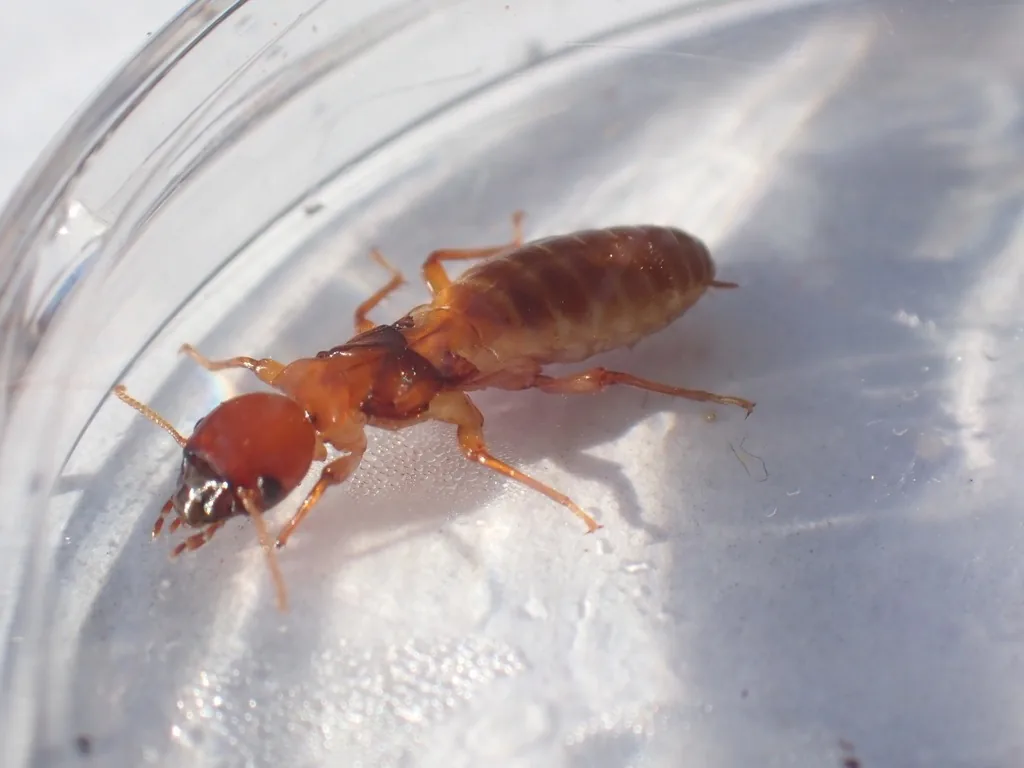
How to identify it
- This page centers on the Pacific dampwood termite, Zootermopsis angusticollis, the largest termite in the Pacific Northwest.[1][2]
- It is caramel-colored to dark brown; workers are about 1/2 inch long and soldiers about 3/4 inch.[2][3]
- Winged swarmers are orange-brown and about 3/4 inch to over 1 inch long, including the wings.[3][2][1]
- Their droppings are moist and crush between your fingers, often clumping into a paste in the galleries.[5]
Look-alikes
| Look-alike | How to tell them apart |
|---|---|
| Subterranean termites | Much smaller, with black swarmers about 3/8 inch long; they nest in soil and commonly attack sound wood.[3][1] |
| Drywood termites | Nest in dry, sound wood and leave hard, dry pellets that won't crush; dampwood droppings are moist and pasty.[2][5][4] |
| Carpenter ants | A look-alike that needs different control methods, so get a positive identification before treating.[2] |
Where it lives
Zootermopsis dampwood termites are most common in western Washington and Oregon and in cool, humid coastal California; Neotermes dampwood termites occur in Florida.[1][4][5]
Biology and life cycle
Colonies form in decayed wood kept moist by soil contact, a plumbing or roof leak, bad drainage, or condensation in a poorly ventilated crawl space.[1][4]
Wood decay fungus is often found along with them.[1]
They carve large, open galleries in the wood where they live and feed, rather than tunneling through soil.[4][5]
A colony can extend into sound wood several meters from the water source, linked to it by smooth-walled tunnels.[5]
Swarmers leave established nests in late summer or fall, often after rain; seeing them fly is not cause for alarm by itself.[3][2]
Damage and signs
Health risk
The concern is structural rather than health-related: dampwood termites signal moisture and wood decay, and decay fungi worsen the damage if the water problem isn't fixed.[4][1]
Control
Prevention
Fix the moisture source: repair roof and plumbing leaks, keep gutters working, and direct sprinkler and AC water away from wood.[5][2]
Avoid wood-to-soil contact, remove leftover form boards and wood scraps, keep woodpiles away from the house, and ventilate the crawl space.[3][1]
Traps and physical control
Replace structurally unsound wood; once the colony loses access to water, it dries out and dies.[1][5]
Pesticides
Pesticides are rarely needed, and chemical treatment alone won't work unless the moisture is removed and damaged wood is repaired.[3][1][2]
Borate treatments are sometimes used, because these water-soluble products absorb well into moist wood.[5]
When to call a professional
Oregon State recommends a professional inspection, and leaving termite control in structures to licensed pest control companies.[2]
Common questions
- Are dampwood termites as bad as subterranean termites?
- Generally less of a threat. They need wet wood, and Cooperative Extension calls them a minor pest, while subterranean termites attack sound, dry wood.[5][3]
- Do I need to fumigate for dampwood termites?
- Rarely. Fumigation is reserved for very rare cases; correcting the moisture problem is usually the most effective treatment.[5]
Sources
- Pacific Northwest Pest Management Handbooks (Oregon State, Washington State and University of Idaho Extension), “Wood-infesting pests: Termite (Pacific Northwest Insect Management Handbook).” pnwhandbooks.org/insect/structural-health/wood-infesting-insect/wood-infesting-termite (accessed 2026-10-06)
- Oregon State University Extension Service, “Termites (Solve Pest Problems, updated June 11, 2025).” solvepestproblems.oregonstate.edu/insects-spiders/termites (accessed 2026-10-06)
- Washington State University Extension, PestSense, “Termites.” pestsense.cahnrs.wsu.edu/fact-sheet/termites/ (accessed 2026-10-06)
- University of California Statewide IPM Program, “Pest Notes: Subterranean and Other Termites.” ipm.ucanr.edu/home-and-landscape/subterranean-and-other-termites/ (accessed 2026-10-06)
- Cooperative Extension (eXtension Foundation), “How to Get Rid of Dampwood Termites (Pests in the Home).” pestsinthehome.extension.org/termites/how-to-get-rid-of-dampwood-termites/ (accessed 2026-10-06)
- iNaturalist, “Zootermopsis angusticollis taxon page (order and family).” www.inaturalist.org/taxa/121383 (accessed 2026-10-06)