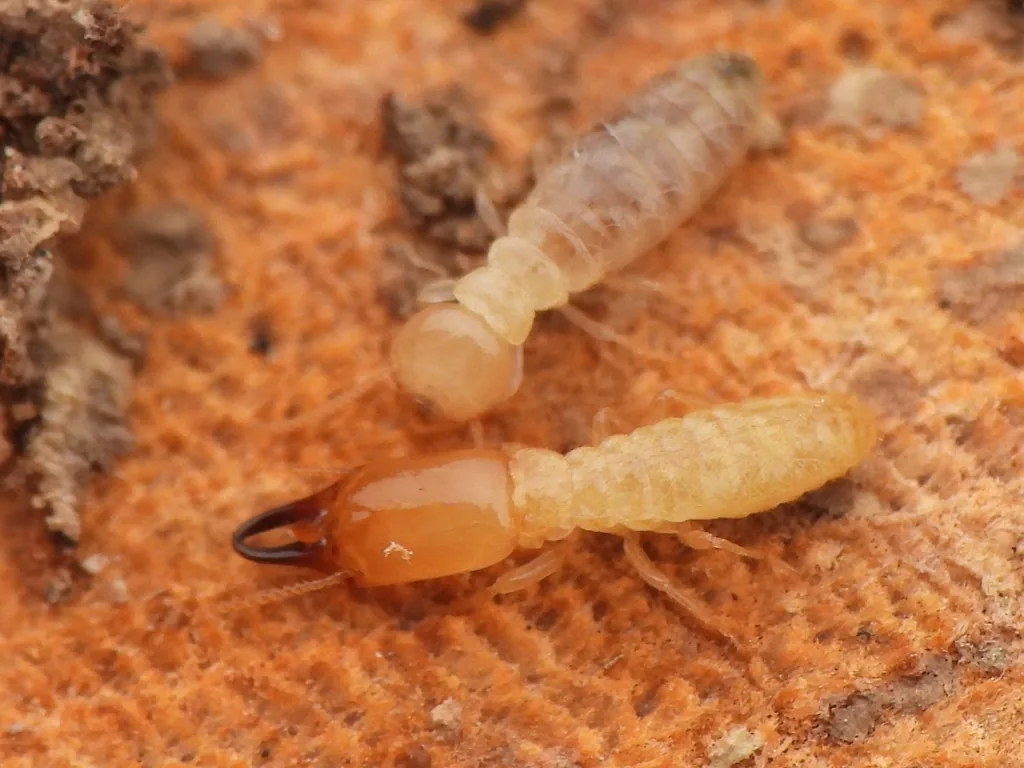
How to identify it
- Workers are small, soft-bodied, creamy white and wingless, with no eyes; they are the termites you see when infested wood or a mud tube is opened.[4][2]
- Soldiers have large, rectangular, amber heads and heavy, curved jaws; there is roughly one soldier per 50 workers in eastern subterranean colonies.[4][1]
- Eastern subterranean swarmers are about 3/8 inch long including the wings, with dark brown to black bodies and white or translucent wings that extend well beyond the abdomen.[4]
- Termites have straight antennae, a uniformly thick waist and wings of equal size; ants have elbowed antennae, a pinched waist and front wings longer than the hind wings.[2]
Look-alikes
| Look-alike | How to tell them apart |
|---|---|
| Winged ants | Elbowed antennae, a narrow waist and front wings longer than the hind wings. Ants often swarm at the same time of year as termites.[2] |
| Formosan subterranean termite | Swarmers are larger (about 1/2 inch), tan to yellowish brown, and fly at night toward lights; soldiers have teardrop-shaped heads.[4][5] |
| Drywood termites | Live entirely inside dry wood with no soil contact and push out six-sided fecal pellets instead of building mud tubes.[1] |
Where it lives
Native subterranean termites (Reticulitermes) occur across much of the United States; the eastern subterranean termite is found through much of the eastern U.S., and Reticulitermes species are the most destructive termites in California.[4][1]
Biology and life cycle
Colonies live in soil, where they get the moisture they need, and send workers out to forage for wood; mature colonies can hold hundreds of thousands of individuals.[1]
A new colony starts from a single pair after a swarm and may have only about 75 members after a year; very few ever reach maturity.[1]
Swarms of winged reproductives are triggered by warm temperatures and rain. In Mississippi's coastal counties they can begin in late January, with most swarming in spring; most swarm during the day.[2][4][5]
Swarmers that emerge indoors cannot damage wood and live only about a day.[2]
Feeding follows the grain of the wood, eating the softer springwood and leaving the harder summerwood.[1]
Damage and signs
- Pencil-wide mud tubes on foundations, piers, sill plates and joists are the most commonly seen sign; break one open to look for live, creamy-white workers.[1][2][3]
- Damaged wood is hollowed out along the grain with bits of dried mud or soil lining the galleries; carpenter ant or moisture damage doesn't look like this.[2]
- Winged swarmers or shed wings on windowsills indoors almost always mean the house is infested; swarms from stumps or woodpiles in the yard don't necessarily mean that.[2][1]
- Infestations can go undetected for years behind walls, flooring and insulation, because the wood surface usually stays intact.[2]
Health risk
Termites don't bite or spread disease to people; the risk is to wood. Registered termiticides are evaluated by EPA and, applied according to label directions, pose no significant hazard to people or pets according to University of Kentucky entomologists.[2]
Control
Prevention
Eliminate wood-to-soil contact (keep siding and frames at least six inches above grade), fix leaks and drainage so soil by the foundation stays dry, ventilate crawl spaces, and keep firewood and mulch away from the foundation.[3][1]
Pesticides
Liquid termiticides create a treated zone in the soil. Modern products such as fipronil, imidacloprid and chlorantraniliprole are non-repellent, so termites pass through and are killed; label directions call for at least five years of control.[1][2]
Baits use slow-acting active ingredients in cellulose placed in stations around the house; foragers share the bait and the colony declines over weeks or months. The most effective baits use insect growth regulators and are professional-only.[1][2]
When to call a professional
Treating a home yourself isn't recommended: it takes knowledge of building construction, special equipment, and often hundreds of gallons of termiticide injected along the foundation and under slabs. Do-it-yourself products seldom eliminate an existing infestation.[2][1]
Spot treatments are usually a gamble; most reputable firms won't warrant them. Take time to compare several licensed companies; termites damage wood slowly, so a few weeks spent deciding costs little.[2]
Common questions
- I found swarmers in the yard. Does my house have termites?
- Not necessarily. Swarms from stumps or woodpiles in the yard are common; swarmers emerging next to the foundation or indoors are a much stronger sign.[2][1]
- Can fumigation or heat kill subterranean termites?
- No. Those methods work for drywood termites, but most subterranean termites are in the soil, out of reach; soil treatments and baits are the primary methods.[1]
- How long does a termite treatment last?
- Liquid termiticides are supposed to control termites for at least five years when applied according to label directions; actual results depend on the product, how thorough the job was and local conditions.[2]
Sources
- University of California Statewide IPM Program, “Pest Notes: Subterranean and Other Termites, Publication 7415 (May 2014).” ipm.ucanr.edu/legacy_assets/PDF/PESTNOTES/pntermites.pdf (accessed 2026-10-06)
- University of Kentucky Entomology, “ENTFACT-604: Termite Control: Answers for Homeowners (revised March 2026).” entomology.mgcafe.uky.edu/ef604 (accessed 2026-10-06)
- University of Kentucky Entomology, “ENTFACT-605: Protecting your Home Against Termites (revised March 2026).” entomology.mgcafe.uky.edu/ef605 (accessed 2026-10-06)
- Mississippi State University Extension, “Species of Termites in Mississippi.” extension.msstate.edu/insects/termites/species-termites-mississippi (accessed 2026-10-06)
- Texas A&M AgriLife Extension, “Formosan Subterranean Termites, E-367.” extensionentomology.tamu.edu/wp-content/uploads/sites/3/2017/01/Formosan-subterranean-termites-E367.pdf (accessed 2026-10-06)
- iNaturalist, “Reticulitermes flavipes taxon page (order and family).” www.inaturalist.org/taxa/119931 (accessed 2026-10-06)