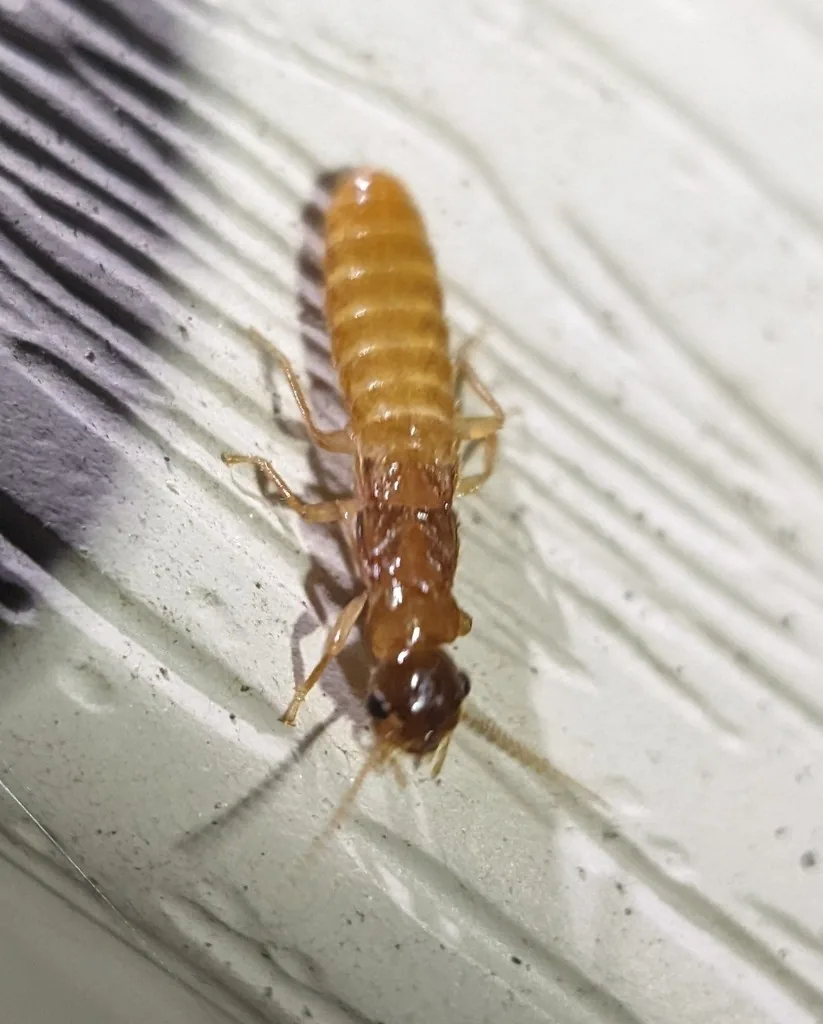
How to identify it
- Swarmers are yellowish brown and about 1/2 to 5/8 inch (12 to 15 mm) long, with a dense covering of fine hairs on clear wings.[1][2]
- Soldiers have teardrop-shaped heads with large, dark jaws, unlike the rectangular heads of native subterranean soldiers, and can release a sticky white defensive fluid from the front of the head.[1][2]
- Colonies have a relatively high share of soldiers, roughly one for every ten workers.[2]
- Workers look like native subterranean termite workers: white, eyeless and hard to tell apart.[2][1]
Look-alikes
| Look-alike | How to tell them apart |
|---|---|
| Native subterranean termites | Smaller, dark-bodied swarmers that fly during the day, and soldiers with rectangular heads.[2][1] |
| Drywood termites | Some are a similar honey-brown color and also fly at night to lights, but their wings lack hairs and have more cross veins, and they leave fecal pellets instead of mud tubes or carton.[1] |
| Asian subterranean termite | A related invasive Coptotermes species in South Florida; the two can hybridize where they overlap, and species can't be confirmed from a hybrid without molecular testing.[4][5] |
Where it lives
Introduced to the U.S.; in Texas it was first found in 1956 near Houston and now occurs in at least 30 counties, in Mississippi it is established in parts of 26 counties, and in California it was restricted to a small area near San Diego. It spreads mainly in infested wood such as railroad ties and landscape timbers.[1][2][3]
Biology and life cycle
Colonies are at least four times as large as those of native subterranean termites and can grow to more than a million individuals within five years.[1]
Swarmers fly at night or dusk and are attracted to lights. In south Mississippi they usually swarm from late April through mid-May; in Texas from early May through June.[1][2][3]
Besides soil nests, they often build above-ground (aerial) nests of carton, a hard material of chewed wood, soil, saliva and feces, inside walls where there is a moisture source such as a leak.[1][2]
An aerial nest can survive cut off from the soil and keep damaging the structure.[1]
Damage and signs
- They eat both the soft springwood and harder summerwood, so damage can be more severe than from native species.[1]
- They attack living trees, including pecan, citrus, sweet gum, cedar, willow and oaks, and weakened trees may blow over.[1]
- While foraging they can chew through non-wood materials such as plaster, rubber and plastic.[1]
Health risk
The soldiers' bite and defensive fluid are harmless to people; the risk is to wood in buildings and trees.[1]
Control
Prevention
Fix roof and plumbing leaks, remove wood-to-soil contact, and don't use old railroad ties or shoring timbers in landscaping; creosote doesn't guarantee they are termite-free.[1][2]
The best time to protect a building is before and during construction, when the soil under the slab can be treated.[1]
Pesticides
Soil-applied termiticides and baits are the primary treatments and prevent initial infestations, which usually start from the ground, but they won't control an established aerial colony.[2][1]
When to call a professional
Treatments used against native subterranean termites also work on Formosan termites; the main difference is finding and treating any aerial nests.[2]
Common questions
- Are Formosan termites harder to kill than other termites?
- The same treatments are effective; what makes them harder is their large colonies and the need to find and treat any above-ground carton nests.[2]
- What about hybrid Formosan termites?
- Hybrids with the Asian subterranean termite have been confirmed in southeast Florida but are rare, and UF/IFAS says control recommendations don't change.[4][5]
Sources
- Texas A&M AgriLife Extension, “Formosan Subterranean Termites, E-367.” extensionentomology.tamu.edu/wp-content/uploads/sites/3/2017/01/Formosan-subterranean-termites-E367.pdf (accessed 2026-10-06)
- Mississippi State University Extension, “Species of Termites in Mississippi.” extension.msstate.edu/insects/termites/species-termites-mississippi (accessed 2026-10-06)
- University of California Statewide IPM Program, “Pest Notes: Subterranean and Other Termites, Publication 7415 (May 2014).” ipm.ucanr.edu/legacy_assets/PDF/PESTNOTES/pntermites.pdf (accessed 2026-10-06)
- University of Florida IFAS, “Here's what homeowners need to know about hybrid termites in Florida (June 8, 2026).” blogs.ifas.ufl.edu/news/2026/06/08/heres-what-homeowners-need-to-know-about-hybrid-termites-in-florida/ (accessed 2026-10-06)
- Chouvenc T. et al., via PubMed, “Ongoing human-mediated spread and hybridization of two major invasive termite species. Proc. R. Soc. B 292: 20250413 (2025).” doi.org/10.1098/rspb.2025.0413 (accessed 2026-10-06)
- iNaturalist, “Coptotermes formosanus taxon page (order and family).” www.inaturalist.org/taxa/199393 (accessed 2026-10-06)