Moisture Indicator Structural Damage Satellite Colony Inside

Carpenter
Ant

Camponotus pennsylvanicus & related species

They don't eat wood โ€” they tunnel through it. But here's what matters: finding carpenter ants inside your home almost always means you have a moisture problem. Fix the moisture, and you fix the ant problem at its source.

Size1/4 โ€“ 1/2 inch โ€” largest U.S. ant
ColorBlack (East); black & red (West)
Tunnels InMoist, softened wood only
ActiveNighttime โ€” follow trails after dark
๐Ÿ›
Quick Reference Card
Carpenter Ant
SizeLargest ant in North America
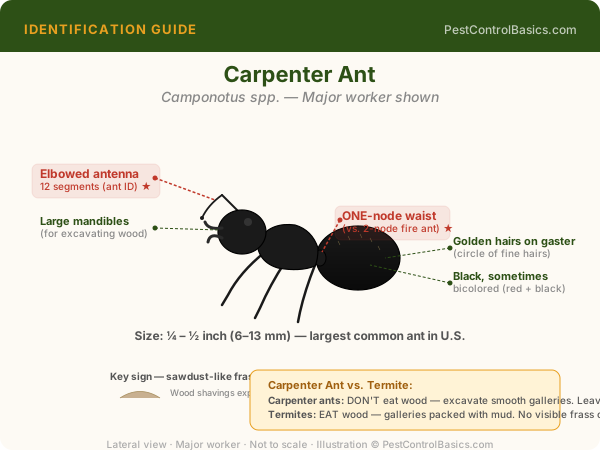
WaistOne node โ€” smooth, rounded
WingsFront wings larger than rear (vs. termite)
FrassCoarse sawdust + insect parts (not termite frass)
Nests InMoist wood โ€” not dry wood
ActiveNighttime foragers โ€” watch after 9pm
Root CauseMoisture problem โ€” find it first
vs. TermiteAnts have elbowed antennae & pinched waist
๐Ÿ“ FIELD GUIDE ILLUSTRATION
Carpenter ant (Camponotus spp.) identification illustration with labeled anatomical features โ€” PestControlBasics.com

Original illustration by PestControlBasics.com. Use anatomical labels above to confirm your identification.

Biology & Key Facts

They don't eat wood โ€” they excavate it

This is the most important distinction: carpenter ants do not consume wood for food the way termites do. They excavate galleries through moist, softened wood to create nesting space. They feed on other insects, honeydew from aphids, and food scraps โ€” not the wood itself.

The frass (debris) they push out of galleries is a telltale sign: coarse sawdust mixed with insect body parts and soil. Termite frass (for drywood species) is fine, 6-sided pellets. Subterranean termite galleries contain no frass โ€” the wood is hollowed out cleanly. Carpenter ant galleries are smooth-walled, almost sandpaper-smooth inside.

๐Ÿ’ก The Moisture Insight โ€” Most Important Thing on This Page

Carpenter ants cannot tunnel through dry, structurally sound wood. They require wood that has been softened by moisture โ€” from roof leaks, plumbing leaks, condensation, poor drainage, or wood-to-soil contact. Finding carpenter ants inside is always a signal to investigate for a moisture source. Treat the ants without finding the moisture, and they will return. Find and fix the moisture source, and the infestation often resolves without chemical treatment.

Parent Colony vs. Satellite Colony

Carpenter ant infestations almost always involve two colonies: a parent colony located outdoors in a dead tree, stump, or log โ€” and one or more satellite colonies inside the structure, where workers move to exploit food sources and warmer nesting conditions. The satellite colony inside your home contains workers and larvae but usually no queen. Treating only the satellite colony without finding the parent will result in continuous replenishment of the indoor population.

Identification Guide

Carpenter ant or termite? It matters enormously.

These two pests are commonly confused โ€” and the treatment protocols are completely different. Here's how to tell them apart definitively.

Body Shape
Carpenter ant: three distinct body segments, pinched "waist" (petiole). Termite worker: thick, no pinching โ€” looks like a soft white grain of rice.
Antennae
Carpenter ant: elbowed antennae with a distinct bend. Termite: straight antennae, no bend, bead-like segments.
Wings (if present)
Carpenter ant swarmers: front wings longer than rear. Termite swarmers: all four wings equal length and very long relative to body.
Frass / Debris
Carpenter ant: coarse sawdust mixed with insect parts โ€” looks like shavings. Termite: fine 6-sided pellets (drywood) or no frass visible (subterranean).
Gallery Appearance
Carpenter ant galleries: smooth, clean walls running with the grain. Termite galleries: rough, packed with soil or fecal pellets, crossing the grain.
Activity Time
Carpenter ants are nocturnal foragers โ€” you'll see them after dark following chemical trails. Termites almost never appear in the open.
Finding the Colony

Where to look โ€” and how to track them

Follow the Foragers at Night

Carpenter ants forage primarily between 9pm and 3am. Use a red-light flashlight (ants don't see red light and won't scatter) to observe their trails after dark. Follow foragers back toward their entry point โ€” typically a gap around a pipe, window frame, or utility penetration. The entry point leads you to the satellite colony inside.

Listen for the Colony

Large carpenter ant galleries produce a faint rustling sound inside walls โ€” especially when disturbed. Tap along walls and listen for a hollow sound followed by increased rustling activity. Stethoscopes sold for this purpose (or a screwdriver handle pressed against the wall) can amplify the sound of ants moving inside.

Look for Moisture Hot Spots

Focus your inspection on any area with past or present moisture exposure. These are the most likely satellite colony locations:

๐Ÿ›€
Around Chimneys
Flashing leaks allow water to penetrate framing. Common in older homes.
Very High Risk
๐Ÿ›Œ
Below Clogged Gutters
Overflow saturates fascia boards and soffit โ€” prime carpenter ant habitat.
High Risk
๐Ÿšฝ
Around Skylights
Skylight seals fail over time โ€” slow leak saturates surrounding framing.
High Risk
๐Ÿšท
Under Sinks
Slow drain leaks saturate cabinet floors and wall framing over months.
High Risk
๐Ÿ 
Deck & Porch Framing
Where deck ledger attaches to the house โ€” water infiltration is common.
Very High Risk
๐Ÿ‘
Window & Door Frames
Failed caulking allows water into the rough opening framing over years.
Moderate Risk
๐Ÿ” The Parent Colony Outside

Search your yard for the parent colony: dead tree stumps, fallen logs, firewood piles, and hollow trees within 100 yards of your home. Removing or treating the parent colony is essential for long-term control. A colony producing thousands of workers per year will continuously replenish satellite colonies indoors if the parent is left untreated.

Treatment Protocol

The correct sequence โ€” moisture first, then bait

Step 1: Fix the moisture source. Every other step is temporary if you skip this. A carpenter ant infestation is a symptom โ€” moisture damage is the disease. Find and repair every source of moisture intrusion before applying any treatment.

Step 2: Remove the parent colony if accessible outdoors. Treat stumps with a liquid insecticide drench. Remove firewood stacks away from the structure.

Step 3: Apply bait and residual treatment.

๐Ÿ‡
Bait โ€” Reaches the Satellite Colony
Advance Carpenter Ant Bait (Abamectin)
How it works: Granule bait formulated for carpenter ants โ€” they prefer protein-based bait over sugar (unlike most ant species). Place near foraging trails and entry points. Workers carry it back to the satellite colony and feed the larvae and other workers. Slow-acting by design โ€” 48โ€“72 hours before visible kill effect, which allows maximum distribution. Do not use alongside repellent sprays.
โ˜…โ˜…โ˜…โ˜…โ˜…
Best Method
๐Ÿ’ง
Void Treatment โ€” Inside the Wall
Delta Dust (Deltamethrin) โ€” Wall Void Application
How it works: Once you've located the satellite colony location (using the wall-tapping method or by finding frass), apply deltamethrin dust directly into the wall void through a drilled hole (5/8 inch diameter). Dust disperses through the void and kills ants on contact. Seal hole after application. This is the most direct treatment for an established indoor satellite colony. Requires knowing the location first.
โ˜…โ˜…โ˜…โ˜…โ’ธ
Very Effective
๐ŸŒฟ
Perimeter Treatment โ€” Outdoor Parent Colony
Bifenthrin Liquid (Talstar, Bifen IT) โ€” Stump & Perimeter
How it works: Drench accessible parent colony locations (stumps, logs, soil around trees) with bifenthrin solution. Apply as a perimeter band around the foundation โ€” 3 feet up the wall and 3 feet out โ€” to intercept foragers before they enter. Replace every 4โ€“8 weeks during ant season. This addresses the outdoor source that continues supplying workers to indoor satellite colonies.
โ˜…โ˜…โ˜…โ˜…โ’ธ
Essential Step
โš  When to Call a Professional

If you cannot locate the satellite colony, if the colony is in a wall void you can't easily access, or if you've had carpenter ants return repeatedly over multiple years โ€” a professional inspector with a moisture meter and borescope can find colonies that DIYers typically miss. The cost of one professional inspection is far less than ongoing structural damage from a colony that was never fully eliminated.

Prevention

Make your home unattractive to carpenter ants

Wood-to-Soil Clearance

Maintain at least 6 inches of clearance between any wood structural element and soil. This is the single most effective long-term prevention strategy. Where decks, porches, or stairs contact the ground โ€” ensure there's concrete, gravel, or treated wood separating structural lumber from direct soil contact.

Firewood Management

Store firewood at least 20 feet from the structure and elevated off the ground on metal or concrete supports. Firewood piles are primary carpenter ant parent colony locations. Bringing infested firewood inside the house is a common way to introduce carpenter ants.

Moisture Management

Annual roof inspection, keep gutters clean, repair caulking around windows and penetrations every 3โ€“5 years, fix any slow plumbing leaks immediately. A moisture meter used during fall inspection to check basement framing and around bathroom walls can identify developing problems before carpenter ants do.

Tree Trimming

Branches touching or overhanging the roof provide direct access bridges. Trim all branches to maintain at least 3 feet of clearance from the roof and walls. Also inspect hollow trees within 100 feet โ€” these are common parent colony locations.

DG
Derek Giordano
Certified Pest Control Operator ยท Former Business Owner
Derek ran his own pest control company in Florida for several years, servicing thousands of regular customers. All content is based on hands-on field experience and current EPA & university extension guidelines.
🧪 Recommended Treatment Products
Ant Bait Strategy Guide Fipronil (Termidor) Boric Acid Dust
Full product guides with mixing rates, safety info, and brand comparisons. → Browse All 121 Pesticide Guides

Related Resources

๐Ÿ“š Full Pest Library๐Ÿงช DIY vs. Pro Quiz๐Ÿ’ฐ Cost Guide๐ŸŒฟ IPM Guide๐Ÿ” Find a Pro
🔗 Related Pests
Powderpost Beetle Acrobat Ant Thief Ant Carpenter Bee Ghost Ant
Compare similar pests to confirm your identification. → Use our ID Flowchart
๐Ÿ”ฎ
Reviewed by Derek GiordanoContent on PestControlBasics.com is developed with input from certified pest management professionals and cross-referenced against EPA, CDC, and university extension guidance. Last reviewed: April 2026.
๐Ÿ“š Sources: Texas A&M Fire Ant Project ยท EPA Safe Pest Control
Published: Jan 1, 2025 ยท Updated: Apr 7, 2026

Ant trail disruption: counterproductive in most cases

When an ant trail appears in a kitchen or pantry, the instinctive response is to wipe it down with cleaner and remove visible ants, but this approach often makes the problem worse. Foraging trails carry workers between the colony and a food source; wiping the trail disrupts the pheromone path and triggers scouts to find new routes, often producing multiple smaller trails replacing the original concentrated one. The better approach is to let an active trail run while placing bait near it and waiting. Ants encountering bait carry it back along the trail to the colony; trail integrity ensures bait moves efficiently back to feed larvae and the queen. After 24-48 hours of bait deployment, trail activity typically increases briefly as workers retrieve bait, then declines sharply as the colony begins to fail. Cleaning the trail prematurely interrupts this process and forces re-baiting. The discipline is counterintuitive โ€” tolerating visible ants while bait works โ€” but produces colony-level elimination rather than the temporary trail removal that wiping accomplishes.

How structural moisture issues drive pest problems most homeowners miss

A surprising fraction of pest problems are downstream of moisture issues that go uncorrected because they don't produce obvious damage. Subterranean termites require moist soil contact; correcting drainage and downspouts often reduces termite pressure more than any chemical treatment. Carpenter ants nest in damp or previously-damp wood; the colony moves in only after moisture has softened the substrate. Drain flies, fungus gnats, and springtails are all moisture-driven and resolve when the moisture source resolves. Mold mites and booklice indicate humidity that exceeds about 70%, often in unventilated bathrooms or basements. Even rodent activity correlates with moisture: rodents need accessible water and follow water-supply intrusions to bring themselves into structures. The diagnostic question worth asking on any chronic pest problem: is something wet that shouldn't be? Common offenders are clogged gutters, downspouts that drain near the foundation rather than away from it, condensate lines from HVAC systems and water heaters, slow plumbing leaks under sinks, sweating cold-water pipes in unconditioned spaces, and crawlspaces without adequate vapor barriers. Fixing the underlying moisture issue typically yields permanent improvement that chemical treatment alone cannot match.

Carpenter ants and what they're really telling you

Carpenter ant activity is sometimes treated as a standalone pest problem, but it's almost always a symptom of underlying moisture or wood condition issues that deserve attention. Carpenter ants excavate galleries in wood that's already softened by moisture or decay; they don't initiate damage in sound dry wood. Finding carpenter ant activity indoors implies that somewhere in the structure, wood is wet or has been wet โ€” a slow plumbing leak, a window flashing failure, ice dam damage from a previous winter, condensation in an unventilated wall cavity, or roof leak in an attic. Eliminating the visible carpenter ants without finding and correcting the moisture source produces temporary results: the existing colony dies, but new colonies establish in the same damp wood. The diagnostic worth pursuing involves walking the perimeter looking for sources of water intrusion, checking under sinks and around toilets, inspecting attic for any roof leaks, and tracing carpenter ant frass (which looks like coarse sawdust) back to its source. Repairing the moisture issue and treating the ants together produces durable results.

Nuptial flights: what swarming ants tell you about pressure

Most ant species produce reproductive swarms โ€” winged males and females leaving the colony to mate and establish new colonies elsewhere โ€” and the timing of these flights is one of the most useful diagnostic signals in residential ant management. A nuptial flight near or inside a structure indicates that a mature colony exists nearby, often within a few hundred feet, and that new colonies are about to be established in surrounding areas. For species that infest structures, this is the moment at which exclusion work has the highest leverage: sealing gaps now prevents the new mated queens from finding harborage in walls and voids. Different species swarm at different times of year and under different conditions, with most species favoring warm, humid post-rain afternoons. Recognizing the swarm event, identifying the species from the alate morphology, and acting on exclusion within the same season is dramatically more effective than waiting until the new colonies announce themselves as visible trails six months later. Homeowners who learn the swarm patterns for their specific region can use the events as a calendar trigger for inspection and prevention rather than treating them as the curiosity they're often dismissed as.

Pet-safe pest control: what the label actually communicates

Pet-safe is a marketing phrase that does specific work, and the work it does is narrower than most pet owners assume. A product labeled pet-safe is generally one that, when used according to label directions and after the specified re-entry interval, presents a low risk of acute toxicity to pets at expected exposure levels. That is not the same thing as zero risk, and it doesn't say anything about chronic exposure, behavioral effects, or exposure to pets with unusual physiology, age, or pre-existing conditions. The other thing it doesn't account for is real-world misuse: pets that lick treated surfaces immediately after application, products applied in higher concentrations than directed, or applications in locations the label didn't anticipate. The practical interpretation is that pet-safe products are a reasonable choice when used carefully, but the safer overall practice with any pet in the home is to keep animals out of treatment areas until products are fully dry or absorbed, choose lower-toxicity formulations like bait stations over surface sprays when feasible, and ask explicitly about ingredients and re-entry intervals rather than relying on the label phrase alone.

Odorous house ants: why they're harder than they look

Odorous house ants are one of the most commonly misidentified household ant species, and the misidentification often leads to treatment failure. These ants have multiple queens per colony, satellite nests in multiple locations, and the ability to relocate the colony rapidly if disturbed, which means that spray treatments often produce a brief reduction followed by relocation and re-emergence in a new location nearby. The right approach for odorous house ants is non-repellent bait, applied where foragers are active, with explicit avoidance of any contact spray that would disrupt the trail and trigger relocation. Bait acceptance can be slow with this species, often taking days to a week before colony-level effects appear, and treating impatience by switching to a faster-acting spray is precisely the mistake that creates a chronic problem. Homeowners frustrated with persistent small ant infestations are very often dealing with odorous house ants treated repeatedly with the wrong approach; switching to a bait-only protocol and tolerating the slower onset typically resolves problems that years of spraying could not.

๐Ÿ—บ๏ธ US Distribution โ€” Carpenter Ants

Common Occasional Not Present
States Present
32
Occasional
6
Primary Region
Eastern United States
๐Ÿ“Š Source: University extension services, USDA, CDC vector data, and published entomological surveys.