The short answer
- Mud tubes running up a foundation from the soil point to subterranean termites. Native subterranean swarmers are small, about 3/8 inch long with the wings, with dark brown to black bodies.[2][1][8]
- Tan or yellowish-brown swarmers about half an inch long, flying to lights at night in late spring, are usually Formosan termites or, near the Gulf Coast, southeastern drywood termites. The wings, the head color and whether pellets turn up separate the two.[1][4]
- Small piles of hard, six-sided pellets of uniform size below tiny holes in wood mean drywood termites.[3][2][1]
- Large termites in wet, rotting wood near a leak or soil contact are dampwood termites, and they signal a moisture problem.[2][11][8]
- A dark, hard, bumpy nest on a tree, fence or the ground with tunnels running across surfaces, in south Florida, may be the invasive conehead termite. Report it to the Florida Department of Agriculture and Consumer Services.[10][12]
Termite profiles on this site
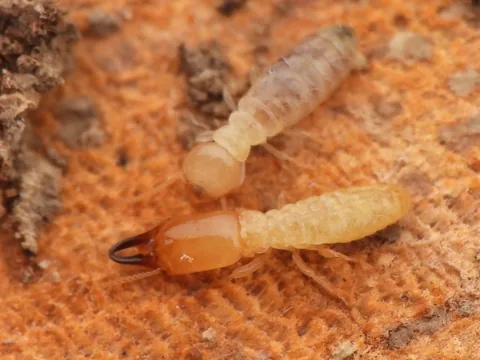 Eastern Subterranean Termite
Reticulitermes spp. (shown: R. flavipes)
Subterranean termites live in the soil and travel into buildings through earthen shelter tubes; they are the most destructive termites in most of the United States and usually warrant a professional.
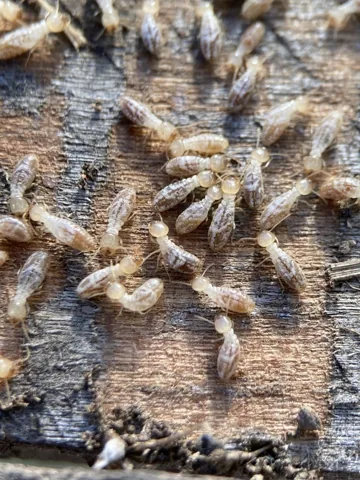 Western Subterranean Termite
Reticulitermes hesperus
The western subterranean termite lives in soil and travels through mud tubes to feed on wood, including the lumber in houses. Its genus, Reticulitermes, holds the most destructive termites found in California and ranks among the most economically important wood-destroying pests in the western United States.
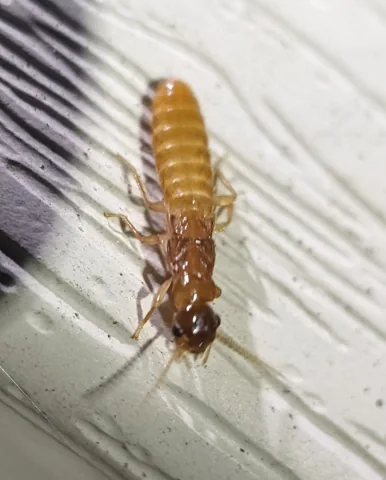 Formosan Subterranean Termite
Coptotermes formosanus
The Formosan subterranean termite is an invasive species from East Asia and one of the most aggressive and economically damaging termites in the world; its colonies are much larger than those of native subterranean termites. EPA lists it among the less common termites in the U.S., behind the native subterranean termite.
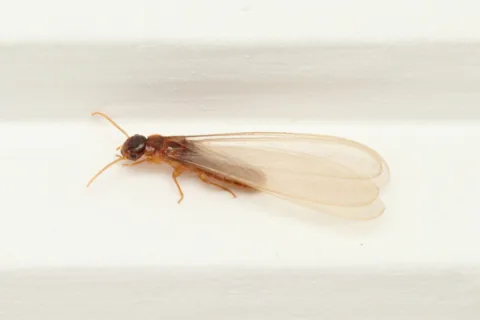 Asian Subterranean Termite
Coptotermes gestroi
The Asian subterranean termite is a very destructive tropical termite, considered second only to its relative the Formosan subterranean termite. In the U.S. both invasive Coptotermes species are established in Florida, and the Asian species has spread beyond South Florida, where it was first confined.
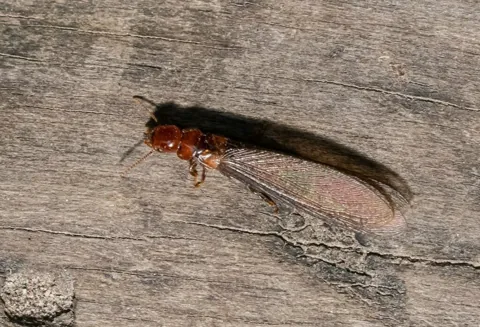 Western Drywood Termite
Incisitermes minor
Drywood termites live entirely inside wood without needing soil contact; the western drywood termite is California's second most important termite pest after subterranean termites. Clemson Extension says drywood termites get the moisture they need from humid air and are most common along humid coastal areas of South Carolina.
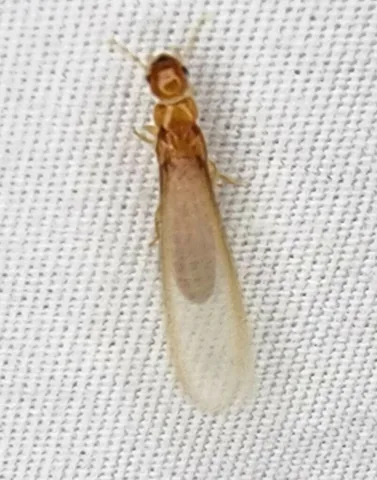 Southeastern Drywood Termite
Incisitermes snyderi
The southeastern drywood termite is the most common drywood termite in Florida and in Texas. It lives inside dry, sound wood in dead trees and in buildings, and its pale swarmers fly toward lights at night.
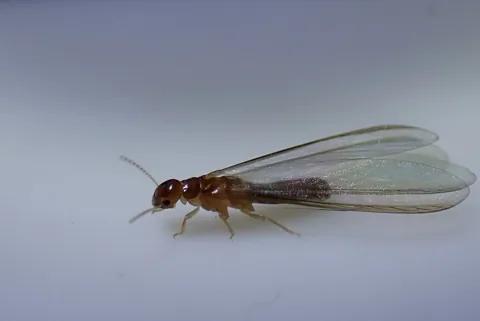 West Indian Drywood Termite
Cryptotermes brevis
The West Indian drywood termite lives its whole life inside dry wood and never needs soil. Extension entomologists describe it as almost never found in natural settings, only in the wood of buildings, furniture and picture frames, and it travels mostly when people move infested wood.
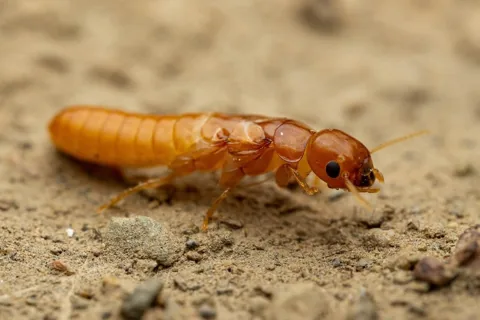 Light western drywood termite
Marginitermes hubbardi
Arizona has two drywood termites that matter, and the light western drywood termite is the one built for the low desert. It tolerates and prefers conditions much drier than the dark western drywood termite, lives below about 4,000 feet from Phoenix to Tucson and along the Colorado River, and in the southern part of its range it is now found more often in wooden buildings than in the saguaro skeletons and streambed cottonwoods it evolved on. The University of Arizona calls its damage there extensive enough to threaten a building's structural integrity.
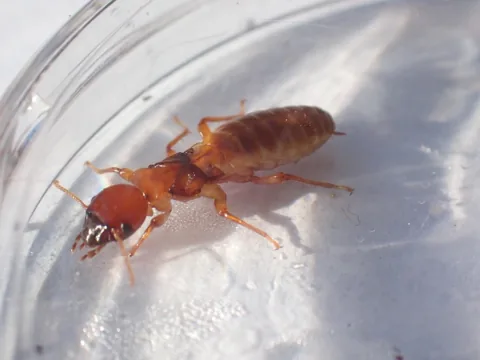 Dampwood Termites
Zootermopsis angusticollis
Dampwood termites live and feed in wet or rotting wood and don't nest in dry, sound lumber. Finding them in a building points to a leak, wood touching soil, or another moisture problem that needs fixing.
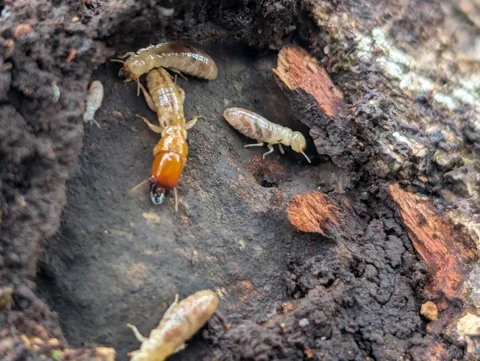 Florida Dampwood Termites
Neotermes castaneus, N. jouteli and N. luykxi
Florida dampwood termites are Neotermes termites of southern Florida and the Keys. They live in moist, mostly dead wood in trees, logs and stumps, and one species occasionally turns up in damp foundation timbers of buildings.
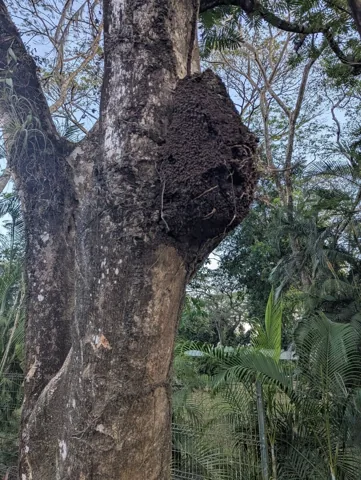 Conehead Termite
Nasutitermes corniger
The conehead termite is an invasive tropical termite that builds nests in trees and travels in tunnels over the surface. Florida is working to eradicate it from the two areas of Broward County where it has been found. Unlike most U.S. termites, it builds dark, bumpy nests in plain sight and runs covered tunnels across the ground, up trees and over walls.
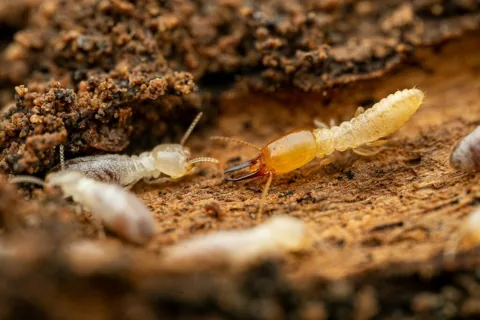 Desert Subterranean Termite
Heterotermes aureus
The desert subterranean termite is the most common and by far the most destructive termite in Arizona, and researchers call it the most economically important termite pest there. It lives in the soil and builds mud tubes to reach wood, from cactus ribs and fence posts to the timbers of houses.
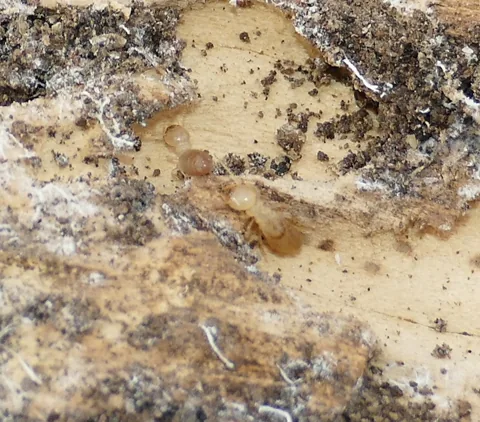 Arid-land subterranean termite
Reticulitermes tibialis
Where the Sonoran desert gives way to higher, cooler country, the subterranean termite in the walls is usually this one. The arid-land subterranean termite ranges across the semi-arid prairies, steppes and deserts of the Great Basin and the Rocky Mountains, east as far as Indiana and west into California, and in Arizona it is found throughout the state and is the most common termite pest around Flagstaff. It belongs to Reticulitermes, the most widespread and destructive termite genus in the United States, though it is less persistent at tubing up into buildings than its relatives and prefers wood that is already damp.
No photo yet
Cuban Subterranean Termite
Prorhinotermes simplex
The Cuban subterranean termite, Prorhinotermes simplex, lives in moist logs in swampy areas of southern Florida. The USDA Forest Service's eastern forest insect manual says it has been known to attack the woodwork of buildings, but extremely rarely.
No photo yet
Florida Darkwinged Subterranean Termite
Amitermes floridensis
The Florida darkwinged subterranean termite is a small subterranean termite found in central Florida. Since 2022 it has been classed as Amitermes wheeleri, Wheeler's termite, a species of arid lands in the Southwest that is not a serious structural pest.
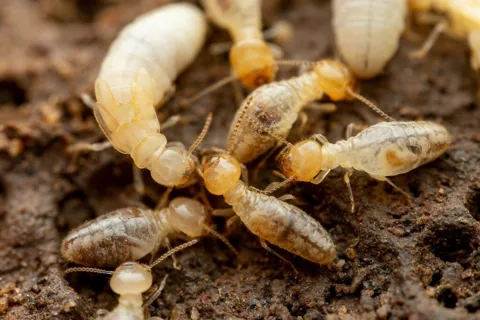 Desert termites
Gnathamitermes
Find a dead shrub, a fence post or a patch of dried grass in the Sonoran Desert plastered with thin sheets of sand and soil, and you have found desert termites at work. Gnathamitermes perplexus is extremely common there, feeding on dead grasses, weeds, small shrubs and even cow chips under the cover of its tubes, and the University of Arizona's termite guide rates it a nuisance at most: it will not cause structural damage to a home, and any feeding on the weathered outer layer of wood is cosmetic. Texas A&M says the same of the desert termite of western Texas, which does not damage structures and rarely harms rangeland, crops or turf.
No photo yet
Wheeler's desert termite
Amitermes wheeleri
Wheeler's desert termite is the other 'desert termite' of the Southwest, a cousin of the mud-sheet builder Gnathamitermes that lives near washes and dry streambeds and shows itself as dark carton on a dead cholla stump, the base of a mesquite or a fence post. It eats deeper into wood than Gnathamitermes does, but the University of Arizona still ranks it a nuisance at most: it will not cause structural damage to a home, and treatment is unnecessary unless it turns up in a structure.
What to look at first
Texas A&M AgriLife says soldiers and winged swarmers are the castes used to identify termites. Workers are pale and look much alike: Mississippi State says Formosan workers are very similar to eastern subterranean workers, with no eyes and no pigmentation.[4][1]
Swarmers drop their wings soon after flying, and Texas A&M says the wings are needed for proper identification, so save a few winged termites if you can. Mississippi State suggests preserving swarmers in ethyl alcohol and sending them to an extension lab when you aren't sure.[5][1]
Make sure it is a termite first. Kentucky Extension says termites have straight antennae, a uniformly thick waist and wings of equal size, while ants have elbowed antennae, a pinched waist and front wings longer than the hind wings. The swarmers-vs-ants guide has more detail.[9][4]
Where the termites live narrows it down too. Mississippi State and UC IPM both describe subterranean termites as soil nesters that build shelter tubes, and drywood and dampwood termites as wood nesters that need no soil contact.[1][2][3]
Subterranean termites (eastern, western and other native species)
These are the termites most homes deal with. Mississippi State calls the eastern subterranean termite (Reticulitermes flavipes) its most common termite and says it occurs through much of the eastern United States; NC State says subterranean termites are North Carolina's main problem; UC IPM says Reticulitermes species are the most destructive termites in California.[1][7][2]
Swarmers: Mississippi State describes eastern subterranean swarmers as about 3/8 inch long including the wings, with dark brown to black bodies and white or translucent wings that extend well beyond the abdomen. The Pacific Northwest handbook gives the western subterranean termite (R. hesperus) swarmer as about 0.38 inch with the wings, dark brown to black with brownish-gray wings.[1][8]
When they swarm: Mississippi State says eastern subterranean termites usually swarm in the morning and mostly in spring, with peak flights from late February to early April near the coast and April through June in the north of the state. UC IPM says western Reticulitermes swarm on warm, sunny days after fall or spring rains, and NC State says North Carolina's native species swarm from late winter into September or October, usually during the day.[1][2][7]
Soldiers: Mississippi State describes eastern subterranean soldiers as having large rectangular heads and heavy curved mandibles, at roughly one soldier per 50 workers. UC IPM describes western soldiers as wingless with light caramel bodies and long, narrow amber heads with no eyes.[1][2]
Workers: the Pacific Northwest handbook says western subterranean workers are creamy white and about 0.18 inch long, like a grain of rice.[8]
Several similar species occur alongside them. Clemson says the eastern and southeastern subterranean termites can only be told apart with a microscope. Mississippi State says the light southern subterranean termite (R. hageni) usually swarms in fall and has light brown swarmers that can be mistaken for Formosan termites, although they are smaller.[6][1]
Signs: UC IPM says shelter (mud) tubes are the most commonly seen evidence of subterranean termites, and that breaking one open may show workers and soldiers running through it. Texas A&M says subterranean termites eat only the soft springwood, leaving layered damage with soil in the galleries.[2][5]
Formosan subterranean termites
The Formosan termite (Coptotermes formosanus) is an invasive subterranean termite. Mississippi State says it was first detected there in 1984 and was introduced in infested railroad crossties; Clemson describes infestations in Charleston County, Hilton Head Island and Orangeburg tied to infested lumber; UC IPM says it is established in California only in a small area near San Diego.[1][6][2]
Swarmers: Mississippi State says they are about half an inch long with the wings and tan to light brown; Texas A&M says yellowish brown and 12 to 15 mm (0.5 to 0.6 inch) long. Both say they swarm at night and are drawn to lights.[1][4]
Swarm timing differs by place and source. Mississippi State says late April through mid-May in south Mississippi, usually within a week or so of Mother's Day, delayed into June in the center of the state, with the season lasting only a few weeks. Texas A&M says early May through June.[1][4]
Wing hairs: Texas A&M describes a dense covering of gold to reddish hair on the transparent wings. Mississippi State says the many small dark hairs on the wings and body can only be seen through a good microscope, but they make the wings look less clear than those of drywood swarmers.[4][1]
Soldiers are the easiest way to confirm it. Mississippi State and Texas A&M both describe a teardrop-shaped head with large mandibles, unlike the rectangular head of native subterranean soldiers. Mississippi State says Formosan colonies have about one soldier for every ten workers, so a colony full of soldiers is a good hint. Texas A&M says the soldiers ooze a sticky white fluid from the front of the head when disturbed, and that the bite and fluid are harmless to people.[1][4]
Carton nests: both sources say Formosan termites can build above-ground nests of carton, a hard material of chewed wood, soil, saliva and feces, in wall voids where moisture is available. Mississippi State says such nests can survive cut off from the soil and are not controlled by soil treatments or in-ground bait stations.[1][4]
Drywood termites
UC IPM says drywood termites infest dry, sound wood, including structural lumber, furniture, fences and dead tree limbs, and most never connect to the soil. Colonies are small, usually fewer than 1,000 individuals. Mississippi State says an infestation may be limited to a single piece of wood or furniture.[3][2][1]
Pellets are the giveaway. UC IPM describes them as elongate with rounded ends and six flattened sides separated by ridges, pushed out through kickout holes smaller than 2 mm across. Texas A&M says they are about 1/32 inch long and take the color of the wood. Mississippi State warns not to confuse them with cockroach droppings, which vary in size and shape, while termite pellets are uniform.[3][5][1]
Damage: Texas A&M says drywood termites eat both the hard summerwood and soft springwood, leaving smooth, sculpted galleries with pellets in them rather than soil.[5]
- Western drywood termite (Incisitermes minor): UC IPM says it is the most common drywood termite in California, found along the Pacific coast into the Central Valley and southern deserts, and swarms during the daytime in summer and fall. Mississippi State says it has become established in parts of Florida and New Orleans and turns up elsewhere in moved furniture.[3][1]
- Southeastern drywood termite (Incisitermes snyderi): Mississippi State says the swarmers are yellow to light brown, about 7/16 inch long with the wings, and fly in May and June, mostly at dusk. Their head is the same color as the body, the body looks smooth and shiny and the wings clear; Formosan swarmers usually have a darker head. Texas A&M also gives 7/16 inch and night flights toward lights.[1][5]
- Drywood soldiers: Mississippi State says southeastern drywood soldiers have stout mandibles with small, irregular teeth along the inner edges, which Formosan and eastern subterranean soldiers lack. Texas A&M says the West Indian drywood termite (Cryptotermes brevis) soldier has a square black head with very short mandibles.[1][5]
- West Indian drywood termite: Mississippi State and Clemson both describe it turning up in structures, usually brought in with infested furniture, and Clemson says it has never been recorded in natural habitats in South Carolina.[1][6]
- Wings: Texas A&M says some drywood swarmers are the same honey-brown color and size as Formosan swarmers, but their wings are clear, lack hairs, and have several cross veins in the outer veins.[4]
Dampwood termites
Dampwood termites are the biggest of the group. eXtension describes them as creamy white to brownish and usually 1/2 to 5/8 inch long; the Pacific Northwest handbook says Pacific dampwood termite swarmers can exceed 1 inch including the wings and are the largest termites in the region.[11][8]
UC IPM says they infest decayed wood kept moist by soil contact or a water leak, make large, open galleries, and are most common in cool, humid coastal areas; their presence signals a moisture or decay problem. In California these are Zootermopsis species, which UC IPM says swarm in summer and fall like drywood termites but are larger and come to lights after dark.[2][3]
eXtension says Zootermopsis species live in the Pacific Northwest and Neotermes species in Florida and coastal southwestern states. The Pacific Northwest handbook says dampwood termites are more common in western Washington and Oregon.[11][8]
Their pellets differ from drywood pellets. UC IPM says dampwood pellets are football-shaped without the clear ridges, and eXtension says they are moist enough to crush between your fingers and often clump into a paste.[3][11]
Both UC IPM and eXtension say the fix is to correct the moisture source and replace damaged wood.[3][11]
Conehead termites (south Florida)
The conehead termite (Nasutitermes corniger) is native to Central and South America and the Caribbean. A 2019 study in the Journal of Economic Entomology says it was discovered in 2001 near a marina in Dania Beach, Florida, and a second infestation turned up in January 2016 in Pompano Beach, about 21 km north; genetic results point to one introduced colony spread by people moving infested material within Broward County.[12][10]
Soldiers: eXtension says conehead soldiers are small, about 5 mm, with a dark brown, pointed cone on the head that secretes a sticky, sap-like defensive fluid, and that about 20% of a colony are soldiers, a higher share than in other termites.[10]
Swarmers: eXtension says they have dark brown bodies and dark brown wings and measure 15 to 18 mm with the wings, much larger than the Florida darkwinged termite (Amitermes floridensis), which also has a dark body and wings.[10]
Nests and tunnels: unlike subterranean and drywood termites, conehead termites mostly live above ground. eXtension describes nests up to 3 feet across, dark brown to black, hard and bumpy, on trees, the ground, debris or buildings, linked by tunnels about half an inch wide that run over the ground, up trees and along walls. A 2025 paper with Florida Department of Agriculture coauthors adds that underground nests and tunnels are common in parts of Broward County.[10][13][12]
eXtension asks anyone who suspects conehead termites to report them to the Florida Department of Agriculture and Consumer Services, says standard subterranean and drywood treatments won't work on them, and notes they do not respond to borate treatments.[10]
Desert termites
In the desert Southwest, other termites turn up. UC IPM says Heterotermes aureus is the most destructive subterranean termite in California's Sonoran Desert, with light-brown swarmers that fly in the early evening and come to lights, and that most other desert genera are not important pests. Texas A&M says desert (agricultural) termite swarmers are brown and usually much larger than Formosan swarmers, with opaque wings, dark veins and often crinkled wing tips.[2][4]
What to do once you know which termite it is
Treatment follows the type. Mississippi State says subterranean and Formosan termites are treated with soil termiticides and in-ground baits, with the added step for Formosan termites of finding and treating any above-ground carton nest. Drywood termites call for removing infested wood, local wood treatments or tenting the whole building, depending on how far they have spread.[1]
UC IPM recommends a licensed professional for inspection and treatment, and NC State says spraying swarmers or the surface of infested wood kills only the termites you see and does not stop the infestation.[2][7]
- Swarmers indoors right now: the termite swarm guide explains what it means and what to save for identification. Kentucky Extension says swarmers indoors almost always mean an infestation.[9]
- Not sure if it's a termite or an ant: compare the antennae, waist and wings in the swarmers-vs-ants guide.[9][4]
- Damaged wood: the termite damage guide shows how subterranean, drywood and dampwood damage and other wood pests differ.[2][5]
- Comparing bids or methods: the termite treatment options guide compares liquid treatments, baits, fumigation and spot treatments for each type.[1][2]
Common questions
- What are the main types of termites in the United States?
- The groups found in homes are subterranean termites (including the invasive Formosan termite), drywood termites and dampwood termites. The conehead termite is an invasive species found so far only in Broward County, Florida.[1][2][3][12]
- How can I tell a Formosan termite from a native subterranean termite?
- Look at the soldiers. Formosan soldiers have teardrop-shaped heads, and colonies have about one soldier per ten workers; eastern subterranean soldiers have rectangular heads, at about one per 50 workers. Formosan swarmers are also larger and paler, and they fly at night toward lights.[1][4]
- Which termites leave piles of pellets?
- Drywood termites. Their hard pellets have six flattened sides and are all the same size. Dampwood termite droppings are softer and tend to clump, and subterranean termites leave soil-packed galleries instead of pellets.[3][1][11][5]
- Which termite is the biggest?
- Dampwood termites. They are usually 1/2 to 5/8 inch long, and Pacific dampwood swarmers can be more than 1 inch long with the wings.[11][8]
- Are termites that swarm in the daytime a different kind from those at night?
- Often, yes. Native subterranean termites and the western drywood termite usually swarm in the daytime, while Formosan and southeastern drywood termites swarm at dusk or at night and are drawn to lights.[1][2][3][4][7]
Photo credits
- Eastern Subterranean Termite: (c) Sam Kieschnick, some rights reserved (CC BY) — via iNaturalist, CC BY 4.0
- Western Subterranean Termite: (c) Z, some rights reserved (CC BY) — via iNaturalist, CC BY 4.0
- Formosan Subterranean Termite: (c) ncb1221, some rights reserved (CC BY) — via iNaturalist, CC BY 4.0
- Asian Subterranean Termite: (c) Carlos Alexandre Mattos Raposo, some rights reserved (CC BY) — via iNaturalist, CC BY 4.0
- Western Drywood Termite: (c) Jeremiah Degenhardt, some rights reserved (CC BY) — via iNaturalist, CC BY 4.0
- Southeastern Drywood Termite: (c) Alexis Smith, some rights reserved (CC BY) — via iNaturalist, CC BY 4.0
- West Indian Drywood Termite: (c) Robin White, some rights reserved (CC BY) — via iNaturalist, CC BY 4.0
- Light western drywood termite: (c) Jake Nitta, some rights reserved (CC BY) — via iNaturalist, CC BY 4.0
- Dampwood Termites: Ellyne Geurts, public domain (CC0), via iNaturalist
- Florida Dampwood Termites: Damien Wallace, public domain (CC0), via iNaturalist
- Conehead Termite: (c) John Brew, some rights reserved (CC BY) — via iNaturalist, CC BY 4.0
- Desert Subterranean Termite: (c) Jake Nitta, some rights reserved (CC BY) — via iNaturalist, CC BY 4.0
- Arid-land subterranean termite: (c) Wendy McCrady, some rights reserved (CC BY) — via iNaturalist, CC BY 4.0
- Desert termites: (c) Jake Nitta, some rights reserved (CC BY) — via iNaturalist, CC BY 4.0
Sources
- Mississippi State University Extension Service, “Species of Termites in Mississippi.” extension.msstate.edu/insects/termites/species-termites-mississippi (accessed 2026-11-10)
- University of California Statewide IPM Program, “Pest Notes: Subterranean and Other Termites, Publication 7415 (May 2014).” ipm.ucanr.edu/legacy_assets/PDF/PESTNOTES/pntermites.pdf (accessed 2026-11-10)
- University of California Statewide IPM Program, “Pest Notes: Drywood Termites, Publication 7440 (August 2014).” ipm.ucanr.edu/legacy_assets/PDF/PESTNOTES/pndrywoodtermites.pdf (accessed 2026-11-10)
- Texas A&M AgriLife Extension Service, “Formosan Subterranean Termites (E-367).” extensionentomology.tamu.edu/wp-content/uploads/sites/3/2017/01/Formosan-subterranean-termites-E367.pdf (accessed 2026-11-10)
- Texas A&M University, Urban and Structural Entomology Program, “Drywood Termites.” urbanentomology.tamu.edu/urban-pests/termites/drywood/ (accessed 2026-11-10)
- Clemson Cooperative Extension, Home & Garden Information Center, “Termites of South Carolina (HGIC 2448).” hgic.clemson.edu/factsheet/termites-of-south-carolina/ (accessed 2026-11-10)
- NC State Extension, “Termites: Biology and Control.” content.ces.ncsu.edu/termites-biology-and-control (accessed 2026-11-10)
- Pacific Northwest Pest Management Handbooks (Oregon State, Washington State and University of Idaho Extension), “Wood-infesting pests: Termite.” pnwhandbooks.org/insect/structural-health/wood-infesting-insect/wood-infesting-termite (accessed 2026-11-10)
- University of Kentucky Entomology, “Termite Control: Answers for Homeowners (ENTFACT-604).” entomology.ca.uky.edu/ef604 (accessed 2026-11-10)
- eXtension Foundation, Pests in the Home, “How to Get Rid of Conehead Termites.” pestsinthehome.extension.org/termites/how-to-get-rid-of-conehead-termites/ (accessed 2026-11-10)
- eXtension Foundation, Pests in the Home, “How to Get Rid of Dampwood Termites.” pestsinthehome.extension.org/termites/how-to-get-rid-of-dampwood-termites/ (accessed 2026-11-10)
- Journal of Economic Entomology, abstract via PubMed, “Thorne and others 2019, Genetic analysis of invasive conehead termites reveals a single origin for two populations in Florida.” pubmed.ncbi.nlm.nih.gov/31504695/ (accessed 2026-11-10)
- Insects, abstract via PubMed, “Thorne and others 2025, Underground nests and foraging activity of invasive conehead termites (Nasutitermes corniger).” pubmed.ncbi.nlm.nih.gov/41465699/ (accessed 2026-11-10)