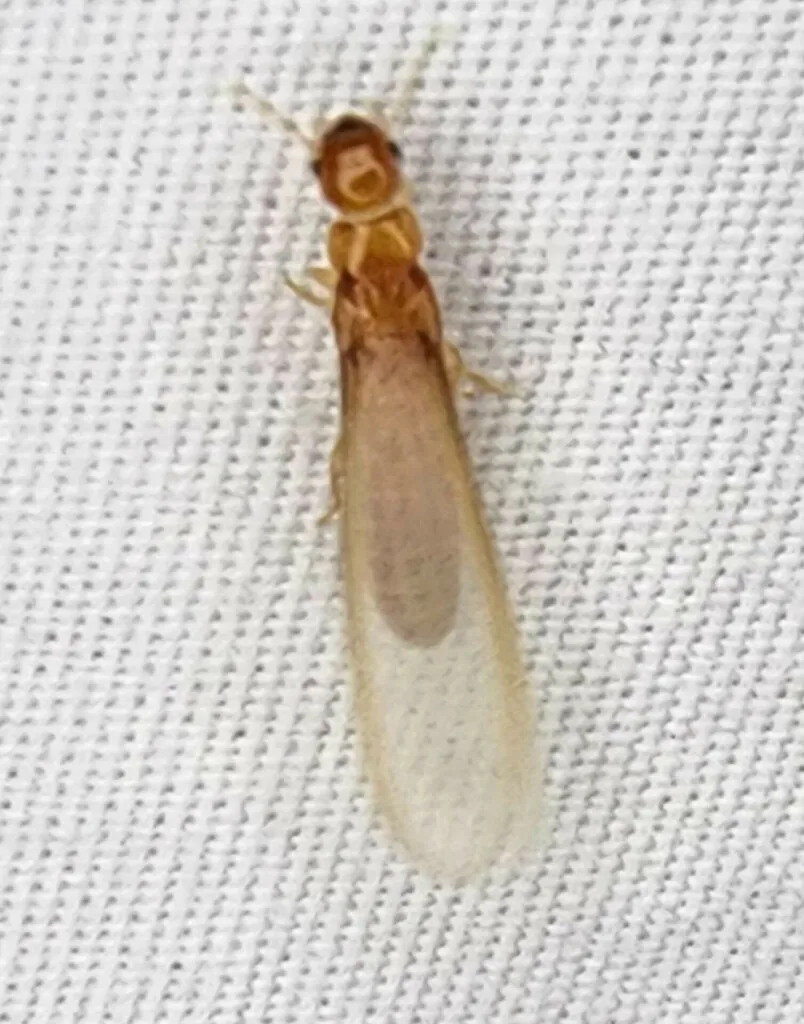
How to identify it
- Also called the southern, eastern or light southeastern drywood termite, depending on the source.[2][4][5]
- Swarmers are light yellow, about 7/16 inch long, with clear, uncolored wings.[3]
- Soldiers are about 5/16 inch long, with dark yellow-brown heads and strong jaws.[3]
- Like other drywood termites, workers and soldiers have a plate behind the head that is as wide as the head, unlike subterranean termites.[5]
- Its droppings are hard, six-sided pellets about 1 millimeter long, which pile up below infested wood.[5][2]
Look-alikes
| Look-alike | How to tell them apart |
|---|---|
| Western drywood termite | Swarmers are larger, about 9/16 inch, with dark bodies and yellow, brown or colorless wings, and they fly during the day instead of at night.[3][2] |
| West Indian drywood termite | Soldiers have a square black head shaped like a burnt match with very short jaws; it forms smaller colonies and lives only in wood in buildings.[3][1] |
| Subterranean termites | Nest in soil and build mud tubes, and the plate behind their heads is narrower than the head.[2][5] |
Where it lives
It is found in Florida and the other Gulf Coast states and in coastal South Carolina; finds farther inland, as in Tennessee, are mostly traced to wood or furniture from the Gulf.[5][4][3]
Biology and life cycle
Colonies are generally larger than those of the West Indian drywood termite, fill larger pieces of wood, and occur in both natural and human-made settings.[1][2]
Swarms usually happen at night from May through November, and the swarmers fly toward lights.[1][2][3]
Colonies grow slowly and generally don't produce swarmers until they are about five years old.[1][2]
Like other drywood termites, colonies need no soil contact or outside water source; they get their moisture from the wood they eat.[2]
In South Carolina, all recorded samples came from structures or light traps in six coastal counties, plus one inland record.[4]
Damage and signs
- It attacks dry, sound wood such as flooring, framing, window sills, doors, fascia boards and furniture, and it can infest hot attics.[1][2]
- Damage builds slowly, but it can become extensive when several colonies live in the same building.[1][2]
- Drywood termites eat both the hard and soft layers of the wood grain, leaving smooth, sculpted galleries that hold pellets but no soil.[3]
- Wood with tunnels just under the surface can look blistered and sounds hollow or papery when tapped with a screwdriver handle.[1]
Health risk
The pellets themselves aren't harmful; their importance is as evidence of an active colony slowly eating the wood.[2]
Control
Prevention
Screen attic and other vents, keep soffits in good repair, and inspect used lumber and wooden furniture before bringing them inside.[1][2]
Fill cracks and keep exposed wood painted; pressure-treated wood resists attack.[1]
Traps and physical control
A small, early infestation can be controlled by removing and replacing the damaged wood, after checking attics, baseboards, sills, joists and furniture for more.[1]
Pesticides
Spot treatments inject insecticide into drilled galleries or kick-out holes, but they miss colonies nobody knows about, and survivors can rebuild.[1][2]
Soil treatments and ground baits won't reach drywood termites, which live inside the wood.[1]
When to call a professional
Heat treatment works only if the inside of the wood reaches at least 120 degrees F long enough, so results depend heavily on the technician.[2]
Tent fumigation by a licensed fumigator is the only way to kill every colony in a heavily infested house; infested furniture can instead go to a fumigation vault.[1][2]
Common questions
- Why are small pale termites flying to my lights on summer nights?
- Along the Gulf Coast and in Florida, that is typical of the southeastern drywood termite, which swarms toward lights at night from May through November.[2][1][3]
- How do I get a termite identified?
- Collect swarmers or soldiers in a sealed container of rubbing alcohol and take them to your county Extension office; wings alone can also be used.[1][2]
- Is this the same as the western drywood termite?
- No. Both are Incisitermes species, but the western drywood termite has larger, darker swarmers that fly during the day.[3]
Sources
- University of Florida/IFAS Extension (Oi, Scheffrahn, Kern and Ruppert), “Drywood and Dampwood Termites, ENY-211 (IG098), revised February 2008 (EDIS archival copy).” journals.flvc.org/edis/article/download/117299/115411/170335 (accessed 2026-10-06)
- Cooperative Extension (eXtension Foundation), “How to Get Rid of Drywood Termites (Pests in the Home).” pestsinthehome.extension.org/termites/how-to-get-rid-of-drywood-termites/ (accessed 2026-10-06)
- Texas A&M AgriLife Extension, Urban and Structural Entomology, “Drywood Termites.” urbanentomology.tamu.edu/urban-pests/termites/drywood/ (accessed 2026-10-06)
- Clemson Cooperative Extension, Home and Garden Information Center, “Termites of South Carolina (HGIC).” hgic.clemson.edu/factsheet/termites-of-south-carolina/ (accessed 2026-10-06)
- University of Tennessee Extension, Entomology and Plant Pathology (Karen Vail), “Drywood Termites in Tennessee (Insec(tc)ure newsletter, Vol. 3 Issue 3, March 2022).” epp.tennessee.edu/wp-content/uploads/sites/267/2023/11/2022-03DrywoodV3I3.pdf (accessed 2026-10-06)
- iNaturalist, “Incisitermes snyderi taxon page (order and family).” www.inaturalist.org/taxa/261633 (accessed 2026-10-06)