How to identify it
- Soldiers have a dark, rough, blunt head shaped like a burnt match, with very short jaws; they use it to plug tunnels against ants and other intruders.[3][4][5][1]
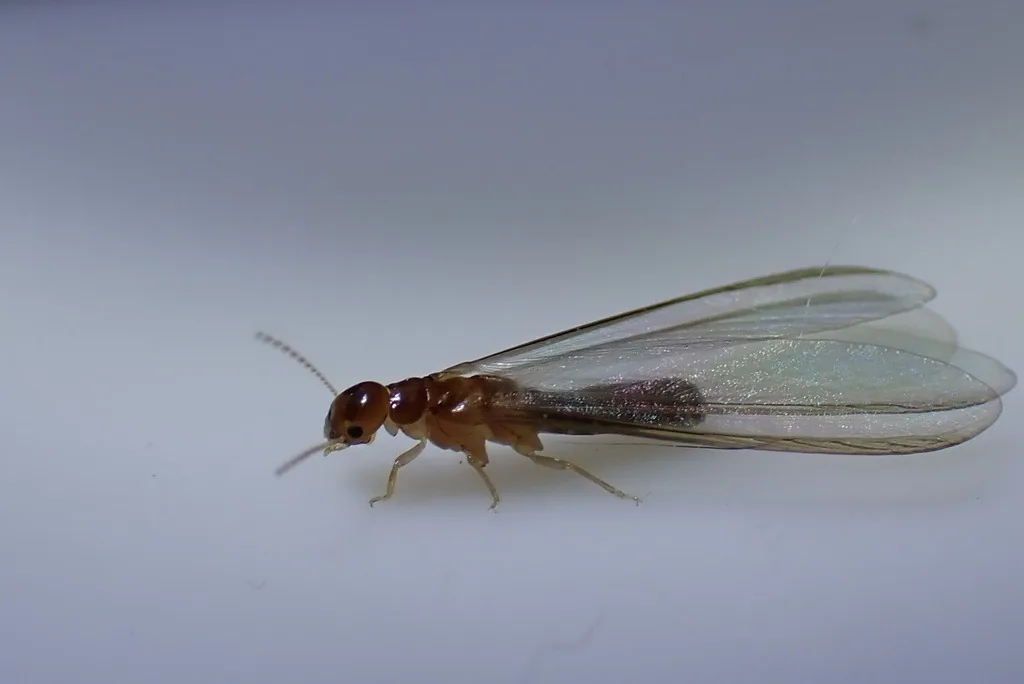
- Winged swarmers are darker than the rest of the colony and carry two pairs of hairless, strongly iridescent wings with three or four dark veins along the front edge.[1]
- As in other drywood termites, the plate just behind the soldier's head is as wide as or wider than the head itself.[1][7]
- Its droppings are tiny, hard pellets about 1 millimeter long, six-sided in cross section, and cream, red or black regardless of the wood's color.[1][4][2]
Look-alikes
| Look-alike | How to tell them apart |
|---|---|
| Western drywood termite | A much bigger species with larger colonies; soldiers have a swollen third antennal segment instead of a plug-shaped head, and swarmers have an orange-brown head and smoky wings.[2] |
| Southeastern drywood termite | Forms larger colonies in bigger pieces of wood, lives in dead trees as well as buildings, and usually swarms at night from May through November.[3][4] |
| Subterranean termites | Nest in the ground and build mud tubes, and the plate behind their heads is narrower than the head.[4][7] |
Where it lives
First recorded in Florida at Key West in 1918, it now occurs in coastal Florida, Hawaii, Puerto Rico, the U.S. Virgin Islands and the southeastern Gulf Coast, with the biggest populations in older buildings in southern Florida.[1]
Biology and life cycle
The colony lives entirely inside wood and gets its water from the wood it eats and from its own metabolism, so it needs no soil contact.[1][4]
Mating flights happen mostly from April to June but can occur in any month; afterward, pairs drop their wings and look for a crack, hole or knot in wood to start a colony.[1][4]
Soldiers first appear two to three years after a colony starts, swarmers only after about five years, and a colony can live more than ten years.[1]
Native to the coastal desert of Peru and Chile, it has never been found in natural habitat anywhere else, only in wood in human-made structures.[1][3]
Outside its core range it shows up in buildings: South Carolina has records from seven counties, none from natural habitats.[6]
Damage and signs
- It infests hardwoods and softwoods kept out of the rain, including framing lumber, furniture, picture frames, boxes and other woodwork, and it favors the outer sapwood.[1][3][4]
- Damage stays hidden inside the wood; outward signs are blistered or peeling surface wood or paint and piles of pellets below tiny kick-out holes.[1][3]
- UF/IFAS reports that nearly all structural fumigation in Florida and Hawaii is done to control this one species.[1]
Health risk
Drywood termite droppings are not dangerous the way some animal droppings are; the concern is slow damage to wood, and fresh pellets mean termites are active.[4]
Control
Prevention
Inspect used lumber, furniture and other wooden items for pellets and holes before bringing them into the house.[3]
Keep exposed wood painted after filling its cracks; pressure-treated wood also resists attack.[3]
Keep them out
Screen attic and foundation vents with fine mesh and caulk openings to keep swarmers out, though UF/IFAS notes that complete exclusion is almost impossible.[1][3]
Traps and physical control
If an infestation is caught early and confined to one piece, removing and replacing the infested wood can control it.[3]
Pesticides
Spot treatments inject insecticide into drilled holes or kick-out holes in infested wood; borate solutions sprayed on bare wood are used as a preventive.[1][3]
Soil treatments and termite baits don't work on drywood termites, because the colony lives in the wood rather than the ground.[3]
When to call a professional
Widespread or hard-to-reach infestations call for tent fumigation with sulfuryl fluoride by a licensed fumigator; it kills the colonies but leaves nothing behind to prevent new ones.[1][3][4]
Heat treatment is another option, usually for a single room or apartment rather than a whole house.[1]
Common questions
- How can I tell whether a drywood termite treatment worked?
- Clean up all pellets and wings after treatment, then watch. New pellet piles or new swarmers mean termites survived, though old pellets can still be shaken loose by vibration.[1][4]
- Can I bring drywood termites home in furniture?
- Yes. Their low moisture needs let them travel in furniture and other wood, and Tennessee cases have mostly been traced to items from Florida and other Gulf states.[1][7]
- Do I need to tent my house right away?
- Usually not. UF/IFAS says most drywood infestations are not cause for panic, so take time to compare companies and treatment options.[3][4]
Sources
- University of Florida/IFAS Extension (Gordon, Scheffrahn and Su), “West Indian Drywood Termite, Cryptotermes brevis (Featured Creatures, EENY-079/IN236).” ask.ifas.ufl.edu/publication/IN236 (accessed 2026-10-06)
- University of Florida/IFAS Extension (Cabrera and Scheffrahn), “Western Drywood Termite, Incisitermes minor (Featured Creatures, EENY-248/IN526).” ask.ifas.ufl.edu/publication/IN526 (accessed 2026-10-06)
- University of Florida/IFAS Extension (Oi, Scheffrahn, Kern and Ruppert), “Drywood and Dampwood Termites, ENY-211 (IG098), revised February 2008 (EDIS archival copy).” journals.flvc.org/edis/article/download/117299/115411/170335 (accessed 2026-10-06)
- Cooperative Extension (eXtension Foundation), “How to Get Rid of Drywood Termites (Pests in the Home).” pestsinthehome.extension.org/termites/how-to-get-rid-of-drywood-termites/ (accessed 2026-10-06)
- Texas A&M AgriLife Extension, Urban and Structural Entomology, “Drywood Termites.” urbanentomology.tamu.edu/urban-pests/termites/drywood/ (accessed 2026-10-06)
- Clemson Cooperative Extension, Home and Garden Information Center, “Termites of South Carolina (HGIC).” hgic.clemson.edu/factsheet/termites-of-south-carolina/ (accessed 2026-10-06)
- University of Tennessee Extension, Entomology and Plant Pathology (Karen Vail), “Drywood Termites in Tennessee (Insec(tc)ure newsletter, Vol. 3 Issue 3, March 2022).” epp.tennessee.edu/wp-content/uploads/sites/267/2023/11/2022-03DrywoodV3I3.pdf (accessed 2026-10-06)
- iNaturalist, “Cryptotermes brevis taxon page (order and family).” www.inaturalist.org/taxa/296455 (accessed 2026-10-06)