On this page
How to identify it
- The sign is the sheet of mud: tubes of sand, soil and feces built over desert shrubs, dead wood and grasses, under which the termites eat away the weathered exterior. Small shrubs and grasses can be consumed entirely, leaving only the hollow tubes standing.[1]
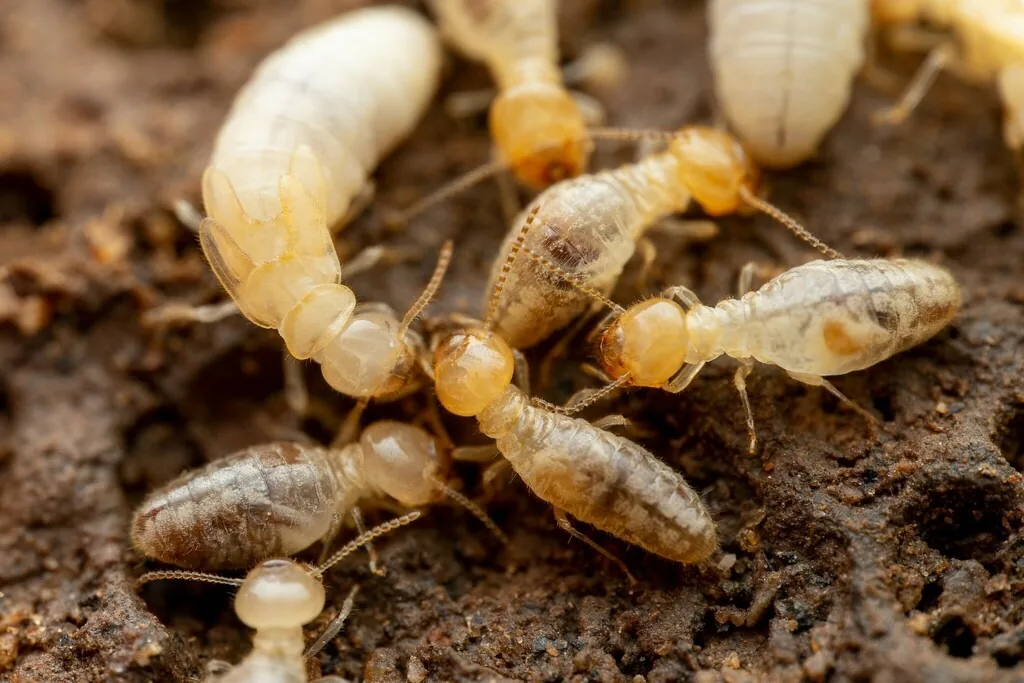
- Soldiers have sub-rectangular heads nearly as broad as long, antennae that darken conspicuously toward the tip, and nearly straight mandibles as long as or longer than the head with an obvious inner tooth below the middle. Next to a desert subterranean termite soldier, whose head is longer and more slender, Gnathamitermes soldiers have smaller, more oval heads.[1]
- Swarmers are large, a little over 1/2 inch with wings and about 1/3 inch without, with a large dark brown head, dark brown thorax and an abdomen banded alternately dark brown and cream. They fly on summer nights, often after rain showers.[1]
Look-alikes
| Look-alike | How to tell them apart |
|---|---|
| Desert subterranean termite (Heterotermes aureus) | The most destructive termite in Arizona, with slender, straight-jawed soldiers and pale swarmers that fly at dusk after monsoon rains; its tubes lead into structural lumber, not over dead grass.[1] |
| Wheeler's desert termite (Amitermes wheeleri) | The other Termitidae of the Southwest's washes and dry streambeds; it builds no exposed galleries, eats wood beyond the weathered surface and covers feeding sites with dark carton, and its soldiers have longer-than-broad heads with short curved jaws and a cone-shaped tooth near the base.[1] |
| Ants | Texas A&M's publication explains how to tell desert termites from ants and from other termite species.[2] |
Where it lives
Gnathamitermes perplexus occurs throughout Arizona, southern Nevada, southern California, far-western Texas and northern Mexico and is extremely common across the Sonoran Desert. Texas A&M calls the desert termite one of the most common termite species in western Texas, and Gnathamitermes tubiformans is the subterranean termite of Chihuahuan Desert research sites, where densities of about 800,000 per hectare have been estimated.[1][2][3]
Biology and life cycle
These are subterranean termites of the family Termitidae, confined to desert and arid lands. Colonies run on a king and queen, with the queen's abdomen swelling over years of egg production until the segments are widely separated by stretched membranes; the Arizona guide's photograph of a termite queen is a Gnathamitermes. Surface foraging, predation and swarming are all pulse-regulated by rainfall.[1][3]
They are decomposers first. In the Chihuahuan Desert, Gnathamitermes tubiformans removed more than half of the fluff grass litter from the soil surface in a year, while soil microarthropods had no measurable effect, and the colonies fix nitrogen, return it in the carton of their surface galleries, and release nutrients to the surface soil mainly through being eaten by predators, which led researchers to propose them as regulators of desert nutrient cycles. Arizona's guide adds that G. perplexus moves considerable quantities of soil to the surface each year and aerates the soil.[4][3][1]
Damage and signs
- Neither Gnathamitermes perplexus nor Wheeler's termite is a serious economic pest, and they will not cause structural damage to a home. G. perplexus can plaster its flattened tubes onto wooden structures and plants and feed on the exterior layer of the wood beneath them, but the damage is typically only cosmetic. In western Texas, desert termites do not damage structures and rarely harm rangeland, crops or turfgrass.[1][2]
Health risk
None described. Both extension sources treat desert termites as nuisance insects of dead plant material and weathered wood, not as a risk to people.[1][2]
Control
Prevention
The Arizona guide says chemical treatment is not necessary unless the termites are found in a structure; mud sheets on dead grass, shrubs or fence posts outdoors call for no action.[1]
Biological control
In University of Arizona laboratory sand assays, the entomopathogenic nematode Steinernema riobrave killed 80 percent or more of Gnathamitermes perplexus and Heterotermes aureus workers at 22 C, and S. feltiae and Heterorhabditis bacteriophora also infected and killed them; the authors called for further study rather than field use.[5]
When to call a professional
If tubes do run onto a house, have the termites identified, since the species that matters in the Southwest is the desert subterranean termite, which attacks dry sound structural wood; the Arizona guide identifies subterranean termites by their soldiers and swarmers.[1]
Common questions
- There are mud sheets all over the dead grass and a fence post in my yard. Do I need a termite treatment?
- Not for these. Desert termites eat the weathered surface of dead plants and wood under their tubes and will not damage a house; Arizona recommends treatment only if termites are found in the structure.[1]
- How do I know they are not the destructive kind?
- Desert termite soldiers have broad, nearly square heads with long straight jaws and a tooth below the middle, and their swarmers are big, banded and fly on summer nights. Desert subterranean termite soldiers have longer, slender heads, and their pale swarmers fly at dusk after monsoon rains.[1]
- Are they doing anything useful?
- Yes. They are among the main decomposers of the desert, clearing more than half the grass litter in a year in Chihuahuan Desert studies, fixing nitrogen and moving soil to the surface.[4][3][1]
Sources
- University of Arizona Cooperative Extension, “Arizona Termites of Economic Importance, az1369 (Baker and Marchosky, June 2005).” extension.arizona.edu/sites/extension.arizona.edu/files/pubs/az1369.pdf (accessed 2026-11-10)
- Texas A&M AgriLife Extension Service, “Desert Termites (publication overview).” agrilifeextension.tamu.edu/asset-external/desert-termites/ (accessed 2026-11-10)
- Oecologia (Springer), “Schaefer and Whitford. Nutrient cycling by the subterranean termite Gnathamitermes tubiformans in a Chihuahuan desert ecosystem. Oecologia 48: 277-283 (1981), PMID 28309813.” pubmed.ncbi.nlm.nih.gov/28309813/ (accessed 2026-11-10)
- Oecologia (Springer), “Silva, MacKay and Whitford (New Mexico State University). The relative contributions of termites and microarthropods to fluff grass litter disappearance in the Chihuahuan Desert. Oecologia 67: 31-34 (1985), PMID 28309841.” pubmed.ncbi.nlm.nih.gov/28309841/ (accessed 2026-11-10)
- Journal of Economic Entomology (Entomological Society of America), “Yu, Gouge and Baker (University of Arizona). Parasitism of subterranean termites (Isoptera: Rhinotermitidae: Termitidae) by entomopathogenic nematodes (Rhabditida: Steinernematidae; Heterorhabditidae). Journal of Economic Entomology 99: 1112-1119 (2006), PMID 16937662.” pubmed.ncbi.nlm.nih.gov/16937662/ (accessed 2026-11-10)
- iNaturalist, “Gnathamitermes taxon page (order and family).” www.inaturalist.org/taxa/249079 (accessed 2026-11-10)