How to identify it
- Winged adults are pale yellowish brown, about 3/8 inch long without wings and 1/2 inch with them.[1]
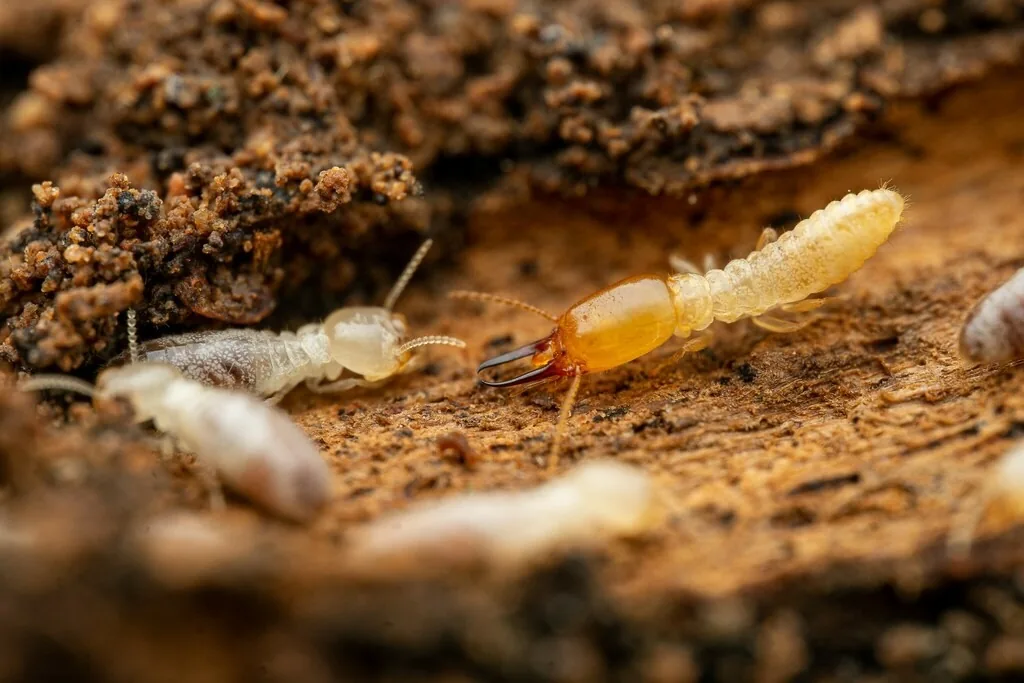
- Soldiers have jaws that are more slender and nearly straight than those of Reticulitermes soldiers, though soldiers alone are hard to identify to species.[1]
- Like other termites, swarmers have four wings of equal size and a straight, unpinched waist, unlike winged ants.[1]
Look-alikes
| Look-alike | How to tell them apart |
|---|---|
| Arid-land subterranean termite | Reticulitermes tibialis swarmers are dark brown to black with nearly colorless wings; telling soldiers apart can require dissecting the jaws.[1] |
| Drywood termites | They don't build mud tubes; piles of hard, dry fecal pellets are the usual sign, often around door and window sills.[1] |
| Winged ants | Ants have two pairs of wings of unequal size and a pinched waist behind the wings.[1] |
| Desert termites (Gnathamitermes) | Gnathamitermes perplexus coats dead grass, twigs and fence wood with thin mud sheets; soldiers have an inner tooth on each jaw, and it is generally not a pest.[1] |
Where it lives
Limited in the U.S. mostly to the arid Southwest; it is the most destructive subterranean termite in Arizona and in the Sonoran Desert of southeastern California.[1][2]
Biology and life cycle
Swarms usually fly after a rain during the summer monsoon, from July to September.[1]
Swarmers fly in the late afternoon or early evening and are attracted to lights.[2]
As a subterranean termite it lives in contact with soil for moisture, and builds tubes of soil, soft fecal matter and wood chips to reach wood above ground.[1]
Fewer than 1 percent of swarmers usually survive to start a colony.[1]
Damage and signs
- It attacks many kinds of wood, including cactus ribs, desert trees, utility poles, posts and structural timbers.[1]
- Damage builds slowly; it often takes years before structural damage is present in a home.[1]
- A mud tube on the outside stem wall is a good sign of termites, and damaged wood sounds hollow when tapped with a screwdriver.[1]
Health risk
The risk is to buildings, not people: the University of Arizona calls termites the state's number one urban pest.[1]
Control
Prevention
Keep exterior wood at least 6 inches above the soil, avoid untreated wood touching soil, and remove stumps, roots and wood scraps near the house.[1]
Slope water away from the stem wall, keep plants and irrigation lines at least 18 inches from it, and keep stucco 4 inches above the soil line.[1]
Pesticides
Bait stations with slow-acting ingredients such as the growth regulators hexaflumuron or diflubenzuron are an alternative to liquid barriers; they take patience.[1]
When to call a professional
Inspect the stem wall twice a year, in spring and late in the monsoon season, and have a professional inspect if you find mud tubes.[1]
A liquid termiticide applied to soil before the slab is poured, followed by a treated trench around the finished house, is recommended in the low desert.[1]
Common questions
- Why do termites swarm after summer storms in Arizona?
- The desert subterranean termite's winged adults fly generally after a rain during the monsoon, from July to September.[1]
- Should I treat termites myself?
- The University of Arizona doesn't recommend it; it suggests getting estimates from several pest management professionals instead of panicking, since damage develops slowly.[1]
Sources
- The University of Arizona Cooperative Extension, “Termite Management for Homeowners, AZ1356 (March 2005).” extension.arizona.edu/sites/extension.arizona.edu/files/pubs/az1356.pdf (accessed 2026-10-06)
- University of California Statewide IPM Program, “Pest Notes: Subterranean and Other Termites, Publication 7415 (May 2014).” ipm.ucanr.edu/legacy_assets/PDF/PESTNOTES/pntermites.pdf (accessed 2026-10-06)
- iNaturalist, “Heterotermes aureus taxon page (order and family).” www.inaturalist.org/taxa/296462 (accessed 2026-10-06)