How to identify it
- Soldiers are small, about 5 mm (0.2 inch), with a brown to black head drawn out into a pointed cone, called a nasus, instead of large jaws.[1][2]
- The soldier's cone squirts a sticky defensive fluid at ants and other enemies; soldiers make up about 20 percent of a colony.[1][2]
- Swarmers have dark brown bodies and dark brown to black wings, and measure about 15 to 18 mm (0.6 to 0.7 inch) including the wings.[1]
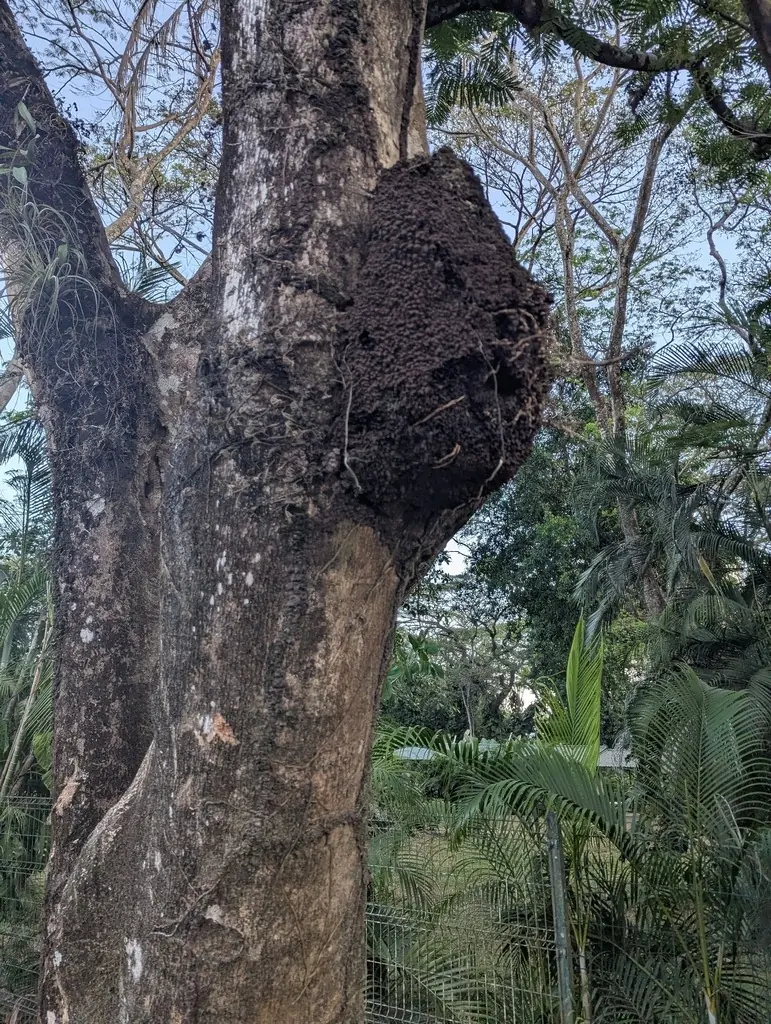
- Nests are dark brown to black, hard and bumpy, up to about 3 feet across, and look like a ball of mud but are made mostly of termite droppings.[2][1]
- Foraging tunnels run over the surface of soil, trees and walls; they are about 1/2 inch wide, and broken tunnels reveal soldiers and workers.[2][1]
Look-alikes
| Look-alike | How to tell them apart |
|---|---|
| Florida dark-winged subterranean termite | Also has dark wings, but its swarmers are only about 9 mm (0.35 inch) long including the wings, roughly half the size of conehead swarmers.[1][2] |
| Subterranean termites | Tunnel underground and build mud tubes, while conehead termites build visible nests above ground and tunnel across surfaces.[2] |
| Drywood termites | Stay hidden inside the wood they infest, while conehead termites build exposed nests and surface tunnels.[2] |
Where it lives
Native from Mexico through Central and South America and the West Indies; in the U.S., established colonies were found in Dania Beach, Broward County, Florida, in 2001.[1][2]
Biology and life cycle
It probably reached Florida on an infested boat that had traveled through its native range and docked at Dania Beach near Fort Lauderdale.[1][2]
Nests sit at the base of trees, on trunks or in high branches, on the ground, or in structures, trash piles and debris.[1][2]
Tunnel networks are highly branched and can reach more than 30 meters from a nest.[1]
Colonies often have several kings and queens, and older colonies can form satellite nests that may split off as new colonies.[1][2]
Mature colonies of more than 50,000 workers and soldiers swarm each rainy season, May to November, usually after rain; large colonies hold 800,000 to over 1.2 million termites.[1][2]
Damage and signs
- It eats dry, wet and decayed wood, both hard and soft, including load-bearing lumber, plywood, framing and trim.[1][2]
- It also feeds on dead branches of live trees, including fruit trees, along with palm leaf bases, bamboo, paper and other cellulose.[1][2]
- UF/IFAS calls it an aggressive structural pest, and colonies can cause substantial damage in a short time.[1][2]
Health risk
The concern is structural: conehead termites destroy wood and other cellulose. Soldiers defend themselves by squirting a sticky fluid rather than biting hard.[1][2]
Control
Prevention
Plan on periodic re-inspections after treatment, because young colonies can stay hidden inside wood for several years.[1]
Traps and physical control
FDACS treatment protocols may include destroying the nest along with termiticide treatment of the nest and of trees, fences and structures with active tunnels.[2]
Pesticides
Because nests are usually visible, non-repellent liquid termiticides work; researchers suggest treating foraging tubes and earlier feeding sites.[1]
Conehead termites don't respond to borate-based treatments, and heavy structural infestations may be fumigated.[2][1]
When to call a professional
Report suspected conehead termites to the Florida Department of Agriculture and Consumer Services (FDACS), which runs a Conehead Termite Program and tracks infestations.[1][2]
Work with an experienced, licensed pest management professional; standard subterranean and drywood termite treatments won't be effective against this species.[2]
Common questions
- Why is it called a conehead termite?
- The soldiers have a pointed, cone-shaped snout on the head. It was once called the tree termite, but the name changed because it nests in many places besides trees.[1][2]
- What should I do if I find a conehead termite nest?
- Don't wait: report it to FDACS, which tracks this invasive termite, and have a licensed professional who knows conehead protocols handle treatment.[2][1]
Sources
- UF/IFAS Extension (EDIS), “Conehead Termite, Nasutitermes corniger (Featured Creatures, ENY/IN1275).” ask.ifas.ufl.edu/publication/IN1275 (accessed 2026-10-06)
- Cooperative Extension (eXtension Foundation), “How to Get Rid of Conehead Termites (Pests in the Home).” pestsinthehome.extension.org/termites/how-to-get-rid-of-conehead-termites/ (accessed 2026-10-06)
- iNaturalist, “Nasutitermes corniger taxon page (order and family).” www.inaturalist.org/taxa/122701 (accessed 2026-10-06)