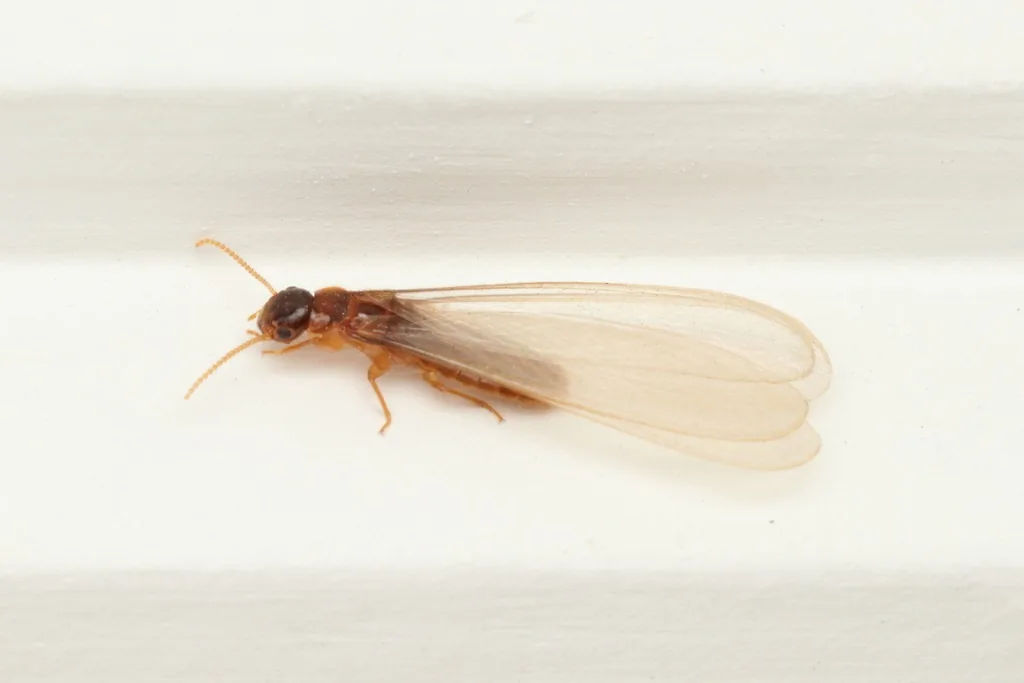
How to identify it
- Soldiers have the teardrop-shaped head and large forehead opening (fontanelle) of all Coptotermes termites, and ooze a white, milky fluid from it when disturbed.[1][2]
- Soldiers make up about 10 to 15 percent of foraging groups and bite aggressively when challenged.[1]
- Swarmers are about 13 to 14 mm long with wings, with a dark brown head, thorax and abdomen and two light spots on the face near the antennae.[1]
- Telling soldiers from Formosan soldiers takes a microscope: Asian soldiers have one pair of hairs at the rim of the fontanelle instead of two.[1]
Look-alikes
| Look-alike | How to tell them apart |
|---|---|
| Formosan subterranean termite | Swarmers are slightly larger, about 14 to 15 mm, and entirely lighter yellow-brown or orange-brown, with barely visible face spots; Formosans also swarm later in spring.[1] |
| Native subterranean termites | Workers look much alike to the eye; Coptotermes termites such as the Asian subterranean termite often pack soil into feeding galleries and fill hollow spaces with carton nest material.[2] |
Where it lives
First found in the continental U.S. in Miami in 1996; it has since been found in Key West and in Broward and Palm Beach counties, and is spreading north through Florida.[1][3]
Biology and life cycle
It is limited to tropical climates; UF/IFAS expects its U.S. range will probably not extend far beyond southern Florida.[1]
Swarms happen at dusk or at night, recorded from February to April in Florida and the West Indies, ending about when Formosan swarms begin.[1]
Porch lights, indoor lights and screens draw swarmers inside, especially through open doors and unscreened windows.[1]
Infested boats are the most likely way it spreads to new areas, when swarmers fly from the vessel to land.[1]
Where its range overlaps the Formosan termite in southeast Florida, the two species occasionally produce hybrids, which so far account for less than 1 percent of swarmers there.[4]
Damage and signs
- Damage can become severe in a relatively short time, especially when a large, mature colony invades a structure.[1]
- Swarms, foraging tubes or damaged wood are usually the first signs; advanced infestations leave carton nest material in hollowed wood or wall voids.[1]
- Hundreds to thousands of swarmers indoors usually mean the building itself is infested.[1]
Health risk
The risk is to buildings, not health: it is a very damaging termite and a threat to wooden structures. Swarmers indoors dry out and die quickly.[1]
Control
Prevention
Reduce moisture in and around the structure to remove conditions that favor subterranean termites.[2]
Pesticides
In-ground bait stations with chitin synthesis inhibitors can eliminate Coptotermes colonies, and above-ground stations can be attached to infested trees.[2]
Non-repellent liquid termiticides are applied to soil around the foundation by trenching or by drilling and injecting through the slab.[2]
When to call a professional
Use the same strategies applied to Formosan termites, such as baits and soil treatments.[1]
Hybrid colonies don't change the plan; UF/IFAS research shows current professional products work on them as well as on either parent species.[4]
Common questions
- Are hybrid super termites a reason to panic?
- No. UF/IFAS says hybrids are rare, behave like the parent species, don't cause more damage, and are controlled the same way.[4]
- How can I tell if my termites are Asian or Formosan?
- Not reliably by eye. Swarmer color helps, but soldiers differ only in microscopic hairs; UF/IFAS FLREC accepts samples for identification.[1][4]
Sources
- UF/IFAS Extension (EDIS), “Asian Subterranean Termite, Coptotermes gestroi (EENY128/IN285).” edis.ifas.ufl.edu/publication/IN285 (accessed 2026-10-06)
- UF/IFAS Extension (EDIS), “Formosan Subterranean Termite, Coptotermes formosanus Shiraki.” ask.ifas.ufl.edu/publication/IN278 (accessed 2026-10-06)
- UF/IFAS News, “New study shows invasive termites threatening homes in Florida are spreading farther than predicted (February 4, 2026).” blogs.ifas.ufl.edu/news/2026/02/04/new-study-shows-invasive-termites-threatening-homes-in-florida-are-spreading-farther-than-predicted/ (accessed 2026-10-06)
- UF/IFAS News, “Here's what homeowners need to know about hybrid termites in Florida (June 8, 2026).” blogs.ifas.ufl.edu/news/2026/06/08/heres-what-homeowners-need-to-know-about-hybrid-termites-in-florida/ (accessed 2026-10-06)
- iNaturalist, “Coptotermes gestroi taxon page (order and family).” www.inaturalist.org/taxa/209098 (accessed 2026-10-06)