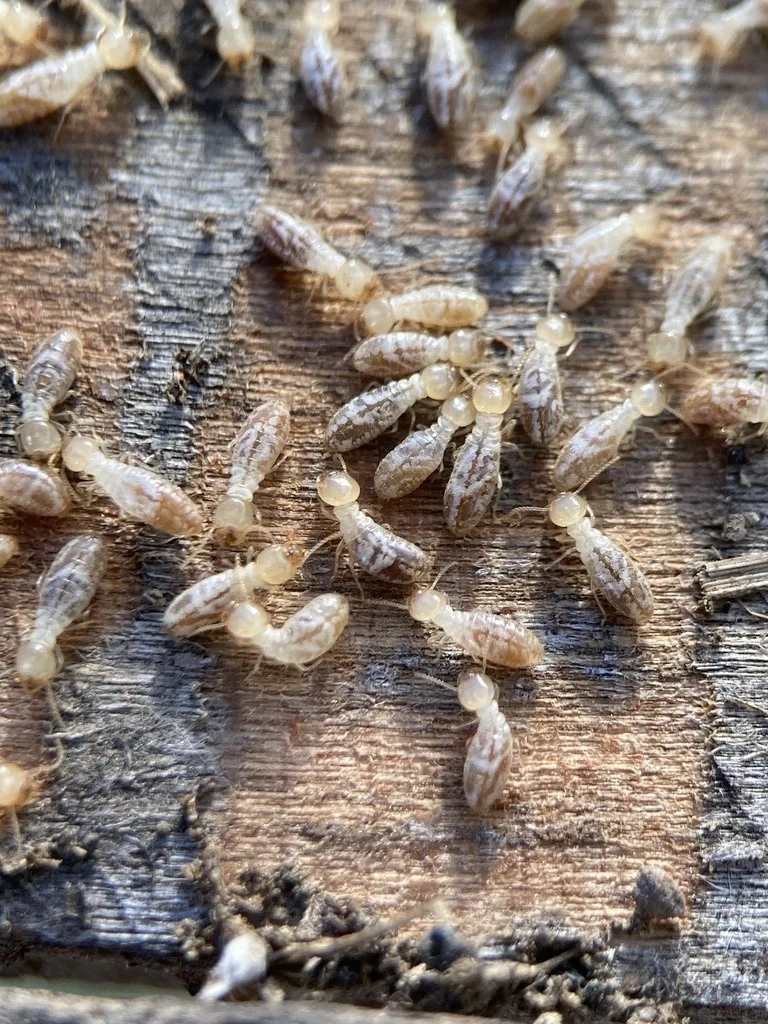
How to identify it
- Swarmers are about 3/8 inch long, with dark bodies and legs; with wings attached they measure about 10 mm.[2][3]
- Swarmer bodies are dark brown to almost black, and the wings are brownish gray with only a few hairs.[3]
- Workers are 1/4 to 3/8 inch long, wingless and pale cream; they are the termites usually seen in damaged wood.[2][1]
- Soldiers have long, light brown, rectangular heads and long, curved jaws with no teeth, on cream-colored bodies.[3]
- Winged termites have equal-length front and back wings, bead-like antennae and a broad waist, unlike winged ants.[2]
Look-alikes
| Look-alike | How to tell them apart |
|---|---|
| Winged carpenter ants | Ants have a pinched waist, elbowed antennae and front wings longer than the hind wings.[2] |
| Drywood termites | They nest in dry wood with no soil contact and push out six-sided fecal pellets instead of building mud tubes.[1] |
| Other subterranean termites | Workers of different subterranean species look alike and are of little value for identification; experts use swarmers and soldiers to name the species.[3] |
Where it lives
Known from western Mexico, California, Idaho, Nevada, Oregon, Washington and British Columbia. In California, Reticulitermes termites occur from coastal dunes to mountain elevations and even some desert areas.[3][1]
Biology and life cycle
Colonies usually live in the soil, with galleries and mud tubes leading to nearby wood; colonies with no ground connection are rare.[3]
Reticulitermes termites swarm in the afternoon in spring or fall, on clear, warm days after a soaking rain.[1]
In California these termites can forage all year; feeding is lowest from November to February and highest, though erratic, in summer.[1]
A new colony may hold only about 75 termites after a year, but mature colonies can reach hundreds of thousands.[1]
Queens and kings can live a decade or more, and workers live one to several years.[1]
Damage and signs
- It attacks many wood products as well as trees and shrubs, and it also feeds on drywall and paper-based ceiling tiles.[3][2]
- Feeding follows the grain, eating the softer springwood and leaving the harder layers; damaged wood is thin at the surface.[1][2]
- Mud tubes on foundations, blistered or darkened wood, and swarmers indoors are the usual signs of an infestation.[1]
Health risk
The concern is damage to buildings: Reticulitermes termites are the most destructive termites in California, and thousands of homes there need termite treatment every year.[1]
Control
Prevention
Remove wood-to-soil contact; keep wood siding, stucco and foam board at least 6 inches above the ground.[2]
Fix plumbing leaks, reduce humidity in crawlspaces and basements, and keep plants trimmed back from the foundation.[2]
Keep them out
Seal cracks and crevices in the foundation, and break open shelter tubes when you find them to cut off access.[2][1]
When to call a professional
Effective soil treatments in California are professional-use only; nonrepellent active ingredients such as chlorantraniliprole, fipronil and imidacloprid are applied to soil or into shelter tubes.[1]
Bait stations with slow-acting growth regulators are shared through the colony; Utah State recommends pairing baits with moisture reduction.[1][2]
Common questions
- Do swarming termites in my yard mean my house is infested?
- Not necessarily. Most soil around a home holds buried roots, stumps or fence posts that termites feed on, so a swarm in the yard alone doesn't prove the house is infested.[1]
- Can fumigation or heat get rid of western subterranean termites?
- No. Those drywood termite methods miss the colony, which lives in the soil below the house; soil treatments and baits are used instead.[1]
Sources
- University of California Statewide IPM Program, “Pest Notes: Subterranean and Other Termites, Publication 7415 (May 2014).” ipm.ucanr.edu/legacy_assets/PDF/PESTNOTES/pntermites.pdf (accessed 2026-10-06)
- Utah State University Extension, “Western Subterranean Termite, Reticulitermes hesperus (IPM nuisance pest notes).” extension.usu.edu/planthealth/ipm/notes_nuisance/termites (accessed 2026-10-06)
- County of Los Angeles Department of Agricultural Commissioner/Weights and Measures, “Western Subterranean Termite (Reticulitermes hesperus) identification sheet (March 2009).” file.lacounty.gov/SDSInter/acwm/215677_WesternSubterraneanTermite.pdf (accessed 2026-10-06). County agricultural commissioner identification sheet prepared by the department's senior biologist.
- iNaturalist, “Reticulitermes hesperus taxon page (order and family).” www.inaturalist.org/taxa/296465 (accessed 2026-10-06)