The short answer
- A true ant has three body sections, bent (elbowed) antennae and a thin, pinched waist. If any of those is missing, it probably isn't an ant.[6][1][2][5]
- Fuzzy, brightly colored red, orange, yellow or white "ant" running over bare ground in summer: a velvet ant, which is a wingless female wasp. Don't pick it up or step on it barefoot; the sting is very painful.[8][9][7]
- Eight legs, no antennae and two body parts: an ant-mimic spider. Some hold their front legs up to look like antennae. They are harmless to people.[10][12][11]
- Straight antennae, a thick waist and, on winged ones, four wings of equal size: a termite. Winged termites indoors almost always mean an infestation that needs treatment.[2][3][4]
- Others that pass for ants include tiny Sclerodermus wasps in infested wood, the ant-like sweetpotato weevil, and the young nymphs of assassin bugs, broad-headed bugs and periodical cicadas.[16][17][18][19][20]
Look-alike profiles on this site
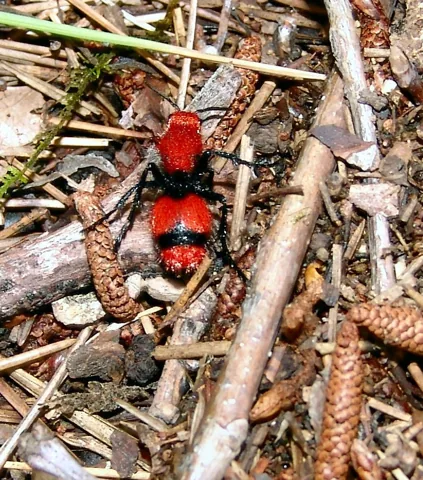 Velvet Ants (eastern velvet ant, "cow killer")
Dasymutilla occidentalis
Velvet ants aren't ants at all. They are solitary wasps in the family Mutillidae, and the wingless, fuzzy females look like large hairy ants as they run across open ground.
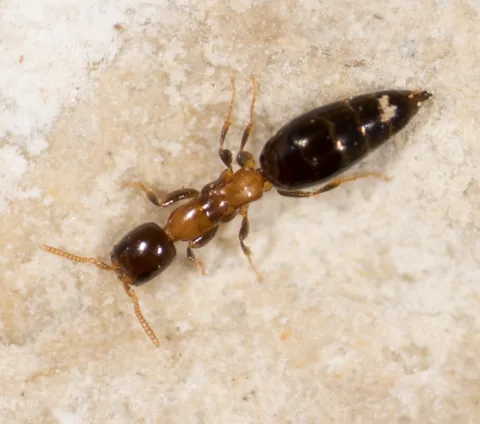 Sclerodermus Wasps
Sclerodermus species (S. carolinensis, S. macrogaster and S. ventura in North America)
Sclerodermus are tiny, ant-like flat wasps that parasitize wood-boring beetle larvae; when they share infested furniture or rafters with people, the females can sting.
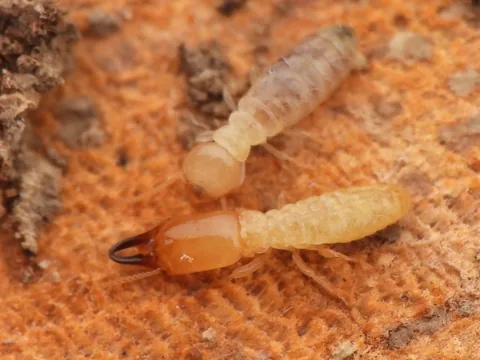 Eastern Subterranean Termite
Reticulitermes spp. (shown: R. flavipes)
Subterranean termites live in the soil and travel into buildings through earthen shelter tubes; they are the most destructive termites in most of the United States and usually warrant a professional.
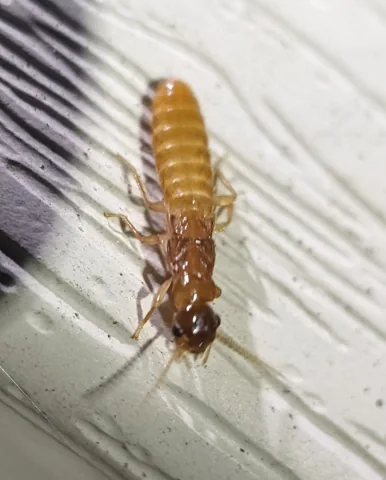 Formosan Subterranean Termite
Coptotermes formosanus
The Formosan subterranean termite is an invasive species from East Asia and one of the most aggressive and economically damaging termites in the world; its colonies are much larger than those of native subterranean termites. EPA lists it among the less common termites in the U.S., behind the native subterranean termite.
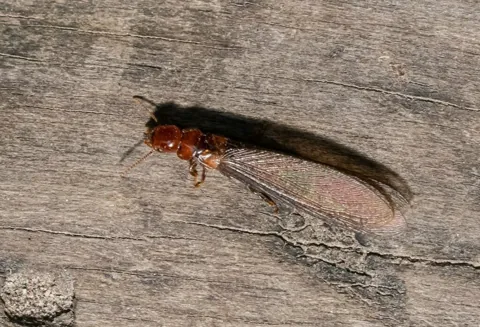 Western Drywood Termite
Incisitermes minor
Drywood termites live entirely inside wood without needing soil contact; the western drywood termite is California's second most important termite pest after subterranean termites. Clemson Extension says drywood termites get the moisture they need from humid air and are most common along humid coastal areas of South Carolina.
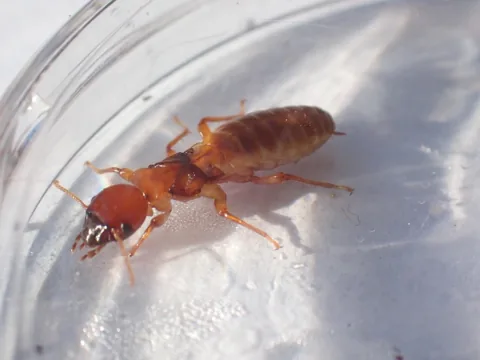 Dampwood Termites
Zootermopsis angusticollis
Dampwood termites live and feed in wet or rotting wood and don't nest in dry, sound lumber. Finding them in a building points to a leak, wood touching soil, or another moisture problem that needs fixing.
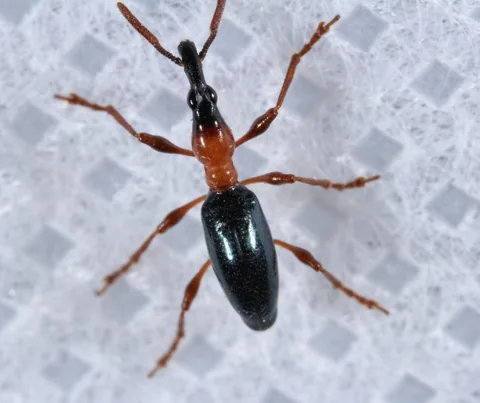 Sweetpotato Weevil
Cylas formicarius
The sweetpotato weevil is the most damaging pest of sweet potato in the country and one of the most destructive in the world. Its larvae tunnel roots in the field and keep breeding in storage.
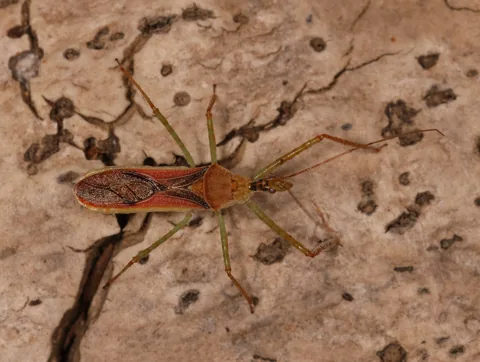 Assassin Bugs
Zelus and Sinea species (shown: Zelus renardii)
Assassin bugs are stalking and ambushing predators with a needlelike beak. They kill caterpillars, other bugs and bees alike, and they can deliver a painful bite if handled.
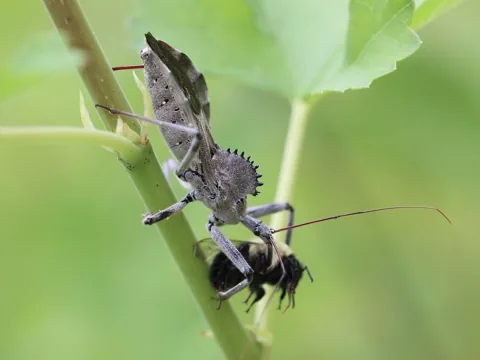 Wheel Bug
Arilus cristatus
The wheel bug is the largest assassin bug in North America, named for the toothed crest on its back. It hunts caterpillars and other insects, but it gives an immediately painful bite if handled carelessly.
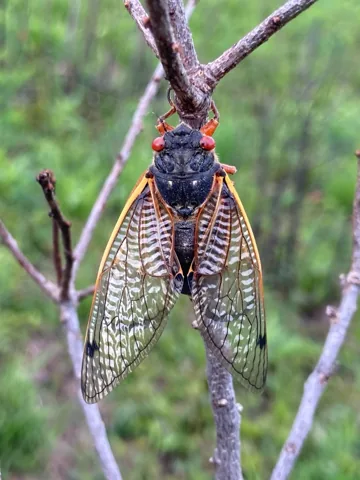 Periodical Cicadas
Magicicada species (e.g., M. septendecim)
Periodical cicadas spend 13 or 17 years underground feeding on root sap, then emerge together in huge numbers in late spring. They don't bite or sting; the real harm is egg-laying damage to small twigs, which matters most on young trees.
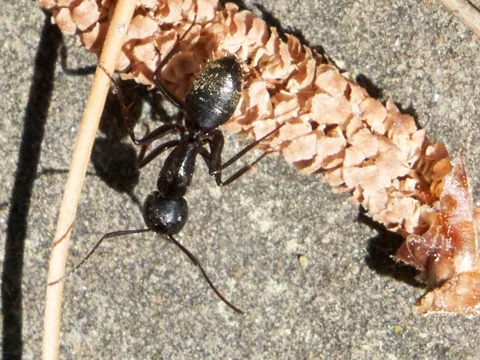 Carpenter Ants
Camponotus species
Carpenter ants don't eat wood the way termites do; they excavate it to nest, usually starting where wood is damp or decayed, and indoor nests are often satellites of a parent colony outdoors. Minnesota and Clemson extension both stress that they don't eat wood; they tunnel into it to make a nest.
Three checks that separate ants from look-alikes
Count the body sections. An ant's body is divided into three parts: a head with antennae, eyes and jaws, a middle section (thorax) where all the legs attach, and the rear section, called the gaster. Spiders have only two body parts, a head region (cephalothorax) and an abdomen, plus eight legs and no antennae.[6][10]
Look at the antennae. Ants have elbowed antennae with a sharp bend partway along. Termite antennae are straight, not elbowed; Arizona Extension describes them as often bead-like.[1][2][4]
Look at the waist. Ants have a thin, constricted waist, with the middle of the body narrowed to a tiny stalk between the thorax and the large abdomen. Termites have a broad, uniformly thick waist and a fairly cylindrical body that is only slightly narrowed behind the head.[1][2][5][4]
If there are wings, compare them. A winged ant's hind wings are smaller than its front wings. A winged termite has two pairs of equal-sized wings that fold over the back.[1][2][4]
Once you're sure it's an ant, our ant identification guide covers which household species it is and where the nest is likely to be.[1][2]
Velvet ants (cow killers): wingless wasps that sting
Velvet ants are not ants at all; they are wasps in the family Mutillidae. Both sexes are covered in dense, velvety hair in bright patterns of black with red, yellow or orange. The females have no wings and are usually seen scurrying quickly across the ground, while the winged males are not usually noticed.[8][9]
The eastern velvet ant (Dasymutilla occidentalis), the species called "cow killer" or "cow ant", is the one most people meet in the Southeast. Clemson gives its size as 3/4 inch; Mississippi State says females are up to one inch long with an average stinger length of just over ½ inch.[8][9]
In the desert Southwest there are many more kinds. The Arizona-Sonora Desert Museum counts more than 3 dozen species in the Sonoran Desert of Arizona, clothed in red, orange, yellow or silver hair; some look like moving fuzzy cotton balls, and one long-haired species is totally white.[7]
Only females sting, and winged males are harmless. The sting is extremely painful but rarely dangerous. People who have been stung by an eastern velvet ant describe it as the most painful sting of any insect in the Southeast. Velvet ants are not aggressive; stings happen when one is stepped on barefoot, sat on, rolled on in the grass or handled.[8][9]
Two more clues: velvet ants may squeak when disturbed, and they are unusually tough, hard-bodied insects that are hard to crush. Females search the ground for the nests of ground-nesting bees and wasps, such as cicada killers, and lay eggs on the young inside.[8][9][7]
Velvet ants are rarely numerous enough to be a nuisance and usually stay outdoors. Clemson says neither chemical nor mechanical control is very effective because of their tough outer shell; move one somewhere else carefully, or leave it alone.[8]
Ant-mimic spiders
Some spiders look and move so much like ants that people, and predators, mistake them. A 2011 study notes that an ant-like appearance has evolved more than 70 times in insects and spiders, accounting for more than 2,000 species.[13][15]
In North America the most often seen are the antmimic or ground sac spiders (family Corinnidae), including Castianeira. NC State's Plant Disease and Insect Clinic lists them among the most common hunting spiders people encounter and describes them as lightning fast and sometimes colorful or boldly patterned.[11][12]
The redspotted antmimic spider (Castianeira descripta) is a good example. The University of Wisconsin-Milwaukee Field Station describes males as about ¼" long, with females a little larger, and says Castianeira species appear to mimic larger ants such as carpenter ants, and also velvet ants. They don't build trap webs; they hunt on foot.[12]
Watch how it walks. The redspotted antmimic is described as walking on six legs with its front pair raised and quivering like antennae. Movement is part of the disguise: in one experiment, people shown videos had more trouble picking out ant-mimicking spiders the faster the videos played.[12][14]
Some jumping spiders mimic ants too. Peckhamia picata is a North American ant-mimicking jumping spider; in a 2011 study, predatory jumping spiders ate it less than a third as often as non-mimic jumping spiders.[13]
Count the legs if you can get a close look: eight legs and no true antennae means a spider. These spiders are not a hazard to people, and NC State notes that spiders in general are harmless and good predators of pests.[10][11]
Termites: workers and swarmers
Termites are sometimes called "white ants", but they are more closely related to cockroaches than to ants. Like ants they live in colonies near the ground, under rocks, wood and leaf litter, which adds to the confusion.[4][5]
Termite workers are the ones you find in damaged wood or mud tubes. UC IPM describes them as wingless, soft-bodied and light caramel in color; Kentucky Extension calls them small and creamy white. They have straight antennae and a thick waist, unlike the pinched waist of an ant.[3][2][5]
Swarmers (winged termites) are the most common mix-up, because termites and ants tend to swarm at the same time of year. Termites have straight antennae, a uniformly thick waist and wings of equal size; flying ants have elbowed antennae, a constricted waist and hind wings smaller than the front ones.[2][1][4]
Swarmers are attracted to light, so they often turn up around windows and doors. Kentucky Extension says finding winged termites indoors almost always indicates an infestation that warrants treatment. Our guides to termite swarmers vs flying ants and types of termites go through the details.[2][3]
Other wasps that pass for ants
Ants are close relatives of wasps, and a wasp without wings looks a lot like an ant. The reverse also happens: winged ants (the new queens and males) are often mistaken for wasps.[6]
Sclerodermus are small wasps, 0.05 to 0.25 inches (1.5 to 6 mm) long, with a flattened, ant-like look and a large, boxy head; most are wingless females. They attack wood-boring beetle larvae in infested wood, and when dozens show up indoors around infested furniture or rafters they can sting people who pick them up or trap them in clothing.[16]
Penn State describes a Sclerodermus sting as a pin-prick followed by a red, itchy welt that usually clears up in 5 to 15 days. The only way to stop recurring stings is to find and get rid of the infestation, which is easiest when it is in a piece of furniture or cabinetry that can be taken out of the home; our Sclerodermus profile has the details.[16]
Ant-like beetles and bug nymphs
The sweetpotato weevil is an ant-like snout beetle about 1/4 inch long, with metallic dark blue head and wing covers and a bright red-orange thorax and legs. It is a pest of sweet potatoes in the field and keeps feeding and breeding in stored sweet potatoes through the winter. The snout is the giveaway that it is a weevil, not an ant.[17]
Young assassin bugs often look like ants or baby praying mantises, and wheel bug nymphs, which are reddish with black legs, can look spiderlike or antlike. They are predators of other insects. Don't handle them: assassin bugs can inflict a painful bite, and crushing or slapping at them generally causes them to bite.[18]
Nymphs of broad-headed bugs (family Alydidae) closely resemble ants, according to Texas A&M AgriLife's field guide. The adults are about 3/4 inch long and yellow to dark brown.[19]
In a periodical cicada year, white, ant-like nymphs hatch six to 10 weeks after the eggs are laid in young woody stems, drop to the ground and burrow into the soil to feed on roots.[20]
What to do once you know
If it is a real ant, use our ant identification guide to work out the species and where the nest is, then follow the matching control plan.[1]
If you have termite workers or swarmers, read the termite swarmer guide and check the termite types guide for which kind you have.[2][3]
If it is a velvet ant or another wasp, see our guide to types of stinging insects for which ones sting and how to avoid them.[8][9]
Spiders, weevils and bug nymphs that only look like ants generally need no treatment; leave the predators in place, since they eat other insects.[11][18]
Common questions
- Is a velvet ant really an ant?
- No. Velvet ants are wasps in the family Mutillidae. The females are wingless, which is why they look like big, hairy ants, and they can sting hard.[8][9]
- What does it mean if an ant has straight antennae?
- Straight antennae and a thick waist point to a termite, not an ant. Ants have elbowed antennae and a pinched waist.[1][2]
- Are ant-mimic spiders dangerous?
- No. They are fast hunting spiders that are generally harmless to people and eat other small invertebrates.[11][12]
- Why do some spiders look like ants?
- Ants defend themselves well, so many predators avoid them. In studies, predatory jumping spiders ate an ant-mimicking jumping spider far less often than non-mimics, and birds avoided an ant-mimicking spider about as much as they avoided the ants it copies.[13][15]
- Can a tiny ant-like insect sting me indoors?
- It might be a Sclerodermus wasp. These small, mostly wingless wasps live in wood infested by wood-boring beetles and can sting if pressed against skin.[16]
Photo credits
- Velvet Ants (eastern velvet ant, "cow killer"): (c) Gordon C. Snelling, some rights reserved (CC BY) — via iNaturalist, CC BY 4.0
- Sclerodermus Wasps: Jesse Rorabaugh, public domain (CC0), via iNaturalist
- Eastern Subterranean Termite: (c) Sam Kieschnick, some rights reserved (CC BY) — via iNaturalist, CC BY 4.0
- Formosan Subterranean Termite: (c) ncb1221, some rights reserved (CC BY) — via iNaturalist, CC BY 4.0
- Western Drywood Termite: (c) Jeremiah Degenhardt, some rights reserved (CC BY) — via iNaturalist, CC BY 4.0
- Dampwood Termites: Ellyne Geurts, public domain (CC0), via iNaturalist
- Sweetpotato Weevil: (c) Joshua Ebright, some rights reserved (CC BY) — via iNaturalist, CC BY 4.0
- Assassin Bugs: (c) Joey Bom, some rights reserved (CC BY) — via iNaturalist, CC BY 4.0
- Wheel Bug: Andy Wilson, public domain (CC0), via iNaturalist
- Periodical Cicadas: (c) Jake McCumber, some rights reserved (CC BY) — via iNaturalist, CC BY 4.0
- Carpenter Ants: (c) Linda Watson, some rights reserved (CC BY) — via iNaturalist, CC BY 4.0
Sources
- University of California Statewide IPM Program, “Pest Notes: Ants, Publication 7411 (October 2012).” ipm.ucanr.edu/legacy_assets/PDF/PESTNOTES/pnants.pdf (accessed 2026-11-10)
- University of Kentucky Entomology, “Termites (ENTFACT-604).” entomology.mgcafe.uky.edu/ef604 (accessed 2026-11-10)
- University of California Statewide IPM Program, “Pest Notes: Termites.” ipm.ucanr.edu/legacy_assets/PDF/PESTNOTES/pntermites.pdf (accessed 2026-11-10)
- University of Arizona Cooperative Extension, “Arizona Termites of Economic Importance, az1369 (Baker and Marchosky, June 2005).” extension.arizona.edu/sites/extension.arizona.edu/files/pubs/az1369.pdf (accessed 2026-11-10)
- Missouri Department of Conservation, “Cockroaches and Termites (Field Guide).” mdc.mo.gov/discover-nature/field-guide/cockroaches-termites (accessed 2026-11-10)
- Arizona-Sonora Desert Museum, “Ants, in A Natural History of the Sonoran Desert (D. E. Wheeler and S. W. Rissing).” www.desertmuseum.org/books/nhsd_ants.php (accessed 2026-11-10)
- Arizona-Sonora Desert Museum, “Wasps, in A Natural History of the Sonoran Desert.” www.desertmuseum.org/books/nhsd_wasps.php (accessed 2026-11-10)
- Clemson Cooperative Extension Home & Garden Information Center, “Velvet Ants (HGIC 2485).” hgic.clemson.edu/factsheet/velvet-ants/ (accessed 2026-11-10)
- Mississippi State University Extension Service, “Bug's Eye View: Eastern Velvet Ant, Vol. 5, No. 22 (B. Layton).” extension.msstate.edu/newsletters/bugs-eye-view/2019/eastern-velvet-ant-vol-5-no-22 (accessed 2026-11-10)
- University of California Statewide IPM Program, “Pest Notes: Spiders (UC ANR Publication 7442).” ipm.ucanr.edu/home-and-landscape/spiders/ (accessed 2026-11-10)
- NC State Extension Plant Disease and Insect Clinic, “Late Spring Spiders Common but Not Dangerous (June 2022).” pdic.ces.ncsu.edu/2022/06/late-spring-spiders-common-but-not-dangerous/ (accessed 2026-11-10)
- University of Wisconsin-Milwaukee Field Station, “Redspotted Antmimic Spider (Bug of the Week).” uwm.edu/field-station/?p=16680 (accessed 2026-11-10)
- Environmental Entomology, abstract via PubMed, “Ant mimicry lessens predation on a North American jumping spider by larger salticid spiders (Durkee, Weiss and Uma, Environ Entomol 2011; PMID 22251733).” pubmed.ncbi.nlm.nih.gov/22251733/ (accessed 2026-11-10)
- Animal Cognition, abstract via PubMed, “Increased speed of movement reduced identification of Batesian ant-mimicking spiders by surrogate predators (Pekar, Anim Cogn 2021; PMID 33942181).” pubmed.ncbi.nlm.nih.gov/33942181/ (accessed 2026-11-10)
- Scientific Reports, abstract via PubMed, “Predation by avian predators may have initiated the evolution of myrmecomorph spiders (Vesely, Dobrovodsky and Fuchs, Sci Rep 2021; PMID 34446800).” pubmed.ncbi.nlm.nih.gov/34446800/ (accessed 2026-11-10)
- Penn State Extension, “Sclerodermus, a Small Wasp that Occasionally Infests Homes.” extension.psu.edu/sclerodermus-a-small-wasp-that-occasionally-infests-homes (accessed 2026-11-10)
- NC State Extension, North Carolina State University, “Pests of Sweetpotato, Insect and Related Pests of Vegetables.” content.ces.ncsu.edu/insect-and-related-pests-of-vegetables/pests-of-sweetpotato (accessed 2026-11-10)
- Missouri Department of Conservation, “Assassin Bugs (Field Guide).” mdc.mo.gov/discover-nature/field-guide/assassin-bugs (accessed 2026-11-10)
- Texas A&M AgriLife Extension, via Internet Archive, “Leaffooted Bug, Field Guide to Common Texas Insects (archived April 11, 2026).” web.archive.org/web/20260411114732/texasinsects.tamu.edu/leaffooted-bug/ (accessed 2026-11-10)
- Ohio State University Extension, CFAES Knowledge Hub, “Periodical Cicadas in Ohio, ENT-0058 (March 18, 2025).” ohioline.osu.edu/factsheet/ent-58 (accessed 2026-11-10)