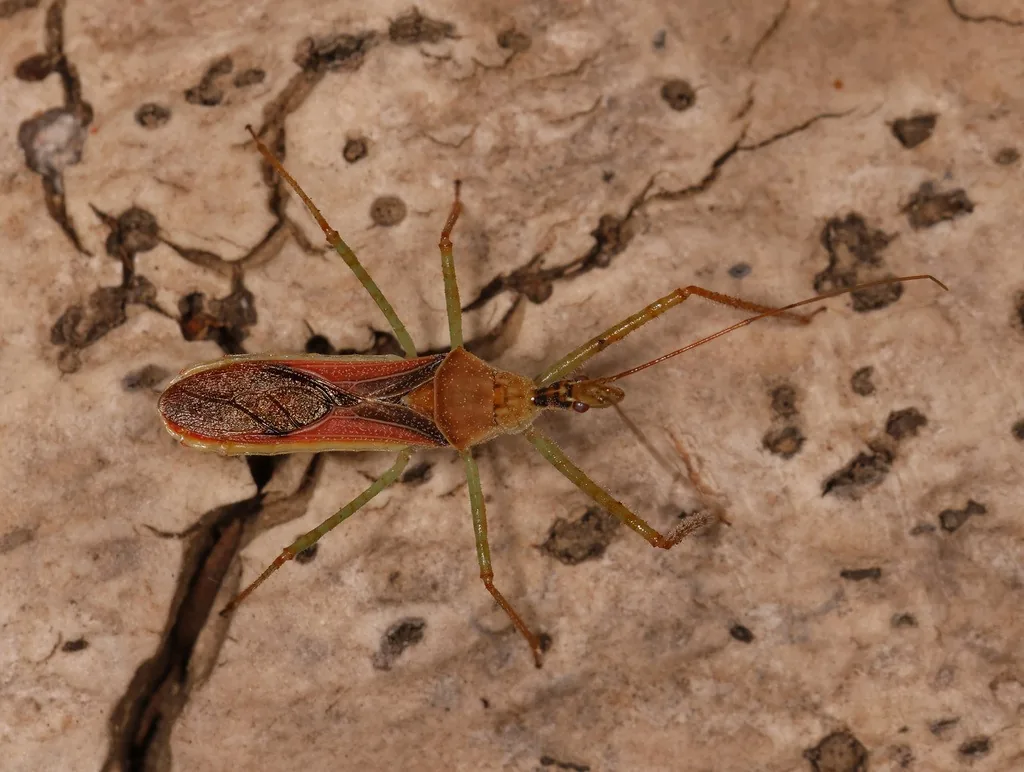
How to identify it
- Adults and nymphs have a long, narrow head with round, beady eyes, a long body and long legs.[1]
- The mouthparts form a long, hinged, needlelike beak, and both adults and nymphs can walk fast when disturbed.[1]
- Color varies a lot by species: blackish, black and orange, brown, gray or pale, and adults run about 1/5 to 1-1/4 inches long.[1]
- Leafhopper assassin bug eggs are oblong and dark brown with a white cap, laid in groups glued to plants.[1]
Look-alikes
| Look-alike | How to tell them apart |
|---|---|
| Leaffooted bug nymphs | Young Zelus have pale legs and antennae; leaffooted bug nymphs have dark legs and antennae and later grow flat, leaflike hind legs.[1] |
| Wheel bug | The wheel bug is the largest North American assassin bug, gray and about 1-1/4 inches long, with a cog-like crest on its back.[2] |
| Kissing bugs | Kissing bugs (conenose bugs) feed on mammal blood. They have no crest and show orange and black marks along the edge of the abdomen.[2] |
Where it lives
Assassin bugs live on almost every kind of land plant. The leafhopper assassin bug is common across California and the rest of the Western Hemisphere.[1]
Biology and life cycle
They grow from egg through five wingless nymph stages to a winged adult, with no pupa.[1]
Most species have one or two generations a year, and Zelus adults often shelter on walls and windows in fall.[1]
Nymphs and adults ambush or stalk prey, stab it with the beak, inject venom and suck out the body contents.[1]
The leafhopper assassin bug coats itself with a sticky material that helps it hold on to plants and trap prey.[1]
Damage and signs
- Every species is a predator of invertebrates or a blood feeder on vertebrates; the garden species eat caterpillars, beetle and sawfly larvae and other bugs.[1]
Health risk
They bite when handled or pressed against skin, and for some species the pain matches or exceeds a bee sting. Wash the bite and apply antiseptic; get medical help at once for hives, widespread swelling or trouble breathing.[3][2]
Control
Prevention
Texas A&M doesn't recommend controlling them: they're beneficial predators, rarely abundant, and need no insecticide sprays.[2]
Don't pick them up. Most bites happen when someone handles one carelessly.[2]
Biological control
UC IPM says they aren't important biological control agents, because they also eat bees, lacewings, lady beetles and other beneficials.[1]
Common questions
- Will an assassin bug bite me?
- Only in self-defense. They bite when mishandled or trapped against skin, and the bite can hurt as much as a bee sting.[3]
- Are assassin bugs good for my garden?
- Partly. They eat many pests, but they're general predators that also take bees and other beneficial insects, and they're rarely numerous enough to matter much.[3][1]
- Is this the same as a kissing bug?
- Kissing bugs belong to the same family but feed on blood. Garden assassin bugs such as Zelus hunt insects.[1][2]
Sources
- University of California Statewide IPM Program, “Assassin Bugs (Natural Enemies Gallery).” ipm.ucanr.edu/natural-enemies/assassin-bugs/ (accessed 2026-10-06)
- Texas A&M AgriLife Extension Service, “Wheel bugs and other assassin bugs (ENT-1003).” citybugs.tamu.edu/factsheets/landscape/others/ent-1003/ (accessed 2026-10-06)
- Mississippi State University Extension Service, “Bug's Eye View: Assassin Bug, No. 18.” extension.msstate.edu/newsletters/bugs-eye-view/2015/assassin-bug-no-18 (accessed 2026-10-06)
- iNaturalist, “Zelus renardii taxon page (order and family).” www.inaturalist.org/taxa/1318470 (accessed 2026-10-06)