The short answer
- Count the wings. Bees and wasps have two pairs; flies, including the hover flies and bee flies that mimic bees, have only one pair.[1][2][10][7]
- Look at the antennae. Flies that mimic bees have very short antennae and large eyes that often nearly touch. Clearwing moths have the feathery antennae and thick waist of a moth, not the threadlike antennae and narrow waist of a wasp.[6][10][14]
- Watch what it does. Hover flies and bee flies hang in midair over flowers; robber flies sit on an open perch and dart out after other insects; clearwing moths run about while rapidly fluttering their wings.[3][6][10][14]
- Hover flies, bee flies, Mydas flies and hummingbird moths can't sting. Large robber flies can bite if you grab one.[2][6][12][19][10][11]
- If you aren't sure whether it's a bee or a wasp in the first place, start with the types-of-stinging-insects guide.[2]
Look-alike profiles on this site
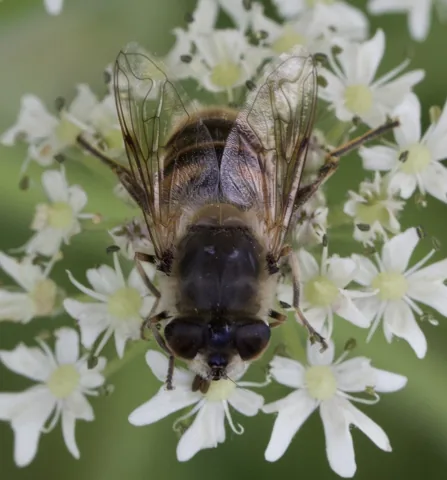 Hover Flies (Flower Flies, Syrphid Flies)
Family Syrphidae (e.g., Eristalis tenax, the drone fly)
Hover flies are true flies dressed up like bees and wasps. They can't sting or bite; the adults pollinate flowers, and the larvae of many species are important predators of aphids in gardens.
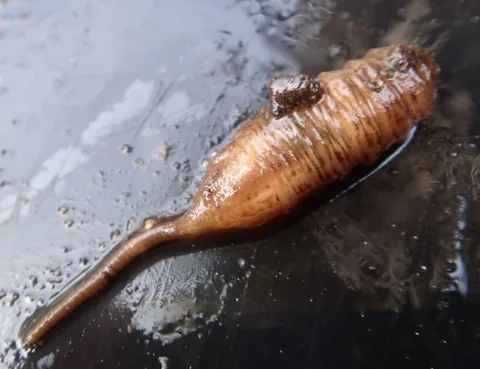 Drone Fly and Rat-Tailed Maggot
Eristalis tenax
Rat-tailed maggots, found at the edges of sewage lagoons, stagnant pools and drainage ditches, grow into drone flies: stingless hover flies that look like honey bees and visit flowers.
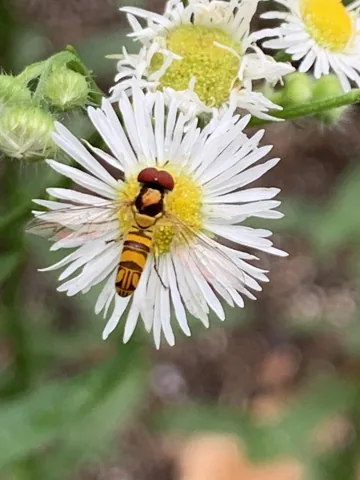 Oblique Streaktail
Allograpta obliqua
The oblique streaktail is a small, colorful hover fly, and its larvae are important aphid predators on citrus and other fruit trees, grains, corn, alfalfa, cotton, grapes, lettuce and other vegetables, and ornamentals. The adults visit flowers for nectar and can hover in place or even fly backward.
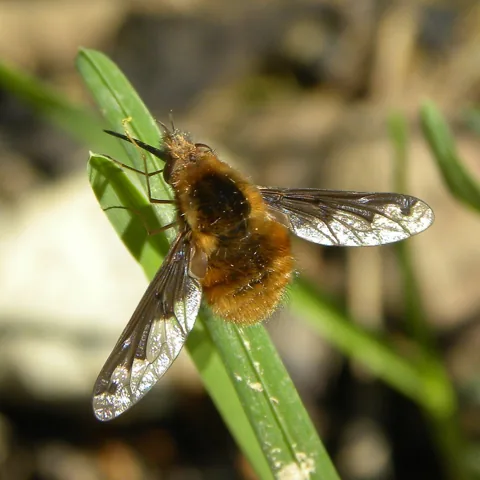 Bee Flies
Bombyliidae (e.g., Bombylius major)
Bee flies are fuzzy, round-bodied flies that hover in front of flowers and look a lot like small bees. They are true flies, not bees, and they can't sting or bite; the long beak on some species is only for sipping nectar. North America has about 800 species. The adults feed at flowers, while the larvae grow on the eggs, larvae or pupae of other insects, including cutworms, grasshoppers and carpenter bees.
 Tiger Bee Fly
Xenox tigrinus
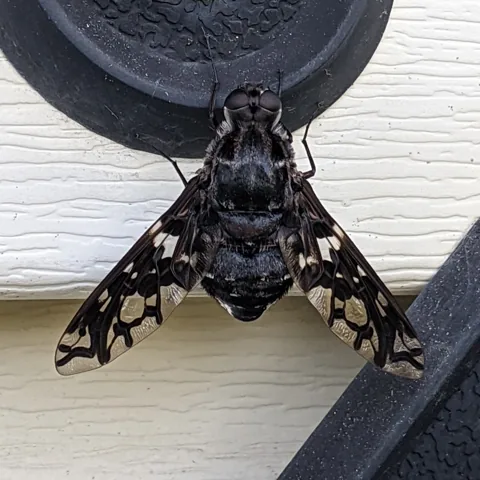
The tiger bee fly is a large, fuzzy black fly with boldly patterned wings that hovers around decks, fences and other wood around homes. It can't sting or bite, and its larvae feed on carpenter bee larvae, which makes it a natural enemy of the carpenter bees that bore into wood.
 Robber Flies
Asilidae (e.g., Proctacanthus milbertii)
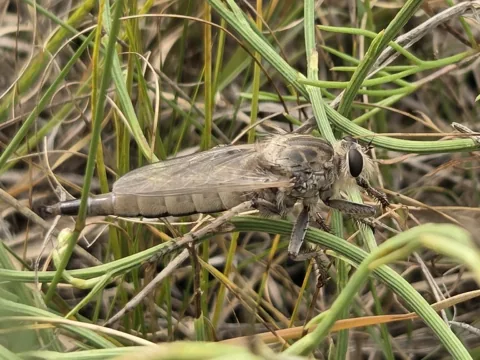
Robber flies, also called assassin flies, are a large family of predatory flies. They perch in open, sunny spots, then dart out to catch flying insects. They are generally beneficial, though they eat helpful insects too, and a robber fly that is grabbed or swatted can bite.
 Mydas Flies
Mydidae
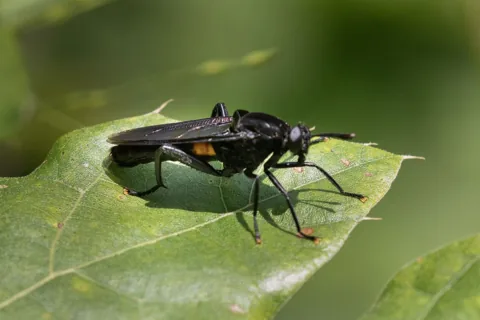
Mydas flies are large, harmless flies that mimic wasps. The eastern Mydas clavatus is velvety black with a bright orange or reddish mark on the second abdominal segment.
 Hummingbird Moths
Hemaris species (mainly H. thysbe, hummingbird clearwing, and H. diffinis, snowberry clearwing or bumblebee moth)
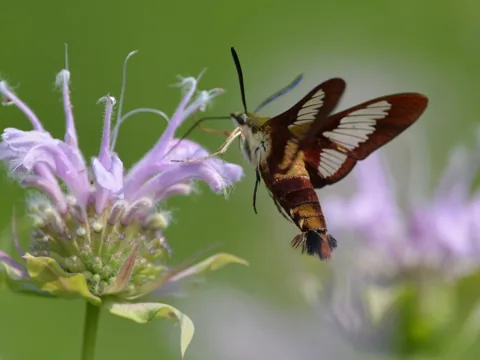
Hummingbird moths are sphinx moths that hover at flowers in daylight and sip nectar through a long tongue, looking like small hummingbirds or bumble bees. The ones usually meant are the clearwing moths in the genus Hemaris, chiefly the hummingbird clearwing and the snowberry clearwing. They have no stinger and are completely harmless.
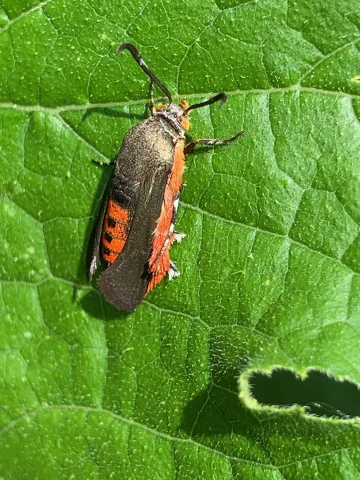 Squash Vine Borer
Eichlinia cucurbitae
The squash vine borer is a day-flying clearwing moth whose caterpillars feed inside the stems and crowns of summer squash, winter squash and pumpkins. A vine that wilts suddenly in midsummer is often the first sign, and in a bad year home gardens and small farms can lose the whole crop.
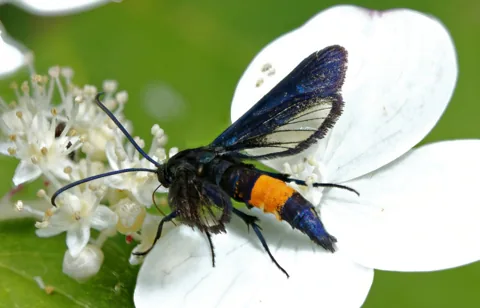 Peachtree Borer
Synanthedon exitiosa
The peachtree borer is a native clearwing moth whose larvae bore into the lower trunk and roots of peach, cherry, plum, apricot and other Prunus trees. The first sign is usually a mass of gum mixed with sawdust at the base of the trunk.
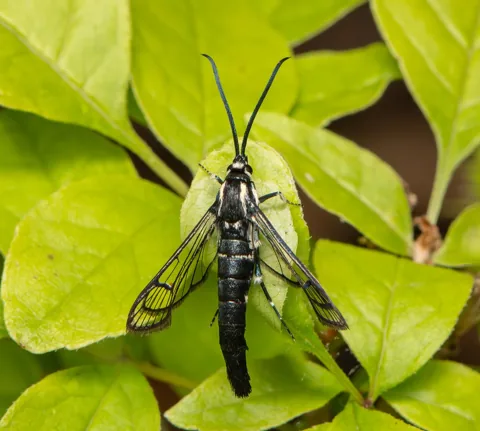 Lesser Peachtree Borer
Synanthedon pictipes
Lesser peachtree borers attack older stone fruit trees, usually entering through bark wounds.
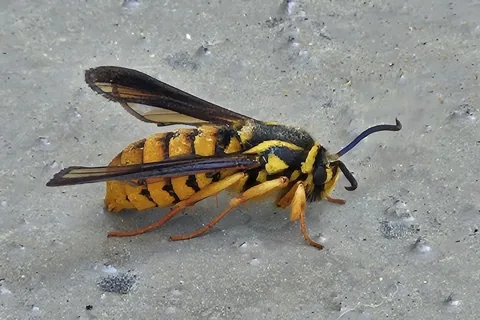 Red Oak Clearwing Moth
Paranthrene simulans
The red oak clearwing (Paranthrene simulans), called the oak borer or oak clearwing borer by landscapers, is a wasp-mimicking clearwing moth of eastern North America. Its larvae bore into the solid wood of oak trunks a foot or two above the ground, usually only one to four to a tree, and Rutgers does not consider it a major landscape pest; it is better known as one of the earliest and most recognizable moths to turn up in the pheromone traps that landscape managers set for other clearwing borers.
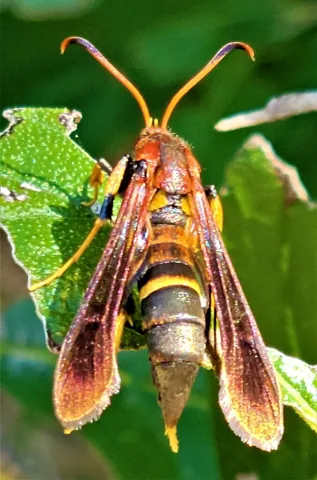 Banded Ash Borer Moth
Podosesia aureocincta
The banded ash clearwing (Podosesia aureocincta) is the late-season twin of the familiar ash/lilac borer. Both are day-flying, wasp-like clearwing moths whose larvae tunnel under the bark of ash, and the adults look so alike that older literature confused their emergence periods until pheromone trapping showed a second species flying in late August and September. Rutgers calls it the last important clearwing borer to become active in the urban landscape each year, and unlike most clearwings, which seek out bark wounds, it will also lay eggs on healthy ash trees.
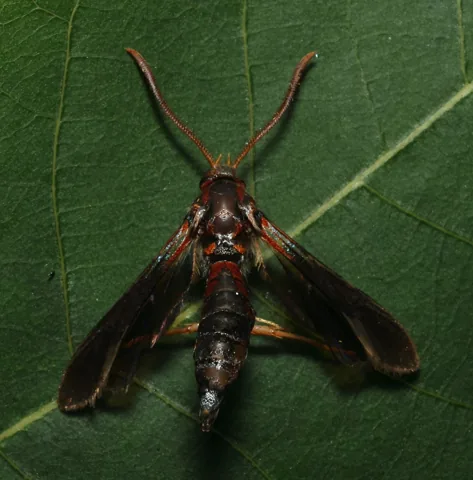 Ash/Lilac Borer
Podosesia syringae
The ash borer, also called the lilac or lilac-ash borer, is a wasp-like clearwing moth whose caterpillars tunnel in ash, lilac, olive and privet. It is not the emerald ash borer.
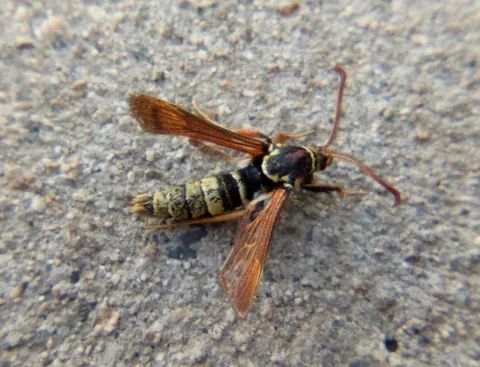 Western Poplar Clearwing
Paranthrene robiniae
Western poplar clearwing larvae bore into birch, poplar and willow, especially stressed trees, in warm low-elevation areas of the West.
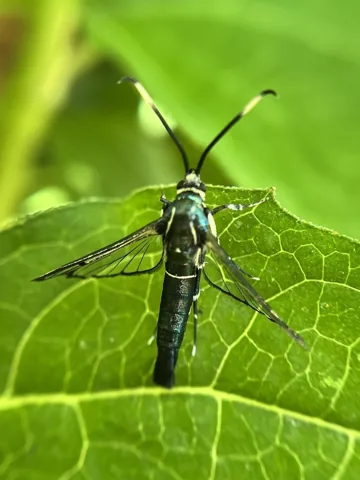 Viburnum borers
Synanthedon viburni (viburnum clearwing borer) and S. fatifera (lesser viburnum borer)
Viburnum borers are the caterpillars of two clearwing moths, the viburnum clearwing borer and the lesser viburnum borer. They tunnel under the bark at the base of viburnum shrubs, and heavy or repeated attack leads to branch dieback, decline and eventually a dead plant.
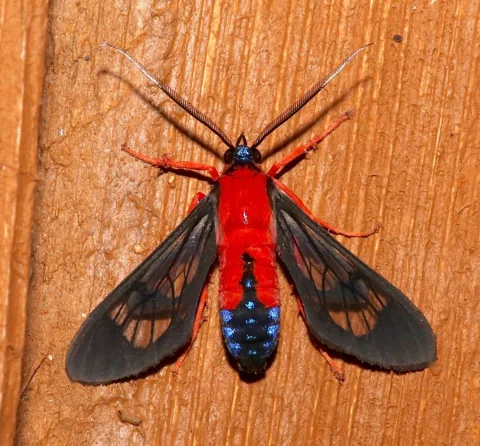 Scarlet-bodied Wasp Moth
Cosmosoma myrodora
The scarlet-bodied wasp moth is a colorful moth with a velvety red body, blue and black markings and clear, black-tipped wings that mimics a wasp. It is harmless, and its caterpillars feed only on climbing hempvine.
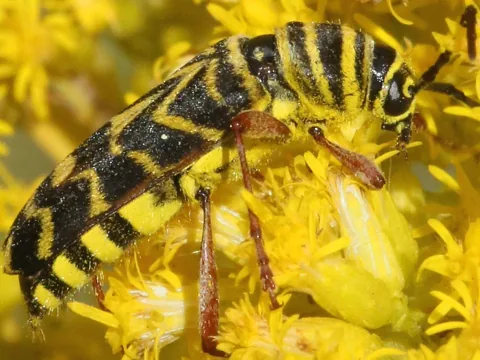 Locust Borer
Megacyllene robiniae
The locust borer is a native longhorned beetle, black with bright yellow stripes, often seen on goldenrod in early fall; its larvae tunnel into the trunks and branches of black locust, weakening trees so they break in the wind.
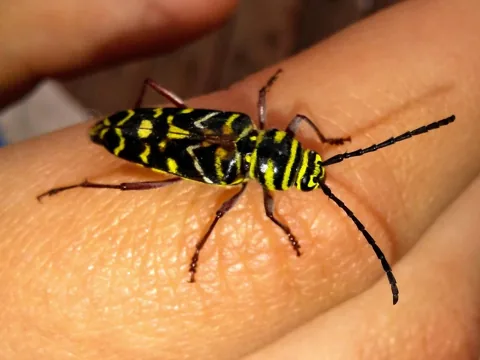 Painted hickory borer
Megacyllene caryae
The painted hickory borer is a native, black-and-yellow longhorned beetle whose larvae develop in recently dead hickory and other hardwoods; adults often emerge from firewood in spring, sometimes inside homes, but they don't attack living trees or the wood in a house.
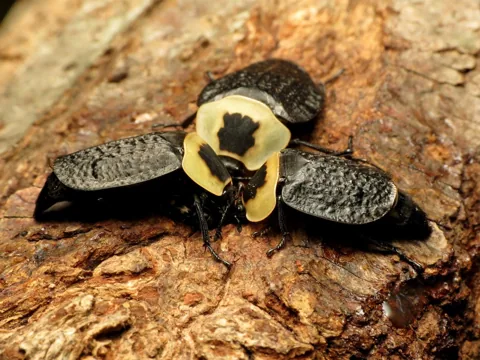 American carrion beetle
Necrophila americana
The American carrion beetle, Necrophila americana, is a flattened carrion beetle with a yellow pronotum, the shield behind the head, marked with a big black spot. It comes to dead animals, where the adults eat fly maggots and some carrion and the larvae feed on the carcass, especially its dried skin.
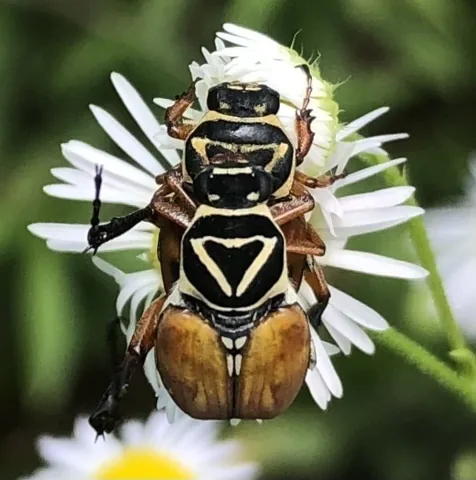 Delta Flower Scarab
Trigonopeltastes delta
The delta flower scarab is a small flower scarab named for the bright yellow triangle on the plate behind its head (delta is the Greek letter shaped like a triangle). Its yellow markings resemble those of stinging bees and wasps, which may help protect it from predators.
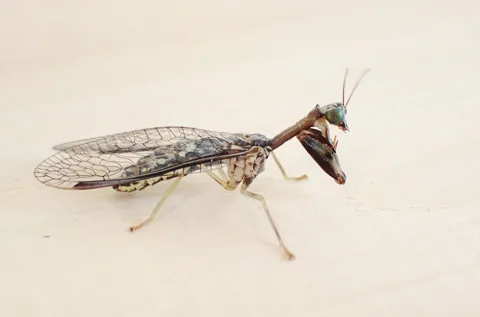 Mantidflies
Mantispidae (Dicromantispa, Zeugomantispa, Climaciella, Leptomantispa)
A mantidfly looks like someone glued the front end of a small praying mantis onto a lacewing, and that is close to the truth of its anatomy: a triangular head, a long neck-like prothorax and spiny grabbing forelegs on an inch-long body with four clear, net-veined wings. It is a lacewing relative, not a mantis, and most people would count it a friend, since it eats small insects and spider eggs. About 11 species live in North America north of Mexico, most often in the southern states, and they turn up at porch lights and blacklights from late spring until frost.
Four checks that separate mimics from bees and wasps
Missouri Department of Conservation (MDC) says bee and wasp mimics in the fly family can be recognized by a single pair of wings, very short antennae, softer bodies and large compound eyes that often nearly touch. The second pair of wings on a fly is reduced to tiny knobs called halteres.[6][10]
UC IPM adds that bees and wasps belong to the Hymenoptera, with two pairs of wings, while flies belong to the Diptera, with one. University of Minnesota Extension says the wing count is the way to tell a syrphid fly from a bee or wasp.[1][2]
- Wings: one pair means a fly. Bee flies usually hold their wings out to the side at about 45 degrees when resting, and robber flies typically rest with them folded down the back.[6][10]
- Antennae: short and stubby in hover flies and other mimic flies; clubbed at the tip in Mydas flies; feathery in clearwing moths.[4][12][14]
- Wing covers: beetle mimics such as the locust borer have hardened forewings (elytra) instead of four see-through wings.[23]
- Waist: UC IPM describes clearwing moths as having a thick moth waist, unlike the narrow, threadlike waist of a wasp.[14]
- Hair: the Wisconsin-Milwaukee field station notes that bee flies are characteristically hairy, while syrphid flies are smooth.[8]
Hover flies (flower flies, syrphid flies)
These are the bee look-alikes most people see on garden flowers. The University of Kentucky says hover flies are often mistaken for bees and wasps because of their black and yellow patterns, but they do not sting or bite. Minnesota Extension says the same and adds that the mimicry protects them from predators.[3][2]
Size varies a lot. UC IPM gives 1/8 to 1 inch (4 to 25 mm); Wisconsin Extension says species range from less than 1/4 inch to more than 3/4 inch long. UC IPM says many are black with orange, yellow or white bands or stripes, while others are brown or metallic blue or green.[1][4]
Kentucky describes their flight as hovering with abrupt changes in direction, and adults feed on pollen and nectar. UC IPM notes a false vein running through the middle of the wing that sets syrphids apart from nearly all other flies, though it takes a close look to see.[3][1]
The larvae are the useful part. They are legless, slug-like maggots that eat aphids and other soft-bodied insects. Wisconsin Extension says each larva eats up to 400 aphids, Minnesota Extension gives 100 to 400 depending on the species, and Kentucky gives 100 to 600 over the larva's lifetime.[4][2][3]
Drone fly: the honey bee look-alike
The drone fly (Eristalis tenax) is a hover fly that resembles a honey bee in size, color and markings. Mississippi State Extension notes that its large eyes make it look more like a male (drone) honey bee than a worker, and drones have no sting either. UC IPM describes the adults as hairy, stout, black and brown flies.[5][1]
Its larva is the rat-tailed maggot, which lives in shallow water rich in decaying matter and breathes through a long tail-like tube. Mississippi State lists sewage lagoons, stagnant pools and drainage ditches as typical places.[5][1]
Bee flies
MDC says bee flies are true flies that do not sting or bite. Most look like pudgy, fuzzy bees, and some have a long, straw-like proboscis for sipping nectar. They often feed while hovering, without landing on the flower. North America has about 800 species, from 1/4 to 1 3/4 inches long.[6]
The long beak looks threatening but isn't. The Wisconsin-Milwaukee field station says bee flies use it to sip nectar and do not sink it into mammalian flesh. Clemson Extension says the way to tell one from a bee is the single pair of wings.[8][7]
Their larvae develop on the young of other insects. Clemson lists wasps, beetles, butterflies and moths, grasshoppers and other flies as hosts, and MDC says some species attack cutworms, armyworms, carpenter bees and grasshoppers.[7][6]
A bee fly hovering over holes in the ground or wood is usually looking for a host's nest. MDC says females are often seen hovering where their hosts nest. The tiger bee fly, about 3/4 inch long with patterned wings, lays its eggs where carpenter bees have nested, and MDC says most people see it hovering around wooden fences and roof overhangs.[6][9][8]
Robber flies
Robber flies are predators that perch in the open, swivel their heads to watch, then dart out to catch flying insects. MDC describes most as humpbacked with a long tapered abdomen, spiny legs and a bearded face. Wisconsin Extension says most are gray, brown or black, but a few resemble bumble bees, and MDC says some Laphria species look almost exactly like bumble bees.[10][11]
MDC says most are 1/2 to 3/4 inch long, with some reaching 1 1/4 inches, and many make a loud buzz in flight.[10][11]
They can bite. Both MDC and Wisconsin Extension say robber flies can give a painful bite if handled carelessly, so look but don't grab.[10][11]
They eat many pest insects, MDC says, but also honey bees, wasps and bumble bees. Wisconsin Extension describes them as generalist hunters that take butterflies, wasps, bees, dragonflies, grasshoppers, beetles and other flies.[10][11]
Mydas flies
Mydas flies are large flies that look like wasps but are harmless. MDC says many are black, dark or tan with red, orange or yellow bands, and that some copy blue-black spider wasps that have an orange or red spot on the abdomen.[12]
MDC gives a length of 1/4 to 1 1/4 inches, with most about 1 inch; a Clemson Extension writer described one seen in South Carolina as about an inch and a half long. Unlike robber flies, they have clubbed antennae.[12][13]
MDC says Mydas fly larvae eat beetle grubs in soil and rotting wood, including some of the root-feeding grubs that damage lawns.[12]
Clearwing moths and other wasp moths
Clearwing moths (family Sesiidae) fly in the daytime and mimic wasps. Rutgers says they resemble wasps in both appearance and action, and that their wings are at least partly transparent. UC IPM says they are often yellow, orange or red on black or dark blue, and that the adults run about while rapidly fluttering their wings, the way wasps do.[15][14]
Some match a particular wasp closely. Rutgers says the oak borer male, over an inch long, looks remarkably like a yellowjacket, and the lilac borer, about an inch long, resembles a paper wasp. UC IPM says the western poplar clearwing resembles a yellowjacket but has the thick waist and feathery antennae of a moth.[15][14]
Garden examples: the squash vine borer is a day-flying wasp mimic, a stout dark gray moth with hairy red hind legs that Kentucky says looks more like a paper wasp than a moth. Male peachtree borers resemble small wasps, with four narrow yellow bands and clear wings, while females are dark blue with two orange bands, according to NC State.[17][18][16]
The adults do no harm themselves; UC IPM says they live only about a week and don't directly damage plants. Their larvae are the problem, boring under bark and pushing out sawdust-like frass. A clearwing moth around a tree or squash patch is a reason to check for borers.[14][17]
The scarlet-bodied wasp moth (Cosmosoma myrodora) has clear, black-tipped wings and a red body with blue and black markings. Mississippi State says it occurs only in Florida and a narrow band of coastal counties in other southeastern states, with a body about 0.6 inch long and a 1.2-inch wingspan.[21]
Bumblebee moth and hummingbird moth
Two clearwing sphinx moths in the genus Hemaris show up at garden flowers alongside bumble bees. NC State says Hemaris diffinis, the bumblebee moth or snowberry clearwing, resembles a bumble bee, and Hemaris thysbe vaguely resembles a hummingbird in flight. MDC describes H. thysbe as a bumble bee mimic with a fuzzy olive to golden thorax and clear patches in the wings.[19][20]
NC State calls these moths completely harmless, and MDC notes they lack stingers; their colors protect them by association with bees. They hover over flowers and feed with a long tongue.[19][20]
Beetles that look like bees or wasps
Beetles have hard wing covers that close over the back when they land, which gives them away once they stop moving.[23]
- Locust borer (Megacyllene robiniae): a longhorned beetle 1/2 to 1 inch long, black with yellow stripes on the head, thorax and wing covers. Adults feed on goldenrod from early September until the first frost. MDC says the stripes mimic stinging insects and the beetle is harmless. Its larvae tunnel into black locust trunks.[23][22][24]
- American carrion beetle: about 1/2 to 3/4 inch long with a yellow pronotum marked by a big black spot. MDC says it seems like a bumble bee in flight.[25]
- Delta flower scarab: named for the bright yellow triangle on its pronotum. MDC says the yellow pattern resembles that of stinging bees or wasps and may protect the beetle.[26]
Wasp mantidfly
The brown wasp mantidfly (Climaciella brunnea) looks like a wasp with the grasping front legs of a praying mantis. MDC says it is banded with yellow, brown, rust or black, even its wings resemble a wasp's, and its colors vary across North America to match the wasps common in each area. Its larvae feed on wolf spiders.[27]
Why the difference matters
Telling a mimic from a real bee or wasp changes what you do next, from leaving it alone to checking a tree for borers.[2][14]
- No need to swat or spray. Hover flies, bee flies, Mydas flies and hummingbird moths can't sting, and Minnesota Extension warns that many insecticides are not selective and kill beneficial insects along with pests.[2][6][12][19]
- Several are pest control you get for free. Hover fly larvae eat aphids, bee fly larvae attack cutworms, armyworms and grasshoppers, and robber flies catch many crop pests. The beneficial-insects guide covers the rest.[4][6][10]
- Some are signals. A wasp-like moth near a tree trunk or a wilting squash vine points to borers, and locust borer beetles on goldenrod in fall are the adults of a borer that lays its eggs in black locust bark. UMass Extension suggests removing goldenrod near ornamental locusts.[14][17][23]
- A tiger bee fly hovering at a fence or eave means carpenter bees are nesting there, and bee flies hovering over bare soil are hunting the nests of ground-nesting insects such as bees and wasps. See the ground bees guide.[9][8]
- Handle robber flies with care. They are the one common mimic group that can bite.[10][11]
Common questions
- Do hover flies sting?
- No. Hover flies do not sting or bite. They are true flies with one pair of wings that copy the colors of bees and wasps.[2][3]
- What is the fuzzy bee with a long beak that hovers over flowers?
- It is probably a bee fly. Bee flies are fuzzy flies with a long proboscis for sipping nectar, and they often feed while hovering. They don't sting or bite.[6][8]
- What looks like a bumble bee but is a fly?
- Some bee flies, some robber flies in the genus Laphria, and the drone fly and other hover flies. One pair of wings and very short antennae mark them as flies.[6][10][5]
- Is a moth that looks like a wasp a problem?
- The moth itself is harmless, but clearwing moth larvae bore into trees, shrubs and squash vines. Check nearby plants for sawdust-like frass, oozing sap or wilting.[14][17]
- What is the black and yellow striped beetle on goldenrod in the fall?
- Usually the locust borer, a harmless longhorned beetle that feeds on goldenrod from September until frost. Its larvae bore into black locust trees.[23][22]
Photo credits
- Hover Flies (Flower Flies, Syrphid Flies): (c) nevwright, some rights reserved (CC BY) — via iNaturalist, CC BY 4.0
- Drone Fly and Rat-Tailed Maggot: (c) Wendy Bailey, some rights reserved (CC BY) — via iNaturalist, CC BY 4.0
- Oblique Streaktail: (c) David George, some rights reserved (CC BY) — via iNaturalist, CC BY 4.0
- Bee Flies: (c) M. Whitson, some rights reserved (CC BY) — via iNaturalist, CC BY 4.0
- Tiger Bee Fly: cgmayers, public domain (CC0), via iNaturalist
- Robber Flies: (c) Chris Friesen, some rights reserved (CC BY) — via iNaturalist, CC BY 4.0
- Mydas Flies: (c) Kristof Zyskowski, some rights reserved (CC BY) — via iNaturalist, CC BY 4.0
- Hummingbird Moths: Chrissy McClarren and Andy Reago, public domain (CC0), via iNaturalist
- Squash Vine Borer: (c) Zeke Blankenship, some rights reserved (CC BY) — via iNaturalist, CC BY 4.0
- Peachtree Borer: (c) Christian Back, some rights reserved (CC BY) — via iNaturalist, CC BY 4.0
- Lesser Peachtree Borer: (c) Patrick O'Brien, some rights reserved (CC BY) — via iNaturalist, CC BY 4.0
- Red Oak Clearwing Moth: (c) azurebeetle, some rights reserved (CC BY) — via iNaturalist, CC BY 4.0
- Banded Ash Borer Moth: (c) johnyochum, some rights reserved (CC BY) — via iNaturalist, CC BY 4.0
- Ash/Lilac Borer: (c) David George, some rights reserved (CC BY) — via iNaturalist, CC BY 4.0
- Western Poplar Clearwing: (c) Daniel S., some rights reserved (CC BY) — via iNaturalist, CC BY 4.0
- Viburnum borers: (c) Jody, some rights reserved (CC BY) — via iNaturalist, CC BY 4.0
- Scarlet-bodied Wasp Moth: (c) Laura Gaudette, some rights reserved (CC BY) — via iNaturalist, CC BY 4.0
- Locust Borer: (c) Peter Chen 2.0, some rights reserved (CC BY) — via iNaturalist, CC BY 4.0
- Painted hickory borer: (c) Jon Hoekstra, some rights reserved (CC BY) — via iNaturalist, CC BY 4.0
- American carrion beetle: (c) Katja Schulz, some rights reserved (CC BY) — via iNaturalist, CC BY 4.0
- Delta Flower Scarab: Ken Kneidel, public domain (CC0), via iNaturalist
- Mantidflies: (c) Susan Blayney, some rights reserved (CC BY) — via iNaturalist, CC BY 4.0
Sources
- University of California Statewide IPM Program, “Syrphids (Flower Flies, or Hover Flies), Natural Enemies Gallery.” ipm.ucanr.edu/natural-enemies/syrphids/ (accessed 2026-11-10)
- University of Minnesota Extension, “Syrphid flies.” extension.umn.edu/beneficial-insects/syrphid-flies (accessed 2026-11-10)
- University of Kentucky Entomology, “Syrphid Flies: Overlooked Pollinating Insects (ENTFACT-710).” entomology.ca.uky.edu/ef710 (accessed 2026-11-10)
- University of Wisconsin-Madison Extension, Wisconsin Horticulture, “Hover, Flower, or Syrphid Flies (Syrphidae).” hort.extension.wisc.edu/articles/hover-flower-or-syrphid-flies-syrphidae/ (accessed 2026-11-10)
- Mississippi State University Extension Service, “Rat-tailed Maggot, Bug's Eye View Vol. 7, No. 2.” extension.msstate.edu/newsletters/bugs-eye-view/2021/rat-tailed-maggot-vol-7-no-2 (accessed 2026-11-10)
- Missouri Department of Conservation, “Bee Flies.” mdc.mo.gov/discover-nature/field-guide/bee-flies (accessed 2026-11-10)
- Clemson Cooperative Extension, Home & Garden Information Center, “What Is It? Wednesday: Bee Fly.” hgic.clemson.edu/what-is-it-wednesday-bee-fly/ (accessed 2026-11-10)
- University of Wisconsin-Milwaukee Field Station, “Big Bee Flies (Family Bombyliidae), Bug of the Week.” uwm.edu/field-station/bug-of-the-week/big-bee-flies/ (accessed 2026-11-10). University field station's natural-history column
- Missouri Department of Conservation, “Tiger Bee Fly.” mdc.mo.gov/discover-nature/field-guide/tiger-bee-fly (accessed 2026-11-10)
- Missouri Department of Conservation, “Robber Flies.” mdc.mo.gov/discover-nature/field-guide/robber-flies (accessed 2026-11-10)
- University of Wisconsin-Madison Extension, Wisconsin Horticulture, “Robber Flies (Asilidae).” hort.extension.wisc.edu/articles/robber-flies-asilidae/ (accessed 2026-11-10)
- Missouri Department of Conservation, “Mydas Flies.” mdc.mo.gov/discover-nature/field-guide/mydas-flies (accessed 2026-11-10)
- Clemson Cooperative Extension, Home & Garden Information Center, “Meeting a Mydas Fly.” hgic.clemson.edu/meeting-a-mydas-fly/ (accessed 2026-11-10)
- University of California Statewide IPM Program, “Pest Notes: Clearwing Moths.” ipm.ucanr.edu/home-and-landscape/clearwing-moths/ (accessed 2026-11-10)
- Rutgers Cooperative Extension, Plant & Pest Advisory, “Identifying Clearwing Moth Borers in Pheromone Traps.” plant-pest-advisory.rutgers.edu/identifying-clearwing-moth-borers-in-pheromone-traps/ (accessed 2026-11-10)
- NC State Extension, “Peachtree Borer.” content.ces.ncsu.edu/peachtree-borer (accessed 2026-11-10)
- University of Minnesota Extension, “Squash vine borers.” extension.umn.edu/garden-and-home/yard-and-garden/yard-and-garden-insects/squash-vine-borers (accessed 2026-11-10)
- University of Kentucky Entomology, “Squash Vine Borer (ENTFACT-314).” entomology.ca.uky.edu/ef314 (accessed 2026-11-10)
- NC State Extension, “Bumblebee Moth and Hummingbird Moth.” content.ces.ncsu.edu/bumblebee-moth-and-hummingbird-moth (accessed 2026-11-10)
- Missouri Department of Conservation, “Hummingbird Clearwing.” mdc.mo.gov/discover-nature/field-guide/hummingbird-clearwing (accessed 2026-11-10)
- Mississippi State University Extension Service, “Scarlet-bodied Wasp Moth, Bug's Eye View Vol. 9, No. 29.” extension.msstate.edu/newsletters/bugs-eye-view/2023/scarlet-bodied-wasp-moth-vol-9-no-29 (accessed 2026-11-10)
- Missouri Department of Conservation, “Locust Borer.” mdc.mo.gov/discover-nature/field-guide/locust-borer (accessed 2026-11-10)
- UMass Amherst Center for Agriculture, Food, and the Environment, “Megacyllene robiniae, Insect & Mite Guide.” www.umass.edu/agriculture-food-environment/landscape/publications-resources/insect-mite-guide/megacyllene-robiniae (accessed 2026-11-10)
- Utah State University Extension, Integrated Pest Management, “Locust Borer.” extension.usu.edu/planthealth/ipm/notes_orn/list-treeshrubs/locust-borer.php (accessed 2026-11-10)
- Missouri Department of Conservation, “American Carrion Beetle.” mdc.mo.gov/discover-nature/field-guide/american-carrion-beetle (accessed 2026-11-10)
- Missouri Department of Conservation, “Delta Flower Scarab.” mdc.mo.gov/discover-nature/field-guide/delta-flower-scarab (accessed 2026-11-10)
- Missouri Department of Conservation, “Mantidflies (Mantis Flies).” mdc.mo.gov/discover-nature/field-guide/mantidflies-mantis-flies (accessed 2026-11-10)