On this page
How to identify it
Look-alikes
| Look-alike | How to tell them apart |
|---|---|
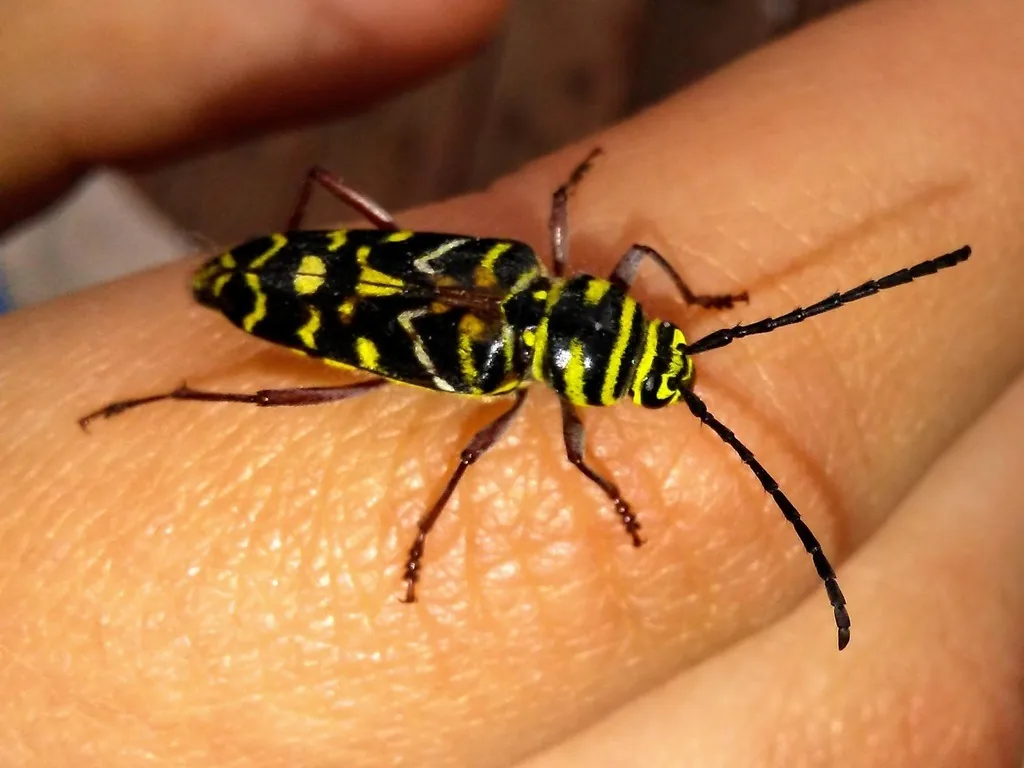
| Locust borer | Nearly identical in color and pattern, but locust borer adults appear in late summer and fall, often on goldenrod, while painted hickory borers emerge in spring.[1][2][3] |
Where it lives
It is a native beetle, commonly reported emerging from firewood and logs in Ohio, Indiana and Virginia.[3][1][2]
Biology and life cycle
Larvae develop in stressed, dying or recently cut hickory and other hardwoods, including maple and oak; they infest only trees that died within about a year or wood cut within a year.[2][3]
When infested wood is cut for firewood, the larvae come along, and indoor warmth can bring adults out early.[3]
Damage and signs
Health risk
Purdue, Virginia and Ohio State describe it only as a harmless nuisance indoors.[1][2][3]
Control
Prevention
Don't store firewood inside the house, and keep long-term woodpiles a distance away from it.[4]
Traps and physical control
No controls are needed; just put any beetles that emerge indoors outside.[3][1]
Common questions
- Are the yellow-and-black beetles coming out of my firewood dangerous to my house?
- No. Painted hickory borers infest only recently dead trees and raw firewood, not furniture, floors or house framing.[3][2]
- How do I tell a painted hickory borer from a locust borer?
- Mostly by season: painted hickory borers emerge in spring, while locust borers show up in late summer and fall, often on goldenrod.[1][3]
Sources
- Purdue University Extension, “Painted Hickory Borers (Purdue Landscape Report).” purduelandscapereport.org/article/painted-hickory-borers/ (accessed 2026-10-19)
- Virginia Cooperative Extension, “Locust Borer, Megacyllene robiniae, ENTO-141 (with a note on the painted hickory borer).” www.pubs.ext.vt.edu/content/dam/pubs_ext_vt_edu/ENTO/ENTO-141/ENTO-141-pdf.pdf (accessed 2026-10-19)
- Ohio State University Extension, “Painted Hickory Borers Flare-Up from Firewood (Buckeye Yard & Garden onLine).” bygl.osu.edu/node/1223 (accessed 2026-10-19)
- Ohio State University Extension, “A Pantry Pest "Morphs" Into Bark Beetles: firewood nuisance pests (Buckeye Yard & Garden onLine).” bygl.osu.edu/node/2108 (accessed 2026-10-19)
- iNaturalist, “Megacyllene caryae taxon page (order and family).” www.inaturalist.org/taxa/126148 (accessed 2026-10-06)