On this page
How to identify it
Where it lives
Common across the eastern United States, including North Carolina and Missouri.[1][2]
Biology and life cycle
Females lay eggs in bark of newly planted, stressed, dying or dead trees and felled logs; debarked logs are safe.[1]
Damage and signs
Health risk
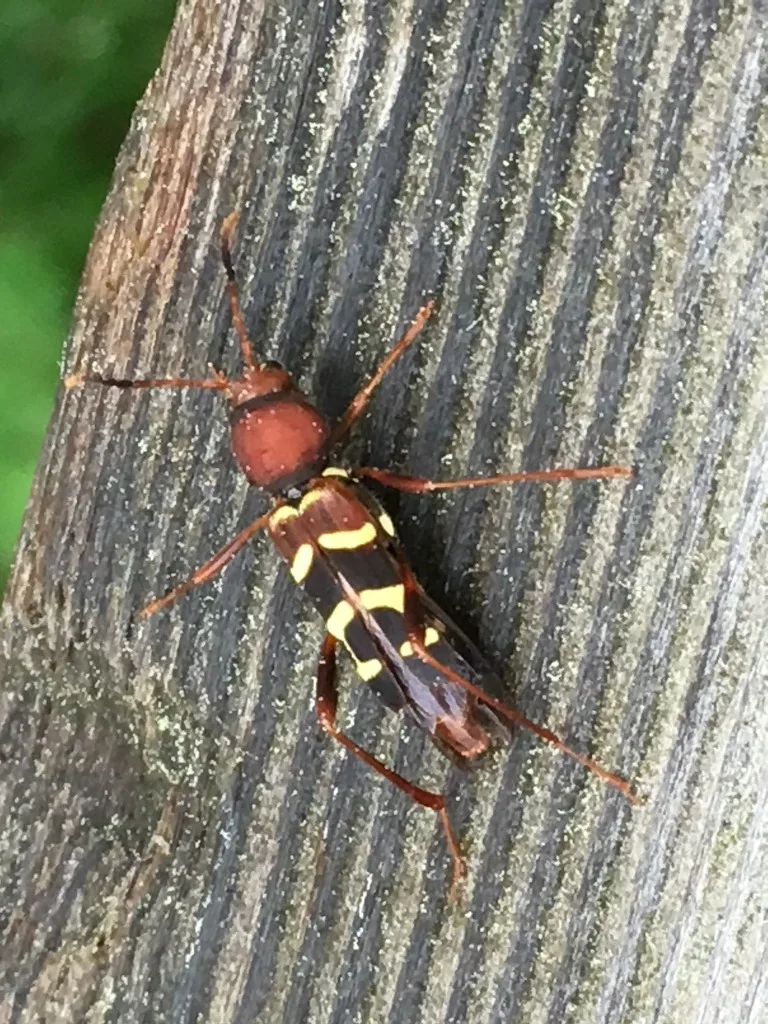
Harmless to people despite looking like a wasp.[2]
Control
Prevention
Keep trees watered, mulched and healthy, prune out dead branches, and keep bark-covered firewood outdoors; larvae already inside trees can't be controlled.[1][2]
Pesticides
A pyrethroid such as permethrin can prevent further attack on an infested tree still worth saving; keep pyrethroids away from ponds and streams.[1]
Common questions
- What is the wasp-like beetle that came out of my firewood?
- Often a redheaded ash borer, which develops in bark-covered logs.[1][2]
- Does it sting?
- No; it only looks like a wasp.[2]
- Where did it come from indoors?
- Usually from bark-covered firewood; the grubs develop in dying or dead hardwoods and logs.[1][2]
Sources
- NC State Extension, “Redheaded Ash Borer (PDIC Factsheet).” content.ces.ncsu.edu/redheaded-ash-borer (accessed 2026-10-15)
- Missouri Department of Conservation, “Red-Headed Ash Borer (Field Guide).” mdc.mo.gov/discover-nature/field-guide/red-headed-ash-borer (accessed 2026-10-15)
- iNaturalist, “Neoclytus acuminatus taxon page (order and family).” www.inaturalist.org/taxa/121732 (accessed 2026-10-06)