The short answer
- Fuzzy body and pollen on the legs: a bee. Smooth, mostly hairless body with a narrow waist: a wasp. A look-alike with only two wings instead of four is a harmless fly.[11]
- Bright yellow and black, about 1/2 to 1 inch, with a barely visible waist, coming out of a hole in the ground or a gap in siding, or crawling into your soda: a yellowjacket. These are the stinging insects most likely to attack, especially near the nest and late in summer.[1][4]
- Black and white, building a gray paper ball the size of a football in a tree or under an eave: a bald-faced hornet, which is actually an aerial yellowjacket. Big, brown and yellow, nesting in a hollow tree or wall and flying to lights at night: the European hornet.[4][17][10][15]
- Slender, long-legged wasp with legs dangling in flight, on an open, umbrella-shaped comb under an eave: a paper wasp. Thread-waisted wasp building mud tubes on a wall: a mud dauber, which rarely stings.[1][16]
- Large black bee hovering at the eaves with a shiny, bare abdomen: a carpenter bee, and the hovering males can't sting. Hairy black-and-yellow bee nesting in an old mouse nest or under a shed: a bumble bee.[6][9]
- Huge wasp, 1.5 to nearly 2 inches, digging holes in sandy soil in July and August: a cicada killer, which seldom stings. A red-and-black fuzzy 'ant' running across bare ground: a velvet ant, a wingless female wasp with a severe sting.[7][21]
If someone may be poisoned
- Call 911 for anyone stung who has trouble breathing or wheezing, swelling of the face or mouth, throat tightness or trouble swallowing, weakness, or blue skin. If they carry an epinephrine auto-injector, use it.[27]
- CDC lists severe chest pain, nausea, severe sweating, loss of breath, serious swelling and slurred speech as reasons to go to an emergency facility right away. A sting inside the mouth or on the neck also needs prompt medical care, because swelling there can block breathing.[26][2]
Bee and wasp profiles
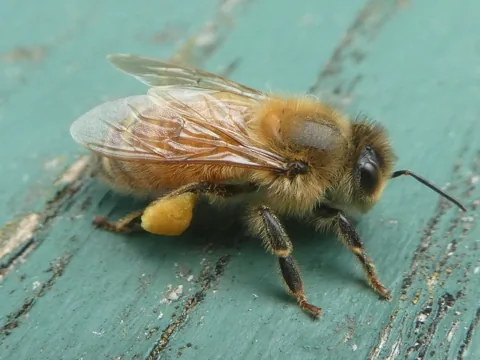 Western Honey Bee
Apis mellifera
Honey bees are important pollinators, but a colony that moves into a wall void or attic can become a stinging hazard. A swarm is temporary and usually best left alone, while an established colony in a building should be removed along with its comb.
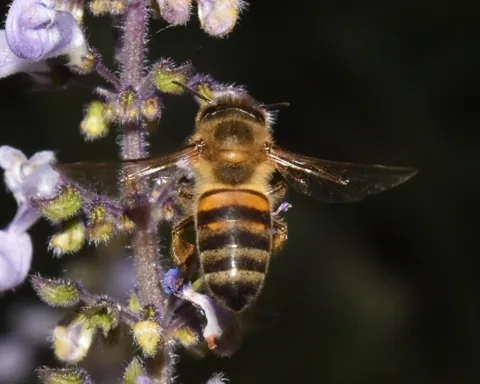 Africanized Honey Bee
Apis mellifera scutellata and its hybrids with European honey bees (Apis mellifera)
Africanized honey bees descend from African honey bees taken to Brazil in the 1950s that got into the wild and bred with European honey bees. They look like ordinary honey bees and carry the same venom, but colonies respond faster, in greater numbers and over a wider area when their nest is disturbed.
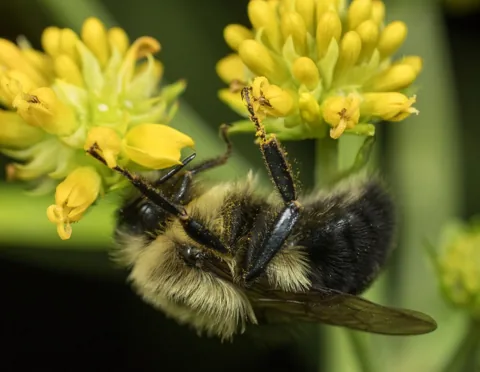 Common Eastern Bumble Bee
Bombus impatiens
Bumble bees are social bees that form annual colonies in soil cavities, old rodent burrows and similar voids; they are valuable pollinators and defend their nests only when disturbed.
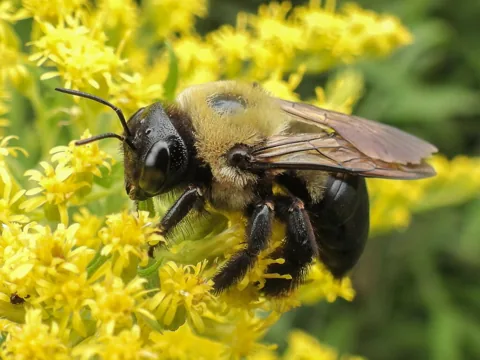 Eastern Carpenter Bee
Xylocopa virginica
Carpenter bees are large, solitary bees that bore round tunnels into bare, weathered wood to rear their young; they rarely cause severe damage but can weaken wood that is reused year after year.
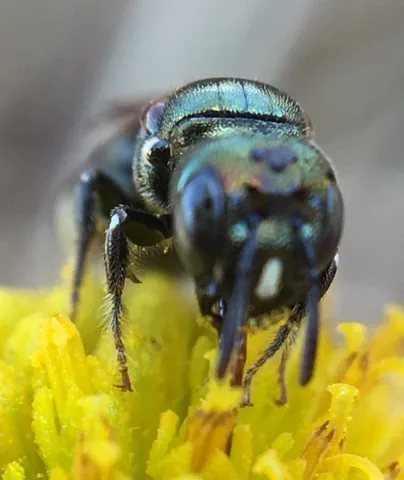 Small Carpenter Bees
Ceratina species
Small carpenter bees are tiny, shiny black bees with blue or green highlights that hollow out nests in the pith of broken weed stems, dead canes and freshly cut rose stems. They are gentle pollinators, though nesting in a fresh rose cut can make the cane die back.
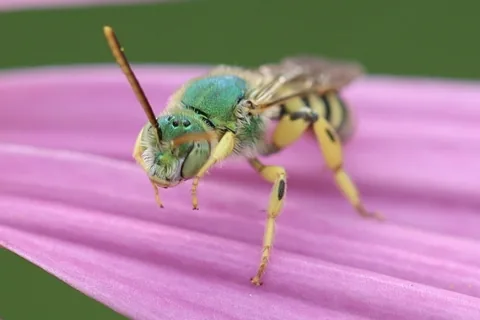 Sweat Bees
Family Halictidae (e.g., Halictus, Lasioglossum and Agapostemon)
Sweat bees are small native bees, many of them shiny metallic green or blue, that are drawn to human perspiration for its moisture and salt. They are not aggressive and are important pollinators of wildflowers and crops.
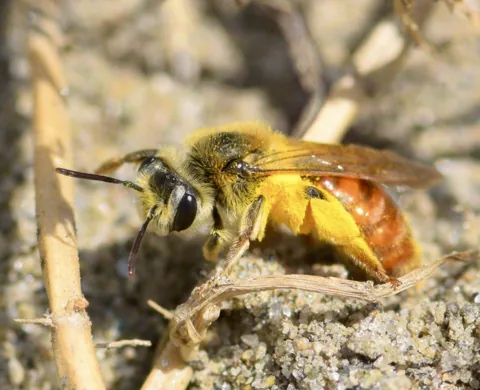 Mining Bees
Andrena species
Mining bees, genus Andrena, are solitary native bees that nest in the ground, often in dense spring aggregations in lawns and bare soil. They pollinate spring flowers and fruit crops, aren't aggressive, and Penn State says they aren't considered pests.
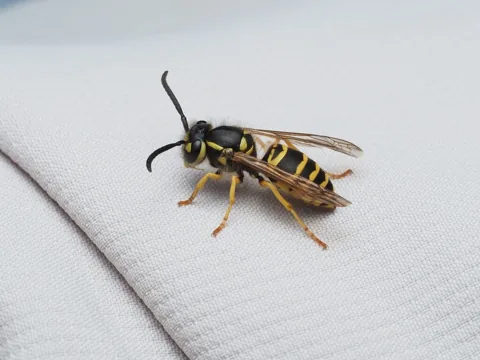 Eastern Yellowjacket
Vespula maculifrons
The eastern yellowjacket is a native, ground-nesting yellowjacket common across the eastern US in lawns, woodlands, pastures and parks; it defends its nest aggressively and can sting repeatedly.
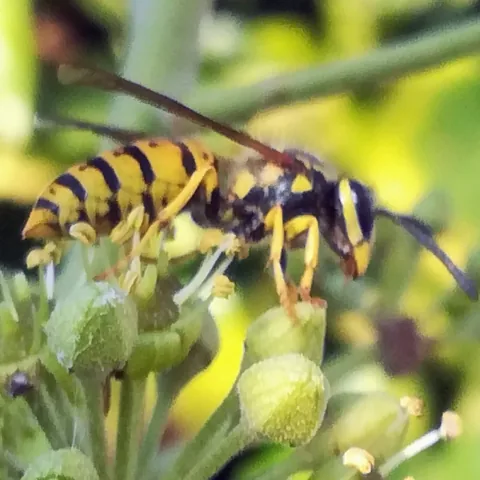 German Yellowjacket
Vespula germanica
The German yellowjacket is an invasive wasp from Eurasia that has spread across the northern US, displaces native yellowjackets and often nests in buildings.
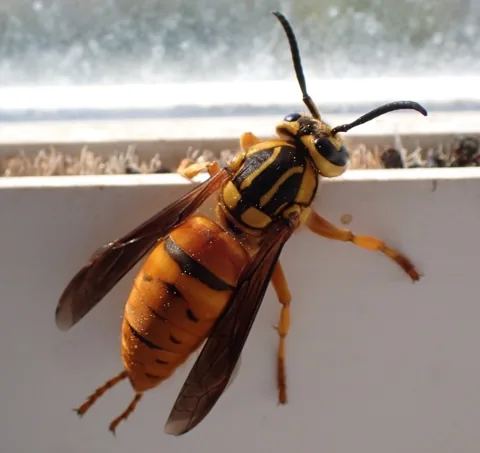 Southern Yellowjacket
Vespula squamosa
The southern yellowjacket is a native yellowjacket that normally nests in the ground. Its large, burnt-orange queens often start colonies by taking over eastern yellowjacket nests.
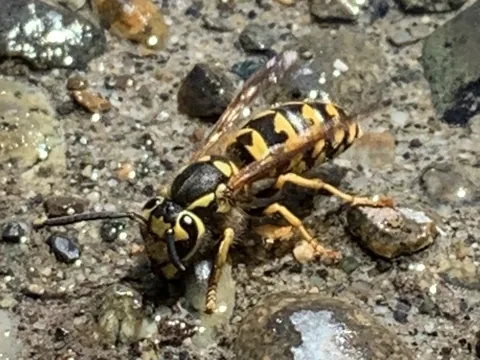 Western Yellowjacket
Vespula pensylvanica
Yellowjackets are social wasps that nest mostly in the ground and in wall voids, defend their nests vigorously, and become persistent scavengers at picnics and garbage cans in late summer and fall.
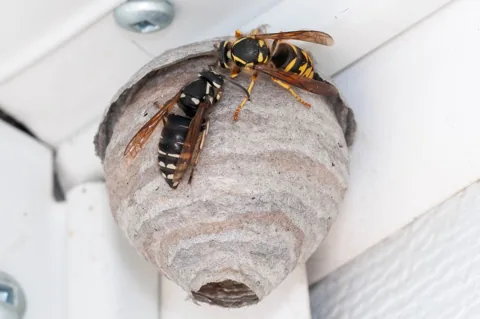 Aerial yellowjacket
Dolichovespula arenaria
The aerial yellowjacket is a black-and-yellow social wasp that builds its enclosed paper nest above ground: in shrubs and trees, under eaves and on outbuildings. It hunts live prey instead of raiding picnics, but it defends its nest fiercely and sometimes bites and stings at the same time.
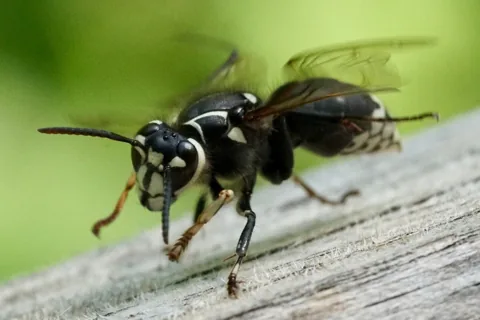 Bald-faced Hornet
Dolichovespula maculata
The bald-faced hornet is a large black-and-white aerial yellowjacket that builds gray, football-shaped paper nests in trees, shrubs and on buildings and defends them aggressively.
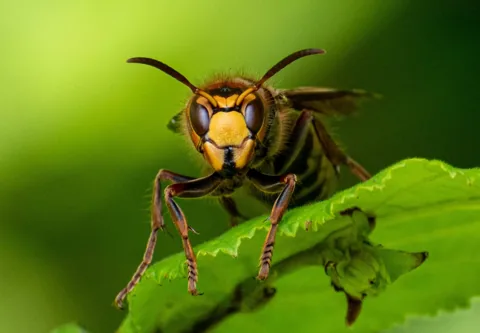 European Hornet
Vespa crabro
The European hornet is a large wasp introduced from Europe and first reported in the United States in 1840. It is now widespread in the East and is the only true hornet (genus Vespa) established in North America.
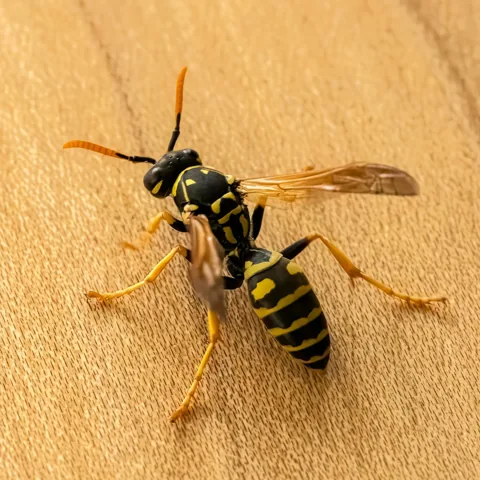 European Paper Wasp
Polistes dominula
Paper wasps hang open, umbrella-shaped paper nests under eaves and in sheltered spots; they are much less defensive than yellowjackets and rarely sting unless a nest is disturbed.
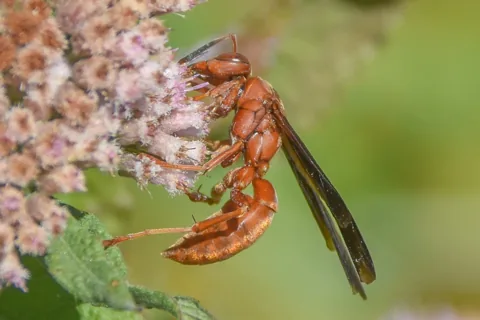 Red Wasp
Polistes carolina
The red wasp (Polistes carolina) is a paper wasp with an almost entirely rust-red body that builds open, umbrella-shaped paper nests under roofs and other overhangs. Paper wasps are not aggressive but will sting to defend the nest.
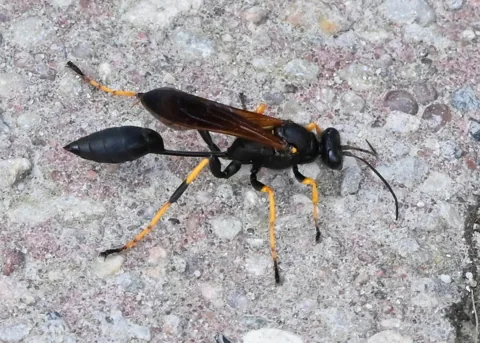 Black and Yellow Mud Dauber
Sceliphron caementarium
Mud daubers are solitary wasps that build mud nests on walls, ceilings, eaves and equipment and stock them with paralyzed spiders. They don't defend their nests and rarely sting.
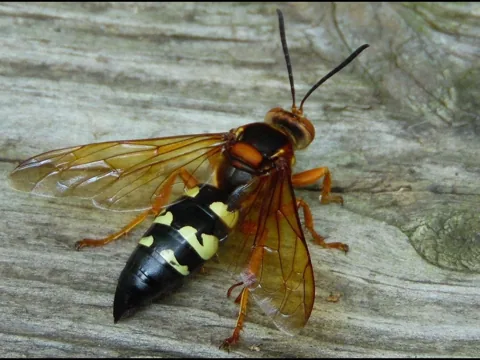 Eastern Cicada Killer
Sphecius speciosus
Cicada killers are very large solitary wasps seen mostly in July and August. Females dig burrows and stock them with annual cicadas. They look alarming, but the Missouri Department of Conservation calls them virtually harmless unless handled roughly, and Kentucky says they aren't a stinging hazard unless directly disturbed.
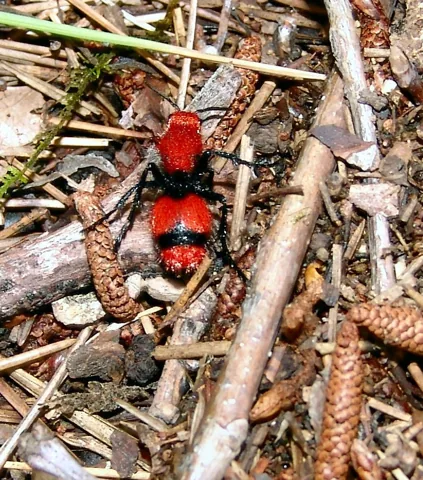 Velvet Ants (eastern velvet ant, "cow killer")
Dasymutilla occidentalis
Velvet ants aren't ants at all. They are solitary wasps in the family Mutillidae, and the wingless, fuzzy females look like large hairy ants as they run across open ground.
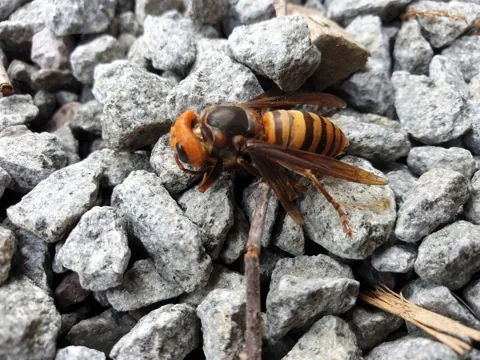 Northern Giant Hornet
Vespa mandarinia
The northern giant hornet is the world's largest hornet. It was first found in the United States near Blaine, Washington, in December 2019, and WSDA and USDA have since declared it eradicated from Washington and the United States.
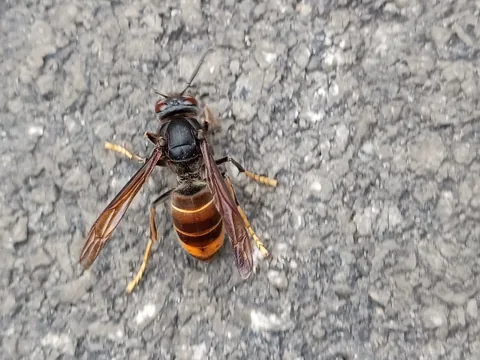 Yellow-Legged Hornet
Vespa velutina
The yellow-legged hornet (Vespa velutina) is an invasive hornet from Southeast Asia that preys on honey bees and other insects. It was first detected near Savannah, Georgia, in August 2023, and state and federal teams in Georgia, South Carolina and North Carolina are trapping it and destroying its nests.
Bee or wasp?
Bees and wasps are often brightly colored in yellow, white, orange and black as a warning, and many harmless flies copy those colors. A close look settles it.[11]
- Hair: bees are covered in hair and carry pollen on their legs; wasps are usually smooth and nearly hairless.[11][1]
- Waist: wasps typically have a slender waist. Paper wasps and mud daubers have long, thin waists; yellowjackets have a very short waist that is barely visible.[11][1]
- Wings: bees and wasps have four wings. Flies that mimic them have two and are generally harmless.[11]
- Food: honey bees usually aren't drawn to human food, though they may visit sweets. Yellowjackets scavenge meat, sweets and garbage, so the striped insect at your picnic plate or soda can is almost always a yellowjacket.[1][4]
- Bumble bee or carpenter bee: bumble bees have a hairy, black-and-yellow abdomen and a head narrower than the thorax; carpenter bees have a shiny, mostly hairless abdomen and a head as broad as the thorax.[6][9]
- Paper wasp or yellowjacket: paper wasps fly with their legs dangling, while yellowjackets hold their legs close to the body. The yellow-and-black European paper wasp also has orange-tipped antennae.[16]
- Who can sting: only females. Male bees and wasps cannot sting, which is why hovering male carpenter bees and cicada killers are harmless however close they come.[11][6][7]
Honey bee (Apis mellifera)
The managed pollinator that also lives wild in hollow trees and sometimes in house walls. Kentucky notes that despite being so well known, honey bees are still misidentified often.[5][1]
- ID marks: fuzzy, slender bees with stripes, less brightly striped and hairier than yellowjackets, with pollen baskets on the hind legs.[11][1]
- Nest: wax comb inside a cavity, usually a hollow tree but often a wall void or attic, sometimes some distance from the entrance hole. Unlike wasp and bumble bee colonies, honey bee colonies live through the winter, and a feral colony in a house may survive for many years.[5][11]
- Swarms: in spring and early summer a colony splits and part of it hangs in a temporary cluster on a branch or bush while scouts look for a new home. Swarms are usually not aggressive and move on within a day or two. Kentucky says swarms are common from late April through June.[11][5]
- Stinging: honey bees are unlikely to sting unless trapped or stepped on, but an established colony in a building becomes defensive and is much more likely to sting than a swarm. The stinger is barbed and stays in the skin, so each bee stings only once.[1][5][2]
- Africanized honey bees look the same and carry the same venom, but they are less predictable, defend a larger area around the nest, and respond faster and in greater numbers.[2]
- Beneficial: yes, for pollination and honey.[5][11]
- What to do: leave a swarm alone or call a beekeeper; your county extension office or a local fire station may have a list of beekeepers who remove bees from buildings. A colony in a wall has to be removed along with its comb, or the honey can seep through walls and attract robber bees, wax moths and carpet beetles. Afterward, plug the entrance holes.[5]
Bumble bees (Bombus)
Big, loud, furry bees that are social like honey bees but live in small colonies that last only one summer.[9]
- ID marks: stout, hairy bodies banded with black and yellow, some with orange or red, from 1/3 to 1 3/8 inches depending on caste.[9]
- Nest: an existing cavity, often underground in an abandoned rodent burrow, or in old bales of hay or straw, along foundations, in sheds, in empty bird boxes or even old mattresses. The queen lines it with dry grass or moss and builds wax pots inside.[9][6][12]
- Colony size: Ohio State says usually fewer than 50 bees; Penn State describes colonies of hundreds of workers. Workers, males and the old queen die with the first hard freeze, and only mated new queens overwinter.[9][12][11]
- Stinging: queens and workers can sting more than once, unlike honey bees. Bumble bees defend their nests, and alarmed workers may dive at animals that come close, but nests are often never noticed.[9]
- Beneficial: yes; queens pollinate early-blooming plants in spring, and each queen lost then is a colony that never forms.[12][11]
- What to do: avoid the nest area if you can. If the first frost is near, waiting it out resolves the problem.[9][11]
Carpenter bees (Xylocopa)
The large black bees hovering around eaves, decks and fascia boards in spring. They bore nest tunnels in wood but don't eat it.[6][3]
- ID marks: large, robust, bumble bee-like, with a shiny, mostly hairless black abdomen, sometimes with metallic blue reflections. Females are about 5/8 to 1 inch long; males often have pale hair on the thorax.[3][6]
- Nest: a perfectly round entrance hole about the diameter of your little finger (UC IPM gives tunnels 1/2 inch across), often with coarse sawdust below. Inside, the tunnel turns at a right angle and runs parallel to the surface. They favor bare, weathered softwoods such as cedar, redwood, cypress and pine, in eaves, rafters, fascia, siding, decks and outdoor furniture.[6][3]
- Stinging: carpenter bees live alone rather than in colonies and are less inclined to sting. Males hover in front of people near nests but cannot sting; females sting only if handled or provoked.[6][3]
- Damage: seldom as destructive as termites, but tunnels reused year after year can weaken wood and let in moisture and decay.[6][3]
- Beneficial: generally yes, as pollinators. UC IPM does not recommend insecticides under most conditions.[3]
- What to do: paint or varnish exposed wood, since carpenter bees usually won't tunnel into painted wood. Fill old holes after the bees have left (UC IPM suggests steel wool and caulk; Kentucky, a glued dowel), then repaint.[6][3]
Sweat bees (Halictidae)
Small bees that land on sweaty skin to drink the salt. Most people never notice them except when one gets pinched against the skin.[23][24]
- ID marks: small, about 0.1 to 0.4 inch, usually black or brown, though many are bright metallic green or blue. Some Agapostemon have a green head and thorax with a black-and-yellow striped abdomen.[23][24]
- Nest: nearly all nest in the ground, often in loose, sandy soil; a few nest in rotting wood or under loose bark.[24][23][9]
- Stinging: not aggressive. They sting only when pressed or trapped in a fold of skin, such as the crease of an elbow or an armpit, and the pin-prick sting rarely hurts for more than a few minutes.[24][9][17]
- Beneficial: yes; they are important native pollinators, and Missouri notes many native bees are declining.[24][9]
- What to do: brush them off gently, and stay indoors or cover up on very hot days if they bother you. No control is needed.[24][17]
Yellowjackets (Vespula)
Kentucky calls yellowjackets arguably the most dangerous stinging insects in the United States. They are unpredictable near the nest, they scavenge human food late in the season, and they sting repeatedly because the stinger has no barbs.[4][1]
All yellowjackets are about 1/2 to 1 inch long with jagged bright yellow and black bands and a barely visible waist. Their nests are made of chewed-wood paper, with tiers of comb enclosed in a paper envelope that has a single entrance. Colonies reach 1,500 to 15,000 individuals depending on the species. In California, UC IPM says the western yellowjacket (Vespula pensylvanica), sometimes called the meat bee, is the one most often encountered.[1]
- Eastern yellowjacket (V. maculifrons): workers about 1/2 inch, queens up to 18 mm. A wide, anchor-shaped black mark on the first abdominal segment and no free black dots on the other segments. A native ground nester in lawns, woods, rock walls and creek banks, occasionally in wall voids. It defends the nest aggressively.[13][25]
- German yellowjacket (V. germanica): workers about 1/2 inch, queens about 3/4 inch. A small diamond- or spade-shaped black mark on the first segment and separate black dots down each side. Invasive; in North America most nests are in attics, wall voids and similar cavities, with 1,000-3,000 workers by fall. It scavenges at trash cans, picnics and fallen fruit, and is generally absent from the Southeast.[14][25]
- Southern yellowjacket (V. squamosa): small workers about 3/8 inch; queens about 3/4 inch and burnt orange. Look for lengthwise black and yellow stripes on the plate just behind the head. Usually nests underground, sometimes in hay bales or wall insulation, and its queens often take over eastern yellowjacket nests. Nests can hold over a thousand wasps, and in southern Mississippi a few survive the winter and grow very large.[18][25]
- When they sting: usually when the nest is disturbed, by mowing, gardening or children at play, or when a forager is swatted or trapped against skin. Defensiveness rises through the season as colonies grow and food gets scarce, and in late summer they crawl into soda cans, where a sting in the mouth or throat is dangerous.[1][4]
- Beneficial: partly. Yellowjackets kill caterpillars, earwigs and other pests, and Penn State says a nest away from doors, mowed lawns and play areas can be ignored.[13][1]
- What to do: cover food and drinks outdoors and keep trash lidded. Colonies die out in fall, so a late-season nest may only need avoiding. A nest in a wall needs a professional, and the entrance should never be sealed, because the wasps can chew through drywall into the house.[4][13][14]
Bald-faced hornet (Dolichovespula maculata)
Not a true hornet but an aerial-nesting yellowjacket, named for its white face markings.[17][10]
- ID marks: black with white or ivory markings, larger than a yellowjacket.[25][4]
- Nest: a large, gray paper nest shaped like a bloated football, hung in a tree or bush or on the side of a building, with a single entrance near the bottom. It is often hidden among branches in dense trees, and its many-layered envelope is somewhat water-repellent.[4][17][1]
- Stinging: nests can hold hundreds of wasps that are extremely aggressive when disturbed. Unlike ground-nesting yellowjackets, they don't turn to scavenging at picnics late in the season.[4][1]
- Beneficial: yes; they hunt other insects, and UC IPM lists them among the predators of other social wasps.[17][1]
- What to do: a nest away from frequently used areas can be left until it dies out over winter. Kentucky advises calling a professional when elimination is needed.[4]
European hornet (Vespa crabro)
The large hornet of the eastern United States, introduced from Europe and first reported here in the 1840s. Ohio State calls it the only true hornet (genus Vespa) in North America and the largest wasp in Ohio.[10][15]
- ID marks: workers up to about 1 inch, queens larger (Penn State gives up to 35 mm; Ohio State, 1 1/2 inches). Reddish-brown thorax and head with a yellow face, and a yellow abdomen whose dark bands carry teardrop-shaped extensions.[15][10]
- Nest: light brown paper inside a protected cavity, usually a hollow tree, often 6 feet or more above ground, and sometimes in attics, barns, wall voids or behind shutters. Nests peak in mid-September with 200-400 workers, occasionally up to 1,000.[10][15]
- Behavior: one of the few wasps that flies at night. It comes to lit windows and porch lights, strips bark from lilac and other shrubs for sap, and feeds on fallen fruit in fall.[10][15]
- Stinging: Penn State says the sting is only about as painful as a honey bee's, but the stinger is smooth and they can sting multiple times.[15]
- Beneficial: yes, as a predator of grasshoppers, flies and yellowjackets. It is often mistaken for the northern giant hornet, which has been found only in Washington State and British Columbia.[15][10]
- What to do: wait for the first hard frosts to kill the colony, pick up fallen fruit and switch off lights near the nest. Never block a nest entrance in a wall. Because these hornets fly at night, treating a nest after dark still carries sting risk.[15][10]
Paper wasps (Polistes)
The wasps with the open, umbrella-shaped nests under eaves and porch ceilings. They are less defensive than yellowjackets and rarely sting unless the nest is bumped.[1][22]
- ID marks: slender, long-legged wasps with a distinct, very thin waist, about 5/8 to 3/4 inch (Clemson) or up to 1 inch (UC IPM). Most are brown or rust-colored with yellow or red markings; the invasive European paper wasp is yellow and black and looks like a yellowjacket.[22][1][4]
- Nest: a single comb of open cells hanging from a short stalk like an upside-down umbrella, with no outer envelope. Found under eaves and gutters, on porch ceilings and door frames, under deck rails, in shrubs, and inside grills, mailboxes and light fixtures. Nests rarely grow larger than an outstretched hand and hold 15 to 200 wasps.[1][4][22]
- Stinging: not very aggressive, but they sting when someone blunders into a hidden nest in a shrub or near a doorway.[4][22]
- Beneficial: yes; they feed caterpillars and other garden pests to their larvae.[22][1]
- What to do: leave nests away from doors and walkways. A small nest near people can be sprayed with a wasp and hornet aerosol in the evening, and knocking down a newly started nest in spring makes the queen go elsewhere.[22][1][4]
Mud daubers
Solitary wasps that build mud nests and stock them with paralyzed spiders. Each nest is built by one female, with no workers to defend it.[20][17]
- ID marks: thread-waisted, 1/2 inch to slightly over 1 inch, often with bright metallic color. Common species are the black and yellow mud dauber, the blue mud dauber and the pipe organ mud dauber.[20][1]
- Nest: hard mud on ceilings and walls, from clusters of tubes several inches long to small vase-shaped cells on plant stems, or mud plastered into cracks and the openings of equipment and lawn furniture.[20][1]
- Stinging: not aggressive and rarely sting unless threatened or touched. The black and yellow mud dauber's sting was rated 1, the mildest level, on a 4-point pain scale.[20][1]
- Beneficial: they hunt spiders, and some species hunt caterpillars.[20]
- What to do: scrape nests off. UC IPM says nests can be removed safely in winter without spraying.[1][17]
Eastern cicada killer (Sphecius speciosus)
A huge solitary wasp that digs burrows in lawns and beds in midsummer. It looks alarming but is one of the least dangerous wasps in the yard.[7][10]
- ID marks: females 1.5 to nearly 2 inches, males up to 1.5 inches. Dark orange head and thorax fading to a black abdomen with three light-yellow bands, and orange-tinged wings and legs.[7]
- Nest: burrows in dry, sandy, loose soil in full sun, with piles of soil at the entrance. Tunnels run 12-15 inches deep and up to 36 inches long. Many females may nest in the same patch, but each digs her own burrow.[7][15]
- Season: adults are seen mostly in July and August, when annual cicadas are singing.[7]
- Stinging: females are mild-mannered and sting almost only when stepped on or grabbed. Males have no stinger, though they hover at eye level and may even bump people near the nest site.[7][9][10]
- Beneficial: yes; Ohio State counts all digger wasps as beneficial predators. Females don't defend their burrows as vigorously as social wasps, and the damage is mostly soil piles in turf.[9][7]
- What to do: usually nothing. Thicker turf, mulch, shade or more watering makes a spot less attractive; Ohio State suggests keeping sand in play areas 4 inches deep or less over a fiber ground cloth.[7][8][9]
Velvet ants (Mutillidae)
Not ants but wasps whose females have no wings. The large eastern velvet ant (Dasymutilla occidentalis) is often called the cow killer.[21][19]
- ID marks: covered in dense, velvety hair, black with red, orange or yellow. The eastern velvet ant is about 3/4 inch (Clemson) to 1 inch (Mississippi State). True ants have elbowed antennae and a node in the waist; velvet ants don't.[21][19][8]
- Where you see them: females running fast over bare ground and sandy lawns from about May through September in South Carolina, often searching for cicada killer and other ground-wasp nests to parasitize. Winged males are rarely noticed.[21][19]
- Stinging: not aggressive, but the female's long stinger delivers an extremely painful sting, called the most painful in the Southeast by people who have had it. It is rarely dangerous. Stings happen when one is stepped on barefoot, sat on or picked up. They may squeak when disturbed.[21][19]
- Beneficial: they parasitize other insects, mainly ground-nesting bees and wasps.[21]
- What to do: wear shoes on lawns in summer and leave them alone. Their tough outer shell means sprays and stomping work poorly; Clemson suggests moving one carefully if it must go.[21][19]
Whose nest is this?
If insects are flying straight in and out of one spot, there is probably a nest there. Watch from a distance before deciding what to do.[1][17]
- Gray paper ball, football-sized or bigger, in a tree, bush or under an eave, with one hole near the bottom: bald-faced hornet, or another aerial yellowjacket.[4][1]
- Single open comb of hexagonal cells on a short stalk, cells visible from below: paper wasps.[1][16]
- A plain hole in the lawn, a rock wall or under landscape timbers with a steady stream of wasps: yellowjackets. The paper nest underground can be much larger than the hole suggests.[4][25]
- Wasps going in and out of a gap in siding, a soffit or an attic vent: yellowjackets (often German) or European hornets; a stream of bees there means a honey bee colony. Never seal the opening while they are active.[14][10][5]
- A wet spot that turns into a hole in a ceiling or wall: yellowjackets enlarging a nest inside, as they do when digging in soil.[1]
- Perfectly round holes about 1/2 inch across in bare wood, with sawdust below: carpenter bees.[6][3]
- Hard mud tubes or mud cells on walls, ceilings or equipment: mud daubers.[20][1]
- Many small mounds of soil about an inch high with a hole in the center, in bare ground in spring: solitary ground bees. They are docile and only sting if handled.[9][12]
- Large soil piles in sunny, sandy turf in midsummer, each with its own large wasp: cicada killers.[7][25]
- A large cluster of bees hanging on a branch: a honey bee swarm resting, not a nest. It usually moves on within a day or two.[11][5]
- Bees going in and out of an old mouse nest, a bird box or insulation in a shed: bumble bees.[12][9]
Sting first aid and allergies
For most people a sting means sharp pain for a few minutes, then a dull ache, redness and swelling that can linger for several days. Sources differ on how many people are allergic: UC IPM gives one to two people in 1,000, while Kentucky cites about two million people in the U.S., roughly 1%, as hypersensitive to the venom.[2][4][17]
- Have someone stay with the person to watch for an allergic reaction. Symptoms can start right after the sting or up to 30 minutes later.[26][2]
- Get a honey bee's stinger out right away: venom keeps pumping from it for 45 to 60 seconds. CDC and MedlinePlus say to scrape it out with a fingernail, gauze or a card edge rather than squeezing it with tweezers; UC IPM and Penn State say speed matters more than method.[2][26][27][17]
- Wash the sting with soap and water. Only honey bees normally leave the stinger behind, because theirs is barbed.[26][27][2]
- Ice the site to reduce swelling; MedlinePlus says to use ice wrapped in a cloth, 10 minutes on and 10 minutes off. Don't scratch it, which can add swelling and infection.[26][27]
- An antihistamine may help the itching and swelling; follow the package directions, as it can cause drowsiness. Watch for increasing redness, swelling or pain over the next few days as signs of infection.[26][27]
- Anaphylaxis signs include hives or flushing over the body, trouble breathing or swallowing, swelling of the face, mouth or throat, dizziness or fainting, chest pain, vomiting and a racing pulse. Kentucky warns not to wait to see if they pass, since death can occur in minutes.[27][4]
- People known to be allergic should carry a prescription epinephrine auto-injector and go to an emergency room after using it, in case symptoms return. CDC also recommends a medical ID bracelet or necklace.[4][2][26]
- Anyone who has had a severe, body-wide reaction should see an allergist. Venom immunotherapy (allergy shots) works about 95% of the time, according to UC IPM.[27][2]
- Many stings at once are dangerous even without allergy: venom damage can clog the kidneys days later, so anyone stung many times should see a doctor and be watched for a week or two.[2][1]
- If many insects attack, run, get indoors or into shade, and don't jump into water, because some insects wait above it. Pulling your shirt up over your head as you go protects your face.[26][2]
Avoiding stings
- Don't swat. If a bee or wasp lands on you, wait for it to leave or brush it off slowly; most stings happen when an insect is slapped or trapped against the skin.[1][4][26]
- Cover food and drinks outdoors, look before you sip from a can, and keep trash cans lidded and away from seating.[4][1]
- Skip perfume, cologne and scented soaps around bees and wasps, and don't go barefoot in clover or other blooming ground covers. Insect repellents don't keep stinging insects away.[2][4]
- Walk the yard for nest entrances before mowing or trimming, especially in late summer.[4][13]
- If a bee or wasp gets into your car, stop slowly and open all the windows.[26][4]
Leave it, or remove it?
- Most bees and wasps are pollinators or predators of other pests. Penn State's advice is to leave a nest alone if it isn't damaging the house or threatening the people in it.[11][17]
- Timing matters: bumble bee, paper wasp, yellowjacket and hornet colonies all die in late fall, and next year's queens start new nests, usually somewhere else. A nest found in September or October may only need avoiding; one found in May will keep growing, and is safer to deal with while small.[17][11][10]
- Call a professional for nests in walls, attics or high in trees, for large bald-faced hornet or yellowjacket nests, for honey bee colonies in a structure (ask about a beekeeper first), or if anyone in the house is allergic. Penn State advises allergic people never to remove a colony themselves.[4][13][17][5]
- Treating a nest yourself means working at night in protective clothing with a product labeled for the insect. The wasp and hornet nest removal guide covers the methods and precautions.[17][4][1]
Common questions
- What is the most aggressive stinging insect?
- Yellowjackets, including the bald-faced hornet, are the most defensive around their nests and the most likely to sting. Paper wasps, bumble bees and honey bees away from a hive are far less likely to attack, and solitary bees and wasps rarely sting at all.[4][1][2][11]
- What is the difference between a hornet and a yellowjacket?
- Ohio State calls the European hornet the only true hornet (genus Vespa) in North America, apart from recent invasive finds such as the yellow-legged hornet in Georgia. The bald-faced hornet is an aerial yellowjacket in the genus Dolichovespula, so both it and the yellowjackets build enclosed paper nests and defend them hard.[10][17]
- Can a bee sting you more than once?
- A honey bee usually can't, because its barbed stinger stays in your skin. Bumble bees, wasps, yellowjackets and hornets have smooth stingers and can sting repeatedly.[2][9][1][15]
- Do male bees and wasps sting?
- No. Only females have a stinger. That's why hovering male carpenter bees and the males that guard cicada killer nesting areas are harmless.[11][6][7]
- Will a wasp nest go away on its own?
- Yes. Paper wasp, yellowjacket and hornet colonies die off when cold weather comes, and the next year's queens build new nests elsewhere. Honey bee colonies are the exception: they live through winter and can stay in a wall for years.[4][17][11]
- What should I do right after a bee sting?
- Get the stinger out quickly, wash the area with soap and water, apply ice, and watch for signs of a serious reaction such as trouble breathing or facial swelling. Call 911 if they appear.[26][27][2]
Photo credits
- Western Honey Bee: (c) Doug Miller, some rights reserved (CC BY) — via iNaturalist, CC BY 4.0
- Africanized Honey Bee: (c) Sunčana Bradley, some rights reserved (CC BY) — via iNaturalist, CC BY 4.0
- Common Eastern Bumble Bee: Jesse Rorabaugh, public domain (CC0), via iNaturalist
- Eastern Carpenter Bee: Erik Schiff, public domain (CC0), via iNaturalist
- Small Carpenter Bees: (c) James Kindt, some rights reserved (CC BY) — via iNaturalist, CC BY 4.0
- Sweat Bees: (c) eebee, some rights reserved (CC BY) — via iNaturalist, CC BY 4.0
- Mining Bees: (c) Bernie Paquette, some rights reserved (CC BY) — via iNaturalist, CC BY 4.0
- Eastern Yellowjacket: Brighton Lee, public domain (CC0), via iNaturalist
- German Yellowjacket: (c) Gianni Del Bufalo bygdb, some rights reserved (CC BY) — via iNaturalist, CC BY 4.0
- Southern Yellowjacket: (c) Cole Shoemaker, some rights reserved (CC BY) — via iNaturalist, CC BY 4.0
- Western Yellowjacket: (c) eebee, some rights reserved (CC BY) — via iNaturalist, CC BY 4.0
- Aerial yellowjacket: (c) Chris O'Donoghue, some rights reserved (CC BY) — via iNaturalist, CC BY 4.0
- Bald-faced Hornet: (c) Amy Schnebelin, some rights reserved (CC BY) — via iNaturalist, CC BY 4.0
- European Hornet: (c) Михаил Малышев, some rights reserved (CC BY) — via iNaturalist, CC BY 4.0
- European Paper Wasp: (c) Andrew McKinlay, some rights reserved (CC BY) — via iNaturalist, CC BY 4.0
- Red Wasp: (c) Jay Pruett, some rights reserved (CC BY) — via iNaturalist, CC BY 4.0
- Black and Yellow Mud Dauber: (c) Maciej Boenisch, some rights reserved (CC BY) — via iNaturalist, CC BY 4.0
- Eastern Cicada Killer: (c) Steve Kerr, some rights reserved (CC BY) — via iNaturalist, CC BY 4.0
- Velvet Ants (eastern velvet ant, "cow killer"): (c) Gordon C. Snelling, some rights reserved (CC BY) — via iNaturalist, CC BY 4.0
- Northern Giant Hornet: (c) Lek Khauv, some rights reserved (CC BY) — via iNaturalist, CC BY 4.0
- Yellow-Legged Hornet: (c) Javier Sánchez Álvarez, some rights reserved (CC BY) — via iNaturalist, CC BY 4.0
Sources
- University of California Statewide IPM Program, “Pest Notes: Yellowjackets and Other Social Wasps, UC ANR Publication 7450.” ipm.ucanr.edu/home-and-landscape/yellowjackets-and-other-social-wasps/ (accessed 2026-11-10)
- University of California Statewide IPM Program, “Pest Notes: Bee and Wasp Stings, UC ANR Publication 7449.” ipm.ucanr.edu/home-and-landscape/bee-and-wasp-stings/ (accessed 2026-11-10)
- University of California Statewide IPM Program, “Pest Notes: Carpenter Bees.” ipm.ucanr.edu/home-and-landscape/carpenter-bees/ (accessed 2026-11-10)
- University of Kentucky Entomology, “ENTFACT-620: Controlling Wasps, Hornets, and Yellowjackets (M. F. Potter).” entomology.mgcafe.uky.edu/ef620 (accessed 2026-11-10)
- University of Kentucky Entomology, “ENTFACT-606: Controlling Nuisance Honey Bees (R. Bessin).” entomology.mgcafe.uky.edu/ef606 (accessed 2026-11-10)
- University of Kentucky Entomology, “ENTFACT-611: Carpenter Bees.” entomology.mgcafe.uky.edu/ef611 (accessed 2026-11-10)
- University of Kentucky Entomology, “ENTFACT-004: Cicada Killer Wasps.” entomology.mgcafe.uky.edu/ef004 (accessed 2026-11-10)
- University of Kentucky Entomology, “ENTFACT-411: Yard Wasps.” entomology.mgcafe.uky.edu/ef411 (accessed 2026-11-10)
- Ohio State University Extension, “HYG-2143: Bumble Bees and Solitary Bees and Wasps in Urban Landscapes.” ohioline.osu.edu/factsheet/HYG-2143-10 (accessed 2026-11-10)
- Ohio State University Extension, “ENT-0102: European Hornets and Look-Alikes (A. Kulhanek).” ohioline.osu.edu/factsheet/ent-0102 (accessed 2026-11-10)
- Penn State Extension, “Five-Step Decision Support: Nesting Bees and Wasps Near Homes.” extension.psu.edu/five-step-decision-support-nesting-bees-and-wasps-near-homes (accessed 2026-11-10)
- Penn State Extension, “Spring Bees: Who Are They and Where Do They Live?.” extension.psu.edu/spring-bees-who-are-they-and-where-do-they-live (accessed 2026-11-10)
- Penn State Extension, “Eastern Yellowjacket.” extension.psu.edu/eastern-yellowjacket (accessed 2026-11-10)
- Penn State Extension, “German Yellowjackets.” extension.psu.edu/german-yellowjackets (accessed 2026-11-10)
- Penn State Extension, “European Hornet.” extension.psu.edu/european-hornet (accessed 2026-11-10)
- Penn State Extension, “European Paper Wasp.” extension.psu.edu/european-paper-wasp (accessed 2026-11-10)
- Penn State Extension, “Getting Rid of Paper Wasps, Yellowjackets, and Other Stinging Insects.” extension.psu.edu/getting-rid-of-paper-wasps-yellowjackets-and-other-stinging-insects (accessed 2026-11-10)
- Mississippi State University Extension Service, “Bug's Eye View: Southern Yellowjackets, Vol. 2, No. 32 (B. Layton).” extension.msstate.edu/taxonomy/term/4171/2016/southern-yellowjackets-vol-2-no-32 (accessed 2026-11-10)
- Mississippi State University Extension Service, “Bug's Eye View: Eastern Velvet Ant, Vol. 5, No. 22 (B. Layton).” extension.msstate.edu/newsletters/bugs-eye-view/2019/eastern-velvet-ant-vol-5-no-22 (accessed 2026-11-10)
- Clemson University Home & Garden Information Center, “Mud Daubers: Identification, Habits, and Control.” hgic.clemson.edu/factsheet/mud-daubers/ (accessed 2026-11-10)
- Clemson University Home & Garden Information Center, “Velvet Ants.” hgic.clemson.edu/factsheet/velvet-ants/ (accessed 2026-11-10)
- Clemson University Home & Garden Information Center, “Paper Wasps.” hgic.clemson.edu/factsheet/paper-wasps/ (accessed 2026-11-10)
- Washington State University Extension, “Halictidae: Alkali Bees, Sweat Bees and Cuckoo Bees (HortSense).” hortsense.cahnrs.wsu.edu/fact-sheet/halictidae-alkali-bees-sweat-bees-and-cuckoo-bees/ (accessed 2026-11-10)
- Missouri Department of Conservation, “Halictid Bees (Sweat Bees).” mdc.mo.gov/discover-nature/field-guide/halictid-bees-sweat-bees (accessed 2026-11-10)
- Missouri Department of Conservation, “Yellowjackets (Vespula Wasps).” mdc.mo.gov/discover-nature/field-guide/yellowjackets-vespula-wasps (accessed 2026-11-10)
- Centers for Disease Control and Prevention, “Insects and Scorpions at Work (NIOSH).” www.cdc.gov/niosh/outdoor-workers/about/insects-and-scorpions.html (accessed 2026-11-10)
- MedlinePlus, U.S. National Library of Medicine, “Insect bites and stings (Medical Encyclopedia).” medlineplus.gov/ency/article/000033.htm (accessed 2026-11-10)