How to identify it
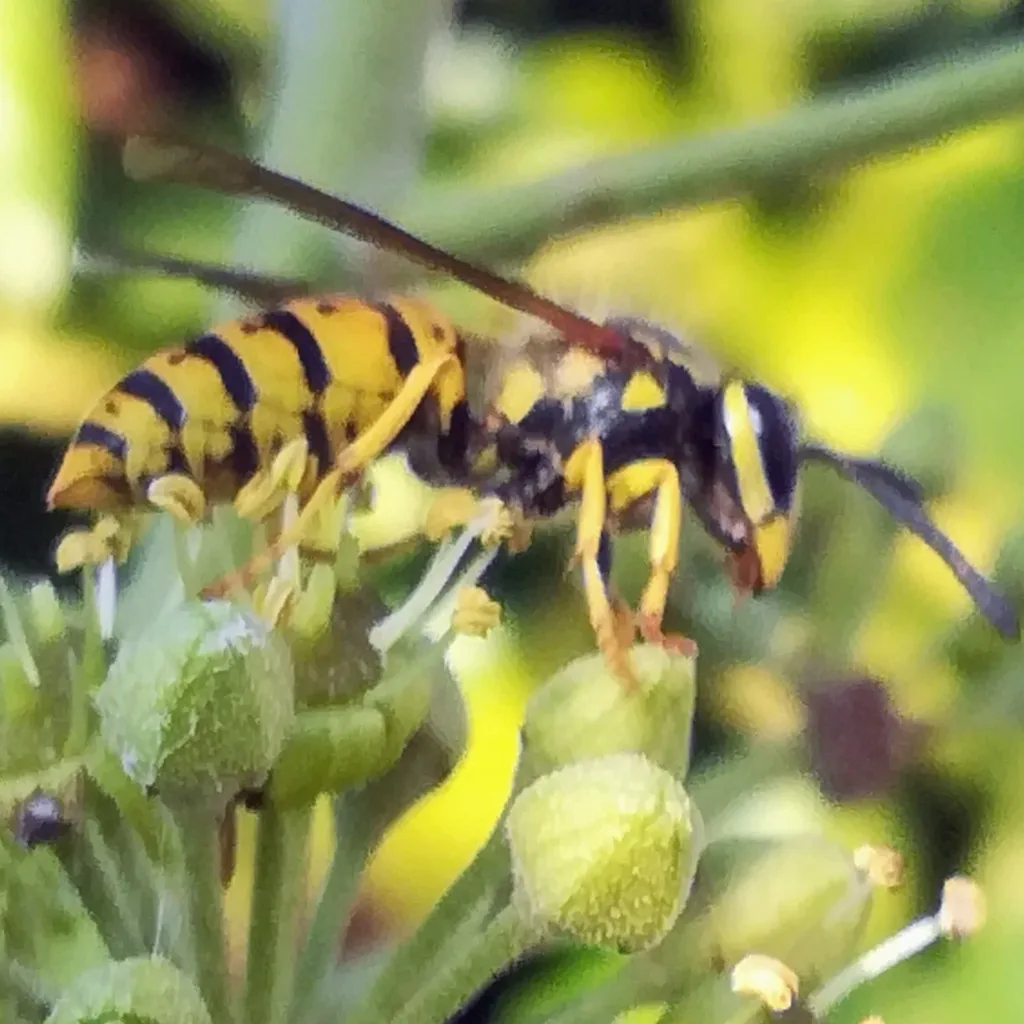
- Workers are about 1/2 inch long and queens about 3/4 inch, black and yellow.[1]
- The abdomen usually has a small spade-shaped black mark on the first segment and black spots down both sides from the second to fifth segments.[1]
- Nests are horizontal combs inside a gray to brown paper envelope, usually in attics, wall voids and other open spaces, sometimes underground.[1]
Look-alikes
| Look-alike | How to tell them apart |
|---|---|
| Eastern yellowjacket | Eastern yellowjackets have a wide, anchor-shaped black mark on the first segment and usually nest in the ground.[2] |
Where it lives
First detected in New York in 1891 and common across the Northeast by the 1970s, it now spans the northern US and southern Canada; south of Washington, D.C., it's limited to higher Appalachian elevations.[1]
Biology and life cycle
An overwintered queen starts each nest alone in spring; by fall, nests usually hold 1,000 to 3,000 workers.[1]
New queens and males leave to mate in fall, the males die, and new queens hibernate in dry, protected places while the old nest dies off.[1]
Nests in warm spots, including heated buildings, occasionally survive winter and keep growing, though large perennial nests are uncommon in North America.[1]
Damage and signs
Health risk
They sting when disturbed; people who are allergic or can't treat a nest safely should call a professional.[1]
Control
Prevention
The simplest control is to wait for the first hard frost or two, which kills these annual nests.[1]
Keep them out
To keep overwintering queens out, seal cracks in siding and around windows and pipes that lead into wall voids.[1]
Traps and physical control
Never cover or close the outside entrance of a nest in a wall void; trapped wasps may chew into living spaces.[1]
Pesticides
Insecticidal dust at the entrance works best for hidden nests; for exposed nests, aerosol wasp sprays must soak through the paper envelope.[1]
Common questions
Sources
- Penn State Extension, “German Yellowjackets.” extension.psu.edu/german-yellowjackets (accessed 2026-10-06)
- Penn State Extension, “Eastern Yellowjacket.” extension.psu.edu/eastern-yellowjacket (accessed 2026-10-06)
- iNaturalist, “Vespula germanica taxon page (order and family).” www.inaturalist.org/taxa/126155 (accessed 2026-10-06)