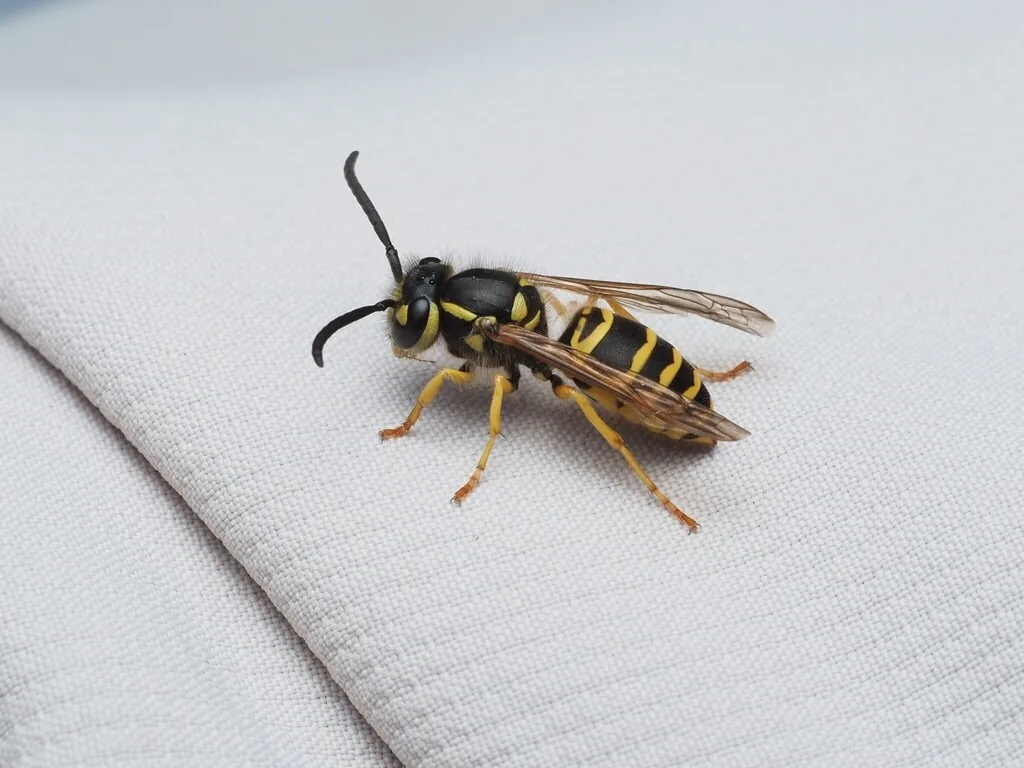
How to identify it
Look-alikes
| Look-alike | How to tell them apart |
|---|---|
| German yellowjacket | German yellowjackets have a small spade-shaped black mark on the first segment and black spots down the sides of the abdomen.[2] |
| Yellowjackets (general) | This page covers one species; the general yellowjacket page covers stings and control for all of them.[1] |
| Southern yellowjacket | Its workers are yellow and black, but its queens are much larger, about 3/4 inch, and burnt orange.[3] |
Where it lives
It's found through most of the eastern US, from North Dakota to Texas and east to the Atlantic coast.[1]
Biology and life cycle
In Pennsylvania, overwintered queens start nests in May or early June in forest floors, rock walls, creek banks, lawns and occasionally buildings.[1]
The first workers appear in June, after which the queen stays inside; males and new queens are produced in August and September.[1]
Mated queens overwinter under bark, in logs and leaf litter, and other protected spots.[1]
Damage and signs
- In northern cities, nests are occasionally built in the wall voids of homes and other buildings.[1]
Health risk
Stings are painful, and for sensitive or allergic people they can be a serious health risk.[1]
Control
Prevention
Nests away from doors, mowed lawns and public areas can be left alone; the wasps are beneficial predators of earwigs and caterpillars.[1]
Traps and physical control
Never plug the opening of a nest in a wall; the wasps may chew through the interior wall into the house.[1]
Pesticides
Ground nests can be killed at night by dusting insecticide directly down the opening while wearing protective clothing; scout the nest by day first.[1]
When to call a professional
Nests in walls or attics, and any nests near the homes of people with sting allergies, should be treated by a professional.[1]
Common questions
- How can I tell an eastern yellowjacket from other yellowjackets?
- Look for a wide, anchor-shaped black mark on the first abdominal segment and a yellow cheek band that doesn't fully circle the eye.[1]
- Should I plug a yellowjacket hole in my wall?
- No. Plugging it can make the wasps chew through the interior wall into your home.[1]
Sources
- Penn State Extension, “Eastern Yellowjacket.” extension.psu.edu/eastern-yellowjacket (accessed 2026-10-06)
- Penn State Extension, “German Yellowjackets.” extension.psu.edu/german-yellowjackets (accessed 2026-10-06)
- Mississippi State University Extension Service, “Southern Yellowjackets (Bug's Eye View, Vol. 2, No. 32).” extension.msstate.edu/taxonomy/term/4171/2016/southern-yellowjackets-vol-2-no-32 (accessed 2026-10-14)
- iNaturalist, “Vespula maculifrons taxon page (order and family).” www.inaturalist.org/taxa/119994 (accessed 2026-10-06)