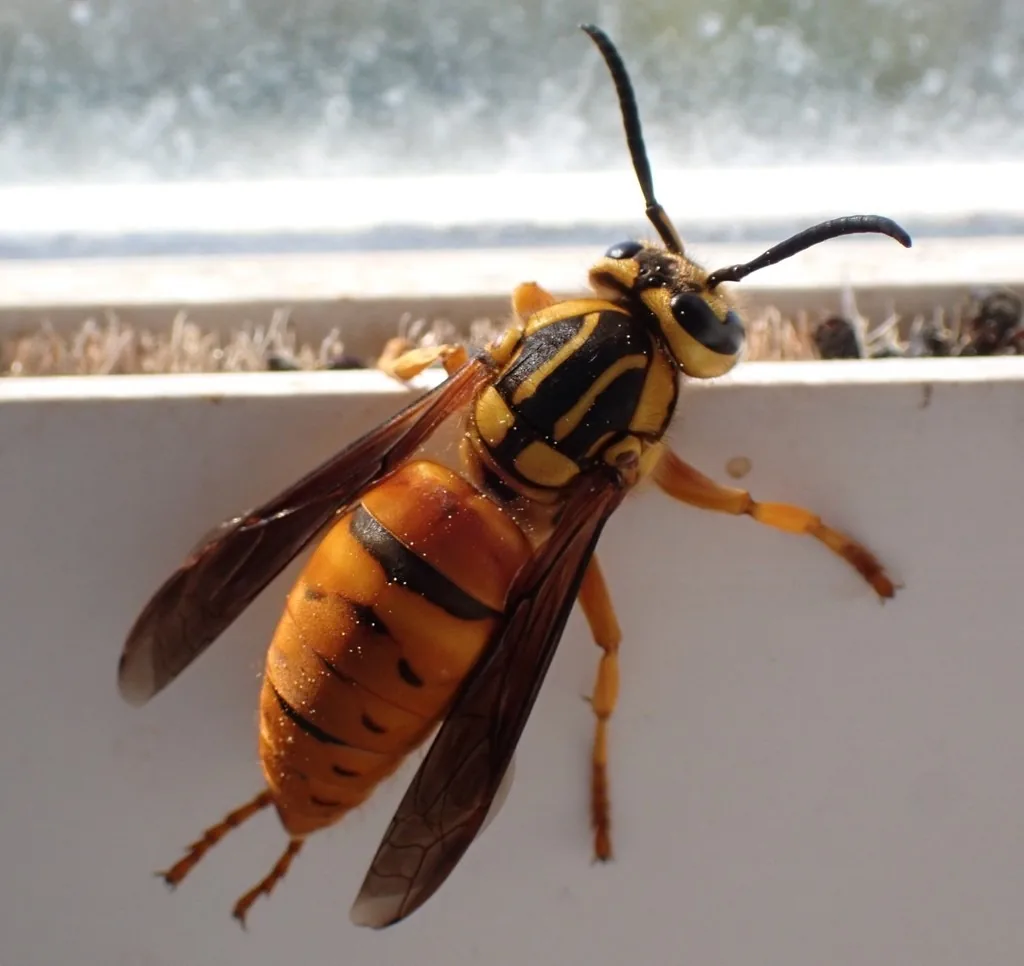
How to identify it
Look-alikes
| Look-alike | How to tell them apart |
|---|---|
| Eastern yellowjacket | Eastern yellowjacket queens are yellow and black like their workers and smaller than southern yellowjacket queens.[1] |
Where it lives
It's found in the eastern United States and parts of Mexico and Central America.[2]
Biology and life cycle
A single mated queen that overwintered under bark or a similar shelter starts each nest, which can grow to over a thousand wasps by fall.[1]
A high percentage of queens begin their nests in spring by taking over an eastern yellowjacket queen's nest.[1]
In fall each nest produces males and new queens; most nests die with freezing weather, but in the Deep South a few survive to become large perennial nests.[1]
Damage and signs
Health risk
Like other yellowjackets, they defend their nests and sting; precautions against stings are important when treating a nest.[1]
Control
Prevention
When a nest is found late in the season, avoiding the area and waiting for freezing weather may be the best approach.[1]
Treat at night, when the wasps are less active, wearing a beekeeper's veil and protective clothing.[1]
Pesticides
When a nest must go, aerosol wasp and hornet spray injected into the entrance hole is usually quick and effective.[1]
When to call a professional
For large nests or nests inside walls, UF/IFAS advises hiring a pest control operator.[2]
Common questions
Sources
- Mississippi State University Extension Service, “Southern Yellowjackets (Bug's Eye View, Vol. 2, No. 32).” extension.msstate.edu/taxonomy/term/4171/2016/southern-yellowjackets-vol-2-no-32 (accessed 2026-10-06)
- University of Florida IFAS Extension (Featured Creatures), “Yellowjackets and Hornets, Vespula and Dolichovespula spp. (EENY-081).” edis.ifas.ufl.edu/publication/IN238 (accessed 2026-10-06)
- iNaturalist, “Vespula squamosa taxon page (order and family).” www.inaturalist.org/taxa/233560 (accessed 2026-10-06)