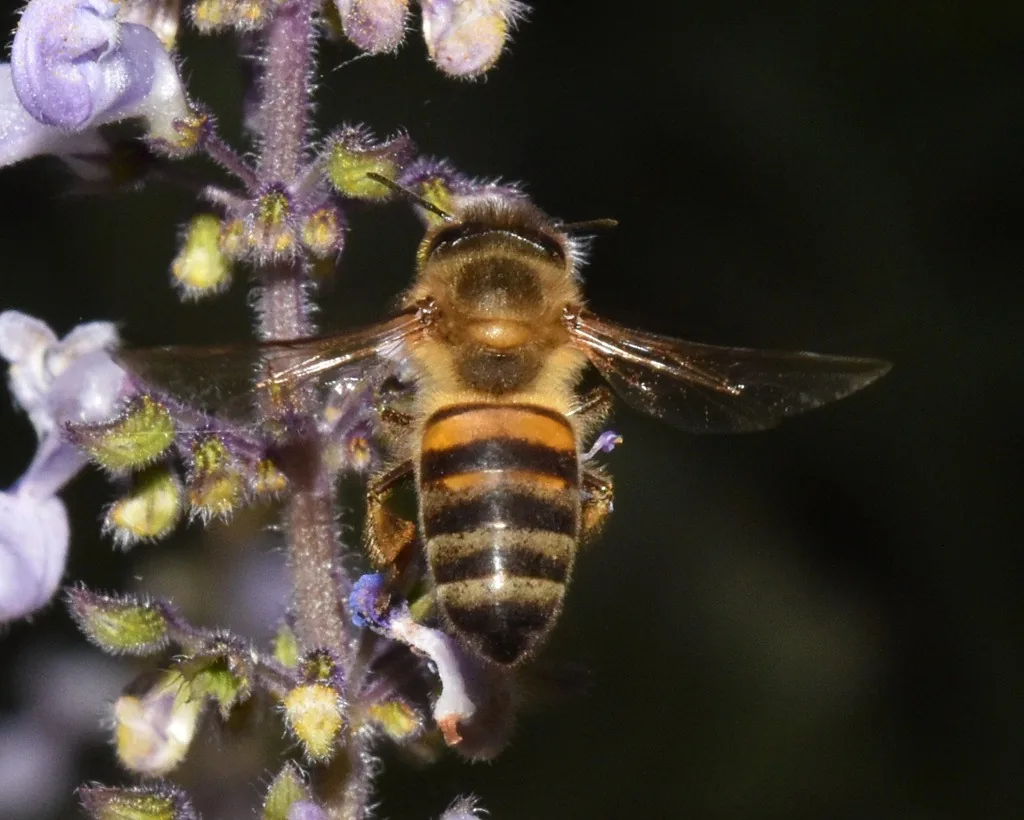
How to identify it
- You can't reliably tell them from European honey bees by eye; they're slightly smaller, and labs confirm them by measuring wings and body parts or by genetic testing.[1][2]
- Adults are robust, hairy, amber to dark brown bees with light and dark stripes on the abdomen; workers are the bees usually seen outside the nest.[3]
- The giveaway is behavior: many bees respond quickly to a disturbance, chase intruders farther and defend a larger area around the nest.[1][3]
- They nest in small spaces that European bees seldom use, such as water meter boxes, cement blocks, old tires, eaves, barbecue grills, ground cavities and exposed tree limbs.[1]
Look-alikes
| Look-alike | How to tell them apart |
|---|---|
| European honey bee | Looks nearly the same but usually defends a nest with no more than 10 to 20 bees, swarms less often and prefers larger cavities such as tree hollows and chimneys.[1] |
| Yellowjacket | Smooth, hairless body with jagged yellow and black patterns, and it can sting more than once.[3] |
Where it lives
First identified in the U.S. near Hidalgo, Texas, in October 1990. By 2012 they had been found in Texas, California, New Mexico, Arizona, Oklahoma, Louisiana, Arkansas, Alabama and Florida; colder climates appear to limit their spread north.[2][1]
Biology and life cycle
European honey bee queens tend to mate with African drones, and some African traits, including defensiveness, are genetically dominant, so Africanized bees tend to replace European bees where they spread.[2][1]
Colonies may swarm more than 10 times a year, compared with 1 to 3 times for European colonies, and often abandon the nest entirely when food is short or the nest is disturbed.[1]
Swarms also invade European colonies and replace the resident queen; usurpation rates in Arizona have run as high as 20 to 30 percent.[2][1]
In Arizona, all wild honey bees are considered Africanized to some extent.[3]
Damage and signs
Health risk
Their venom isn't stronger; deaths result from the sheer number of stings, unless the person is allergic. Children, older adults and people who can't move quickly are at highest risk because they can't escape.[1]
Control
Prevention
Never shoot at, throw rocks or water at, pour gasoline on, burn or spray pesticides on a bee colony; that only stirs the bees up.[4][5][3]
Check for bees before mowing, trimming or running power equipment; vibration and noise set them off, and attacks often happen when someone strikes a hidden nest.[1][5]
Keep pets and children indoors while using mowers or trimmers, and don't tie or pen animals near a known nest.[5]
Keep them out
Bee-proof the yard: fill wall holes 1/8 inch or larger, screen rainspouts, chimneys and water meter boxes, fill animal burrows and remove overturned pots. Don't seal openings bees are actively using.[3]
When to call a professional
Have wild colonies near places people use removed by an experienced beekeeper or pest management professional; many U.S. attacks happen to people who knew about a nest and left it or tried to remove it themselves.[1][3]
What to do if bees attack
Run away right away. Cover your head and face with your shirt or hands, without slowing down, and get inside a building or car and close the doors.[4][1][3]
If there is no shelter, keep going at least 240 yards, about two football fields, or until the bees stop following. Running through tall grass or small trees helps break up the pursuit.[3][1]
Don't swat or flail, and don't jump into water or hide in bushes; the bees will wait for you to come up for air.[4][1][3]
If you can't move, crouch down, cover your head and face, and stay as still and calm as you can.[3]
Don't try to rescue someone without a bee suit; urge them to run or take shelter and call 911.[4]
Once away, scrape stingers out with a fingernail or card edge instead of pinching them. Get medical care for more than 15 stings, trouble breathing, feeling ill or a known allergy.[4][1]
Common questions
- Are Africanized bee stings more venomous?
- No. They use the same venom as European honey bees and probably deliver a little less per sting; the danger comes from the far larger number of bees that attack.[1]
- Is a swarm of Africanized bees dangerous?
- Swarming bees of both kinds are usually docile, but swarms can sting if disturbed. Colonies become more defensive once they settle in and start raising young.[1][3]
- Why did bees attack my dog?
- Defending bees target furry, dark-colored objects that resemble their natural enemies, such as bears and skunks, and penned or tied animals can't escape.[5]
Sources
- University of Florida/IFAS Extension (EDIS), “African Honey Bee, Africanized Honey Bee, Killer Bee, Apis mellifera scutellata (Featured Creatures EENY-429).” edis.ifas.ufl.edu/publication/IN790 (accessed 2026-10-06)
- USDA Agricultural Research Service, “What's Buzzing with Africanized Honey Bees? (Agricultural Research, March 2004).” agresearchmag.ars.usda.gov/2004/mar/bees (accessed 2026-10-06)
- University of Arizona Cooperative Extension, “Wild Honey Bees in Community Environments: Identification, Biology, and Reducing Risks (AZ1846, July 2020).” extension.arizona.edu/publication/wild-honey-bees-community-environments-identification-biology-and-reducing-risks (accessed 2026-10-06)
- University of Arkansas System Division of Agriculture, Cooperative Extension Service, “Africanized Honey Bees: What You Should Know (FSA7068).” www.uaex.uada.edu/publications/PDF/FSA-7068.pdf (accessed 2026-10-06)
- University of Arkansas System Division of Agriculture, Cooperative Extension Service, “Africanized Honey Bees and Your Pets and Livestock (FSA7069).” www.uaex.uada.edu/publications/PDF/FSA-7069.pdf (accessed 2026-10-06)
- iNaturalist, “Apis mellifera scutellata taxon page (order and family).” www.inaturalist.org/taxa/121322 (accessed 2026-10-06)