On this page
How to identify it
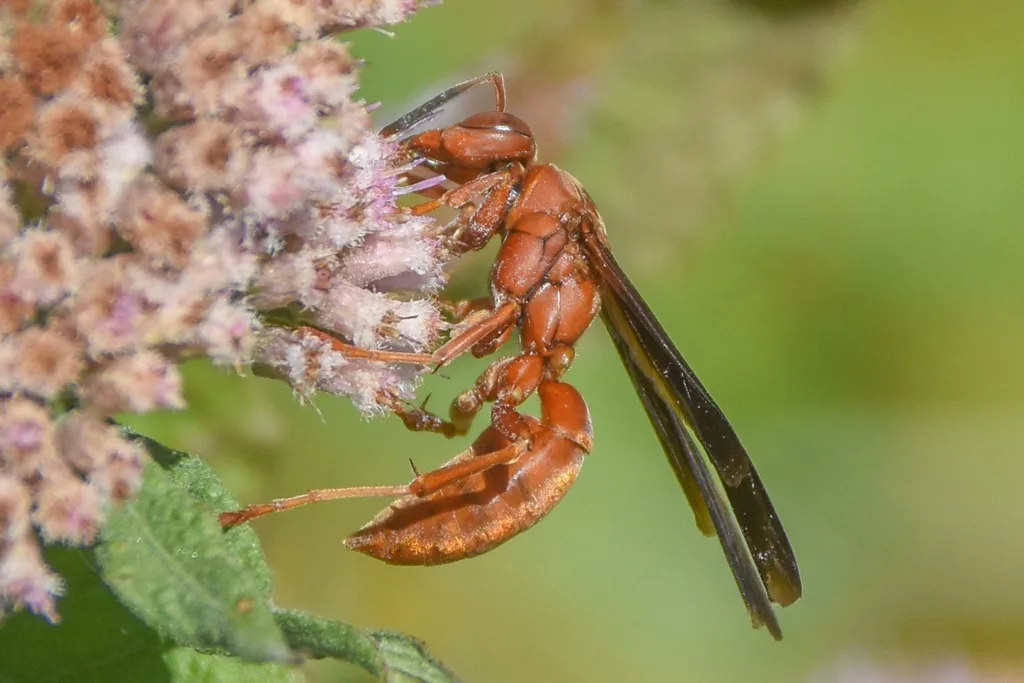
- A slender wasp with a spindle-shaped abdomen; the female body is nearly completely rust-colored, sometimes with dark marks on the thorax.[1]
- Its forewings are about 5/8 to 13/16 inch long (15 to 20.5 mm).[1]
- The nest is a single comb of open, six-sided paper cells hung from a short stalk, with no outer envelope.[1][2]
Look-alikes
| Look-alike | How to tell them apart |
|---|---|
| Polistes perplexus | The only other mostly rust-colored eastern paper wasp; telling them apart needs close inspection of the face.[1] |
| Polistes metricus | Has much more black, especially on the thorax and legs.[1] |
| European paper wasp | A brownish paper wasp marked with yellow, like most paper wasps.[2] |
| Other 'red wasps' | Common names vary: Mississippi State Extension calls Polistes metricus and P. annularis the red wasps and groups P. carolina with the orange paper wasps.[3] |
Where it lives
Eastern and south-central United States: New York, Ohio and Pennsylvania south to Florida and west to Arkansas, Illinois, Kansas and eastern Texas; common in woodlands from summer through fall.[1]
Biology and life cycle
Mated queens overwinter in sheltered places and start nests alone in spring, sometimes joined by sister queens that act as workers.[1][2]
Workers gather wood fiber, nectar and water and hunt caterpillars, cicadas and beetle larvae to feed the larvae.[1][2]
Nests are built from chewed wood under overhangs such as eaves, porch ceilings and door frames, and in tree hollows.[1][2]
Damage and signs
Health risk
It stings painfully, but usually only when the nest is threatened; many stings happen when people bump into hidden nests.[1][2]
Control
Prevention
Leave nests away from the house alone; most paper wasps die at the first hard frost, so late-season workers may not need treatment.[2]
Keep them out
Screen openings and vents, repaint or varnish surfaces where nests keep appearing, and thin shrubs to discourage nesting.[2]
Traps and physical control
A nest just started by a single queen can be knocked down with a broom; she will likely nest elsewhere.[1]
Pesticides
For an established nest, spray it in the evening when the wasps are inactive with an aerosol labeled for wasps and hornets, following the label and avoiding open flames, then remove the nest.[1][2]
Common questions
- Are red wasps aggressive?
- No; they sting mainly when the nest is threatened.[1][2]
- When is the best time to remove a red wasp nest?
- In the evening, when the wasps are on the nest and inactive.[1][2]
- Are red wasps good for the garden?
- Yes; they hunt caterpillars and other plant pests and pollinate flowers.[1][2]
Sources
- University of Florida IFAS Extension (EDIS, Featured Creatures), “Paper Wasp, Red Wasp (Suggested Common Names) Polistes carolina (L.) (EENY-640).” ask.ifas.ufl.edu/publication/IN1112 (accessed 2026-10-16)
- Clemson Cooperative Extension Home & Garden Information Center, “Paper Wasps, HGIC 2481.” hgic.clemson.edu/factsheet/paper-wasps/ (accessed 2026-10-16)
- Mississippi State University Extension, “Bug-Wise No. 7: Paper Wasps (August 13, 2012).” extension.msstate.edu/sites/default/files/newsletter/bw07.pdf (accessed 2026-10-16)
- iNaturalist, “Polistes carolina taxon page (order and family).” www.inaturalist.org/taxa/121792 (accessed 2026-10-06)