HomePest LibraryPaper Wasp
Moderate Risk — Less Aggressive Than Yellow Jackets
🐝

Paper Wasp

Polistes exclamans, P. fuscatus & others

The wasp that builds umbrella-shaped open-celled nests under your eaves, deck railings, and door frames. Paper wasps are significantly less aggressive than yellow jackets — they will sting if the nest is directly threatened, but don't chase or swarm as readily. Small early-season nests can be safely removed.

Nest typeOpen umbrella — cells visible, no outer covering
AggressionModerate — less than yellow jackets
Early season nestsWalnut-sized in spring — easy to treat
Late season nestsCan reach 60–80 cells — larger risk
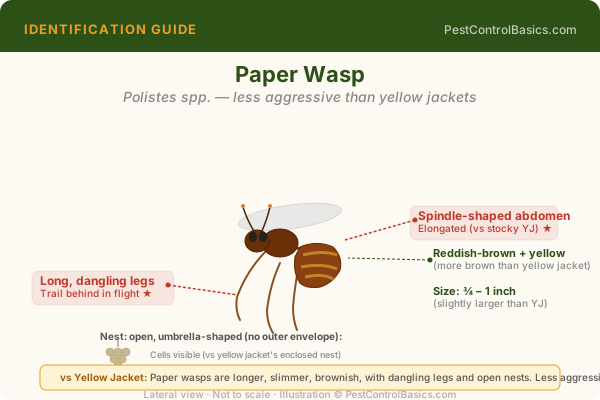
ID featureLong, dangling legs visible in flight
📐 FIELD GUIDE ILLUSTRATION
Paper Wasp identification illustration with labeled anatomical features — PestControlBasics.com

Original illustration by PestControlBasics.com. Use anatomical labels above to confirm your identification. For photo references, see the identification section below.

Identification

Paper wasp vs. yellow jacket

Paper wasps and yellow jackets are both black-and-yellow stinging wasps, but they have distinctly different appearances, nests, and temperaments.

Paper wasp body: Slender and elongated with a very narrow waist. Long legs that dangle noticeably below the body when in flight — a good ID feature in flight. Color varies by species from pale brown to black with yellow markings.

Paper wasp nest: Open umbrella or inverted dome shape with exposed cells — you can see individual hexagonal cells with developing larvae. There is no paper envelope covering the cells. The nest is attached by a thin stalk (petiole) and hangs under a protected surface.

Yellow jacket nest: Enclosed in layers of paper with a single entrance hole. You cannot see the cells from the outside.

Temperament difference: Paper wasps will sting if their nest is directly touched or approached very closely, but they don't aggressively defend a large perimeter the way yellow jackets do. Accidentally bumping a paper wasp nest with your hand is a sting incident; walking past one at a few feet is usually not.

Treatment

Early season removal is the strategic move

The best time to address paper wasp nests is early spring when the founding queen has just started building — in April or May, the nest is often the size of a walnut with just a few cells and one or two wasps. At this stage, any approach works: jet aerosol, soapy water, or even physical removal with protective gloves.

Wait until night: Even for small nests, treating at night ensures all wasps are present and reduces risk. Apply a jet aerosol directly to the nest from 6–10 feet away. Workers will fall immediately. Remove the nest the following day and dispose of it to prevent re-use.

Soapy water for small nests: A strong solution of dish soap in water injected directly into a small nest kills workers quickly and without the chemical exposure of an aerosol. Works well for nests accessible from a close approach at night.

Sting treatment: Paper wasp stings cause immediate sharp pain. Remove any visible stinger (rare — wasps have smooth stingers and rarely leave them). Ice and over-the-counter antihistamines (diphenhydramine) reduce swelling. Oral pain relievers for discomfort. Watch for systemic allergic reaction (hives beyond the sting site, throat tightening, difficulty breathing) — these require epinephrine and emergency care.

DG
Derek Giordano
Certified Pest Control Operator · Former Business Owner
Derek ran his own pest control company in Florida for several years, servicing thousands of regular customers. All content is based on hands-on field experience and current EPA & university extension guidelines.

Related Resources

📚 Full Pest Library🧪 DIY vs. Pro Quiz💰 Cost Guide🌿 IPM Guide🔍 Find a Pro
🔮
Reviewed by Derek GiordanoContent on PestControlBasics.com is developed with input from certified pest management professionals and cross-referenced against EPA, CDC, and university extension guidance. Last reviewed: April 2026.
📚 Sources: EPA Stinging Insects · CDC Venomous Insects
Published: Jan 1, 2025 · Updated: Apr 7, 2026
🔗 Deep-dive: Bald-Faced Hornet vs Paper Wasp
How to tell these two confused stinging insects apart — and why the treatment strategy differs.

Anaphylaxis risk and household preparedness

Approximately 3-5% of adults have severe allergic reactions to insect stings, and the proportion experiencing sting-related anaphylaxis is significant enough that any household with known allergy should keep emergency response planned. EpiPen prescription with current expiration date, training for all household members on its use, and emergency action plan including immediate 911 contact and a known route to the nearest ER. Even without known allergy, large numbers of stings (50+ from social insects) can produce systemic toxic effects; awareness of nest locations before yard work and avoiding aggressive nest disturbance reduces this risk. For known-allergic individuals, professional treatment of nests rather than DIY is reasonable insurance — the risk of a sting during DIY treatment outweighs the cost of professional service.

Common DIY mistakes that defeat otherwise correct treatments

Most DIY pest control failures aren't product failures — they're application failures. The recurring patterns we see across reader emails and field experience: treating only where pests are visible rather than where they live (the active surface is rarely the harborage), spraying repellents over residual products and breaking the residual film, applying baits in already-treated areas (the residual kills foragers before they return with bait), overdiluting product because 'less chemical is safer' (it's not — it accelerates resistance), expecting overnight results when the kill curve is two to four weeks for most products, and stopping treatment at the first sign of improvement rather than completing the protocol. Each of these failure modes is independently preventable with attention to the product label and the pest's biology, and avoiding them improves outcomes more than upgrading to a more expensive product.

Wasp nest treatment timing and technique

Wasp and hornet nest treatment is safest at dusk or after dark when foragers have returned and the colony is less active. Temperatures below 50°F further reduce activity but most stinging insects remain capable of defending the nest. Treatment products: residual aerosols labeled for wasps and hornets reach 15-20 feet, allowing treatment from a safe distance; for ground-nesting yellowjackets, liquid insecticides poured into the entrance at night work well; for wall-void or roof-line nests, dust formulations injected at the entrance allow workers to track the dust into the nest. Wait 24-48 hours after treatment to confirm no surviving activity before removing the nest. Don't reuse nest locations — wasps don't return to last year's nests, but the same favorable conditions often attract new queens.

Identifying wasp species and when each matters

Different stinging insects have different temperaments and treatment urgency. Paper wasps (umbrella-shaped open-cell nests, often under eaves) are generally non-aggressive away from the nest but defend it strongly; nests in low-traffic areas can often be left alone. Yellowjackets (ground nests, wall void nests, large enclosed paper nests) are aggressive defenders and warrant prompt treatment near human activity areas. Bald-faced hornets (large gray football-shaped hanging nests, very aggressive) require careful treatment, often by professionals if the nest is large or near activity. Mud daubers (clay tubes on walls) are solitary, non-aggressive, and don't need treatment. Cicada killers (large solitary wasps with tan and brown coloring) look fearsome but rarely sting. Honeybees should be left alone or relocated by a beekeeper, not exterminated.

When to escalate from DIY to professional

DIY pest control is appropriate for most common household pests when caught early and treated correctly. Escalation to a licensed professional makes sense in specific situations, not just when frustration builds. Wall-void and structural infestations — termites, carpenter ants, rodents nesting inside walls — usually require equipment and access homeowners don't have. Bedbugs at moderate-to-heavy infestation levels almost always require professional treatment; DIY rarely succeeds past the first few isolated bugs. Multi-unit dwellings (apartments, condos) need building-wide coordination that individual unit treatments can't replicate. Health-sensitive households — anaphylaxis risk to stings, immunocompromised individuals, pregnancy, infants — should default to professional because professionals can use the lowest-toxicity option that solves the problem rather than what's available at retail. The financial break-point is roughly when DIY material costs approach one professional visit; below that, DIY is usually fine.

Wasp nest removal: timing and the case for waiting

When a wasp nest appears on a property, the instinct is immediate removal, but timing and species considerations often justify a different approach. Paper wasps and many other social wasp species in temperate climates have annual colonies that die naturally at first hard frost; the queen overwinters separately and starts a new nest the following spring. A nest in a location that isn't a direct human conflict point (eave of a shed, branches of a far tree, post in a fence corner) can often simply be left until natural die-off, with the nest removed cosmetically in late fall after the colony has died. Nests in or near high-traffic areas — doorways, mailboxes, play structures, frequently-used outdoor seating — warrant removal for safety. Treatment timing within the season matters: evening application (when most workers have returned to the nest) maximizes effect, while daytime treatment leaves foragers that return to the nest later and produces incomplete results. Aerosol products labeled for wasp nests that produce a long-distance stream (rather than a foaming application) allow treatment from a safer distance.

The cost of doing nothing: implicit pest tolerance and its hidden expenses

Pest control discussions usually frame the costs of treatment without quantifying the costs of non-treatment, but the latter are often larger and almost always less visible. Cockroach allergens add measurable healthcare costs in homes with asthma. Rodent activity in attics damages insulation (reducing R-value and adding seasonal heating and cooling costs) and creates fire risk through wire chewing that doesn't show up until something fails. Termite damage in unmonitored properties produces structural repair bills in the five-figure range, often discovered during unrelated renovation. Stored-product pests destroy food inventory at rates that aren't tracked because items are discarded individually rather than tallied. The cumulative cost of doing nothing isn't a single line item but a sum of small chronic losses across years. The framing that helps: pest control isn't a luxury expense layered onto a working baseline; it's a maintenance expense that competes with the slow accumulating cost of allowing a problem to continue. Households running the comparison honestly almost always find that modest preventive spending is the cheaper path.

Yellow jackets vs. paper wasps vs. hornets: what you're dealing with

Three commonly-confused wasp groups have meaningfully different behavior and require different management approaches. Paper wasps build open umbrella-shaped nests with visible cells, typically under eaves, in soffit corners, in shrubs, or under deck railings; colonies are smaller (typically 20-50 wasps), workers are less aggressive, and stings are typically defensive rather than offensive. Yellow jackets build enclosed papery nests, often underground in old rodent burrows or in wall voids, soffit cavities, and similar concealed locations; colonies are larger (often several hundred to several thousand), workers are aggressive particularly in late summer when populations peak and food sources change, and ground-nest disturbance produces serious sting events. Hornets (including bald-faced hornets, technically a yellow jacket species in the Vespidae family, and European hornets) build large enclosed aerial nests on tree branches or building exteriors. The identification matters because paper wasp nests can often be treated and removed by homeowners with caution, while yellow jacket and hornet nests are more dangerous and often warrant professional removal, particularly when nests are concealed in wall voids.

Paper wasp tolerance: when not to treat

Paper wasps are widely treated reflexively, but the cost-benefit assessment for treatment is often less favorable than homeowners assume. Paper wasps are valuable predators of caterpillars and other garden pests, they're typically non-aggressive unless the nest is disturbed within a few feet, and most nests in residential settings are in locations where they pose minimal risk to occupants. A nest under an eave on the unused side of the house is qualitatively different from a nest at the front door or near a children's play area. The right question to ask before treatment is whether anyone is actually going to be within the nest's defensive range during the rest of the season, and what the cost of accidental disturbance would be. For nests in low-traffic areas, leaving them alone often produces fewer wasp encounters across the season than treatment does, because the resident colony actively excludes other wasps and the natural cycle leads to nest abandonment by fall. For nests in genuinely high-conflict locations, prompt treatment is warranted, but the default of treating every visible nest underestimates the ecological role and overestimates the actual risk in most situations.

Pet-safe pest control: what the label actually communicates

Pet-safe is a marketing phrase that does specific work, and the work it does is narrower than most pet owners assume. A product labeled pet-safe is generally one that, when used according to label directions and after the specified re-entry interval, presents a low risk of acute toxicity to pets at expected exposure levels. That is not the same thing as zero risk, and it doesn't say anything about chronic exposure, behavioral effects, or exposure to pets with unusual physiology, age, or pre-existing conditions. The other thing it doesn't account for is real-world misuse: pets that lick treated surfaces immediately after application, products applied in higher concentrations than directed, or applications in locations the label didn't anticipate. The practical interpretation is that pet-safe products are a reasonable choice when used carefully, but the safer overall practice with any pet in the home is to keep animals out of treatment areas until products are fully dry or absorbed, choose lower-toxicity formulations like bait stations over surface sprays when feasible, and ask explicitly about ingredients and re-entry intervals rather than relying on the label phrase alone.

Ground-nesting yellowjackets: a distinct problem requiring different handling

Yellowjacket species that nest in the ground present a substantially different management challenge from species that nest above ground. The nest entrance is often inconspicuous — a single small hole in turf, in a soil bank, or at the base of a retaining wall — and the nest itself can be quite large, with thousands of workers. The first sign of the nest is frequently a sting incident during mowing, landscape work, or recreational activity, because the nest is invisible until disturbed. Treatment of ground nests requires direct application of insecticide into the entrance, ideally at dusk or after dark when workers are inside, and follow-up to confirm activity has ceased. Pyrethroid dusts applied to the entrance are typically more effective than sprays, because the dust persists and is tracked into the nest by returning foragers. Sealing the entrance after dusting is sometimes recommended but should only be done after activity has confirmed ceased, because sealing a still-active nest can cause workers to emerge through alternate exits. For homeowners without experience, professional treatment of ground nests is often the right call given the population size and the consequences of incomplete treatment.

🗺️ US Distribution — Paper Wasp

image/svg+xml
Common Occasional Not Present
States Present
49
Occasional
2
Primary Region
Continental US
📊 Source: University extension services, USDA, CDC vector data, and published entomological surveys.