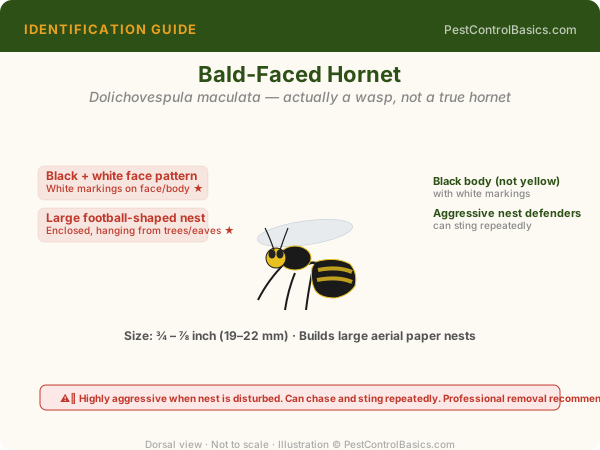
Both build paper nests but have very different aggression levels and sizes.
🐝
Bald-Faced Hornet
Large; white/black; enclosed nest
VS
🐝
Paper Wasp
Smaller; brown/yellow; open comb nest
📐 FIELD GUIDE ILLUSTRATION
Original illustration by PestControlBasics.com. Use anatomical labels above to confirm your identification.
🔑 Key Difference
Bald-faced hornets: large black and white wasps that build enclosed gray paper nests — the classic 'hornet nest' shape. Aggressive defenders. Paper wasps: smaller, build open umbrella-shaped comb nests under eaves. Much less aggressive.
⚠️ Urgency
Bald-faced hornets near traffic areas warrant treatment (very aggressive). Paper wasps in low-traffic locations can often be left — they provide caterpillar pest control.
Study the body shape, coloration, and size carefully
Misidentification leads to wrong treatment product
Behavior
Time of day active, movement pattern, reaction when disturbed
Behavioral clues often confirm when appearance is unclear
Location found
Where in your home or yard the pest appears
Location narrows down species dramatically
Damage/signs
What evidence each species leaves behind
Secondary evidence often confirms ID without seeing the pest
Urgency
Health risk and structural damage potential differ significantly
Determines how fast you need to act
🔧 Getting the Treatment Right
Correct identification before treatment is essential — using the wrong product or approach wastes time and can mask the real problem. If you cannot confidently identify the pest from the comparison above, a professional inspection is the fastest path to the right answer.
💡 Capture method: Place a clear plastic cup over the pest and slide a card underneath to trap it. A photo submitted to your local cooperative extension service can get you a free expert ID.
❓ Identification FAQ
What's the fastest way to confirm which pest I have?
Capture a live or dead specimen and compare it directly against the identification features in this guide. A clear close-up photo submitted to your county's cooperative extension service will get you a free expert identification within 1–3 business days. iNaturalist is also excellent for invertebrate ID.
Can I treat for both at the same time?
If you're unsure which pest you have, it's often more effective to wait for confirmation rather than applying multiple treatments. Misapplied pesticides can scatter populations without eliminating them. The exception: if both pests require identical treatment (as with many fall invaders), treating once covers both.
Building field ID skills for Bald-Faced Hornet vs. Paper Wasp
Field identification gets faster with practice, and the practice is mostly about pattern recognition rather than memorizing taxonomic detail. The fastest learners develop a habit of noting three things on every specimen: where it was found, what it was doing, and one or two distinctive structural features. Over a season this builds a regional mental library that beats any single reference page.
For look-alike pairs specifically, the deciding feature is usually one detail that is consistent across both adults and juveniles, even when overall appearance differs. Antenna structure, leg count, and wing venation patterns hold up better than color or size, which both vary significantly with diet, season, and development stage. Photographing the specimen against a known scale (a coin, a ruler, or a U.S. quarter) is more useful than describing size verbally.
When two species cannot be distinguished from a single photograph, the next step is habitat. Most close look-alikes actually have non-overlapping habitat preferences, and where the specimen was found often resolves the ID without requiring expert consultation.
Why correct identification matters before treatment
Treatment selection depends on identification, and getting the ID wrong wastes time and money. Two pests that look nearly identical can have completely different susceptibility profiles, lifecycle timing, and harborage preferences. Applying the right product against the wrong target produces the appearance of failure when the real problem was identification all along.
The financial impact compounds quickly. A misidentified pest typically triggers two or three rounds of unsuccessful treatment before the homeowner returns to the identification step, and by then the original population has often grown enough to require professional intervention. Spending five minutes confirming the ID at the start is the highest-leverage step in the entire control workflow.
For shared-wall situations (apartments, condos, townhomes), correct ID also affects who is responsible for treatment costs under most lease and HOA structures. A pest misidentified as a structural issue versus a sanitation issue can shift several thousand dollars of cost between landlord and tenant.
Tools that speed up identification
A few inexpensive tools make field ID dramatically faster. A 10x hand lens (jewelers loupe) reveals features invisible to the unaided eye and costs under twenty dollars. A small clear specimen vial allows safe capture and handling without damaging identifying features. A flashlight bright enough to use in daylight (for low-angle illumination that highlights texture) speeds inspection considerably.
Software helps too, but with caveats. Generic identification apps trained on global image libraries often confuse regional look-alikes, especially for pests with high intraspecific variation. State Extension service pages and regional field guides consistently outperform global apps for the species likely to be encountered in any particular area. Bookmarking the relevant state Extension entomology page is one of the highest-value identification habits a homeowner can develop.
For specimens that resist identification, university Extension diagnostic services accept mail-in samples for under twenty dollars in most states and return an expert ID within a few business days. This service is dramatically underused given its accuracy and cost.
Published: Jan 1, 2025 · Updated: Apr 7, 2026
Wasp nest treatment timing and technique
Wasp and hornet nest treatment is safest at dusk or after dark when foragers have returned and the colony is less active. Temperatures below 50°F further reduce activity but most stinging insects remain capable of defending the nest. Treatment products: residual aerosols labeled for wasps and hornets reach 15-20 feet, allowing treatment from a safe distance; for ground-nesting yellowjackets, liquid insecticides poured into the entrance at night work well; for wall-void or roof-line nests, dust formulations injected at the entrance allow workers to track the dust into the nest. Wait 24-48 hours after treatment to confirm no surviving activity before removing the nest. Don't reuse nest locations — wasps don't return to last year's nests, but the same favorable conditions often attract new queens.
How resistance develops and how to slow it down
Pesticide resistance is now common enough across major pest categories — cockroaches, bedbugs, mosquitoes, certain ant species, some flies — that treatment recommendations have shifted to account for it. Resistance develops through repeated exposure to a single active ingredient class; the surviving population reproduces, and over generations the population shifts toward resistance. Slowing resistance development requires rotating active ingredient classes (not just brands), using full label rates rather than reduced rates, and avoiding routine prophylactic spraying when it isn't needed. The EPA mode-of-action (MoA) classification on product labels helps with rotation: alternating between products in different MoA classes is more effective than alternating brand names within the same class. For homeowners, the practical translation is: don't use the same product month after month; if you're spraying regularly, rotate among at least two unrelated chemistries; and don't spray when monitoring suggests no active population.
Identifying wasp species and when each matters
Different stinging insects have different temperaments and treatment urgency. Paper wasps (umbrella-shaped open-cell nests, often under eaves) are generally non-aggressive away from the nest but defend it strongly; nests in low-traffic areas can often be left alone. Yellowjackets (ground nests, wall void nests, large enclosed paper nests) are aggressive defenders and warrant prompt treatment near human activity areas. Bald-faced hornets (large gray football-shaped hanging nests, very aggressive) require careful treatment, often by professionals if the nest is large or near activity. Mud daubers (clay tubes on walls) are solitary, non-aggressive, and don't need treatment. Cicada killers (large solitary wasps with tan and brown coloring) look fearsome but rarely sting. Honeybees should be left alone or relocated by a beekeeper, not exterminated.
Anaphylaxis risk and household preparedness
Approximately 3-5% of adults have severe allergic reactions to insect stings, and the proportion experiencing sting-related anaphylaxis is significant enough that any household with known allergy should keep emergency response planned. EpiPen prescription with current expiration date, training for all household members on its use, and emergency action plan including immediate 911 contact and a known route to the nearest ER. Even without known allergy, large numbers of stings (50+ from social insects) can produce systemic toxic effects; awareness of nest locations before yard work and avoiding aggressive nest disturbance reduces this risk. For known-allergic individuals, professional treatment of nests rather than DIY is reasonable insurance — the risk of a sting during DIY treatment outweighs the cost of professional service.
Why integrated pest management produces better outcomes
Integrated Pest Management (IPM) is the framework most pest management professionals follow and the framework the EPA recommends for residential and commercial settings. IPM is not anti-pesticide; it's a sequencing approach that uses cultural controls (sanitation, exclusion, moisture management) first, mechanical controls (traps, vacuuming, physical removal) second, biological controls (beneficial insects, microbial agents) where applicable, and chemical controls last and targeted. The benefit isn't ideological — it's empirical. IPM-treated sites have lower long-term pest pressure than chemical-only treated sites, because chemicals address the visible population without addressing why the population developed. Homeowners who adopt IPM principles see longer intervals between treatments, lower total pesticide use, and better outcomes during the times when chemicals are appropriate. The shift from 'spray when I see them' to 'fix the conditions, monitor, treat targeted' is the single highest-leverage change most DIY practitioners can make.
Yellow jackets vs. paper wasps vs. hornets: what you're dealing with
Three commonly-confused wasp groups have meaningfully different behavior and require different management approaches. Paper wasps build open umbrella-shaped nests with visible cells, typically under eaves, in soffit corners, in shrubs, or under deck railings; colonies are smaller (typically 20-50 wasps), workers are less aggressive, and stings are typically defensive rather than offensive. Yellow jackets build enclosed papery nests, often underground in old rodent burrows or in wall voids, soffit cavities, and similar concealed locations; colonies are larger (often several hundred to several thousand), workers are aggressive particularly in late summer when populations peak and food sources change, and ground-nest disturbance produces serious sting events. Hornets (including bald-faced hornets, technically a yellow jacket species in the Vespidae family, and European hornets) build large enclosed aerial nests on tree branches or building exteriors. The identification matters because paper wasp nests can often be treated and removed by homeowners with caution, while yellow jacket and hornet nests are more dangerous and often warrant professional removal, particularly when nests are concealed in wall voids.
Why most pest 'sightings' aren't what people think they are
Species misidentification is the single most common reason that DIY pest treatment fails or that homeowners describe products as not working. The patterns are consistent: bed bug bites are routinely attributed to mosquitoes, fleas, or unknown causes; carpet beetle larvae are mistaken for bed bug nymphs; small black ants are called 'sugar ants' regardless of actual species; carpenter ants and termites are confused despite very different treatments; bat bugs are treated as bed bugs (the treatment may work, but the actual problem is overhead). Even when identification is correct at the family level, species within a family often require different approaches — German vs. American cockroaches, subterranean vs. drywood termites, or pavement vs. carpenter ants are practical examples. The first hour of any pest problem should go to identification, not treatment: photograph specimens with a coin for scale, send images to a local cooperative extension office (most respond within a day or two), or post to one of the moderated identification forums where entomologists answer. Correct identification narrows treatment options to those that actually work and discards the larger pile that don't.
Wasp nest removal: timing and the case for waiting
When a wasp nest appears on a property, the instinct is immediate removal, but timing and species considerations often justify a different approach. Paper wasps and many other social wasp species in temperate climates have annual colonies that die naturally at first hard frost; the queen overwinters separately and starts a new nest the following spring. A nest in a location that isn't a direct human conflict point (eave of a shed, branches of a far tree, post in a fence corner) can often simply be left until natural die-off, with the nest removed cosmetically in late fall after the colony has died. Nests in or near high-traffic areas — doorways, mailboxes, play structures, frequently-used outdoor seating — warrant removal for safety. Treatment timing within the season matters: evening application (when most workers have returned to the nest) maximizes effect, while daytime treatment leaves foragers that return to the nest later and produces incomplete results. Aerosol products labeled for wasp nests that produce a long-distance stream (rather than a foaming application) allow treatment from a safer distance.
Paper wasp tolerance: when not to treat
Paper wasps are widely treated reflexively, but the cost-benefit assessment for treatment is often less favorable than homeowners assume. Paper wasps are valuable predators of caterpillars and other garden pests, they're typically non-aggressive unless the nest is disturbed within a few feet, and most nests in residential settings are in locations where they pose minimal risk to occupants. A nest under an eave on the unused side of the house is qualitatively different from a nest at the front door or near a children's play area. The right question to ask before treatment is whether anyone is actually going to be within the nest's defensive range during the rest of the season, and what the cost of accidental disturbance would be. For nests in low-traffic areas, leaving them alone often produces fewer wasp encounters across the season than treatment does, because the resident colony actively excludes other wasps and the natural cycle leads to nest abandonment by fall. For nests in genuinely high-conflict locations, prompt treatment is warranted, but the default of treating every visible nest underestimates the ecological role and overestimates the actual risk in most situations.
Why product instructions are often suboptimal in practice
Pesticide labels are legal documents written to satisfy regulatory requirements, not field guides written to maximize success in a specific home. The instructions cover the broadest reasonable use case, which means they're rarely tuned for the specific construction type, climate, or pest pressure you're dealing with. A label might call for application every six weeks because that's what the registration data supports across a wide range of conditions, but the actual reapplication interval that matches the residual life of the active ingredient in your specific application context could be shorter or longer. This is not an invitation to ignore label directions — doing so is illegal and frequently dangerous — but it does mean that following the label is the floor, not the ceiling, of good practice. Knowledgeable users overlay the label with conditions-aware judgment: shorter re-treatment intervals during heavy rain or high humidity, denser application in known harborage, and supplementary monitoring after treatment to verify that the work actually performed as expected. The label tells you what's permitted; experience tells you what's optimal within that envelope.
Ground-nesting yellowjackets: a distinct problem requiring different handling
Yellowjacket species that nest in the ground present a substantially different management challenge from species that nest above ground. The nest entrance is often inconspicuous — a single small hole in turf, in a soil bank, or at the base of a retaining wall — and the nest itself can be quite large, with thousands of workers. The first sign of the nest is frequently a sting incident during mowing, landscape work, or recreational activity, because the nest is invisible until disturbed. Treatment of ground nests requires direct application of insecticide into the entrance, ideally at dusk or after dark when workers are inside, and follow-up to confirm activity has ceased. Pyrethroid dusts applied to the entrance are typically more effective than sprays, because the dust persists and is tracked into the nest by returning foragers. Sealing the entrance after dusting is sometimes recommended but should only be done after activity has confirmed ceased, because sealing a still-active nest can cause workers to emerge through alternate exits. For homeowners without experience, professional treatment of ground nests is often the right call given the population size and the consequences of incomplete treatment.