On this page
How to identify it
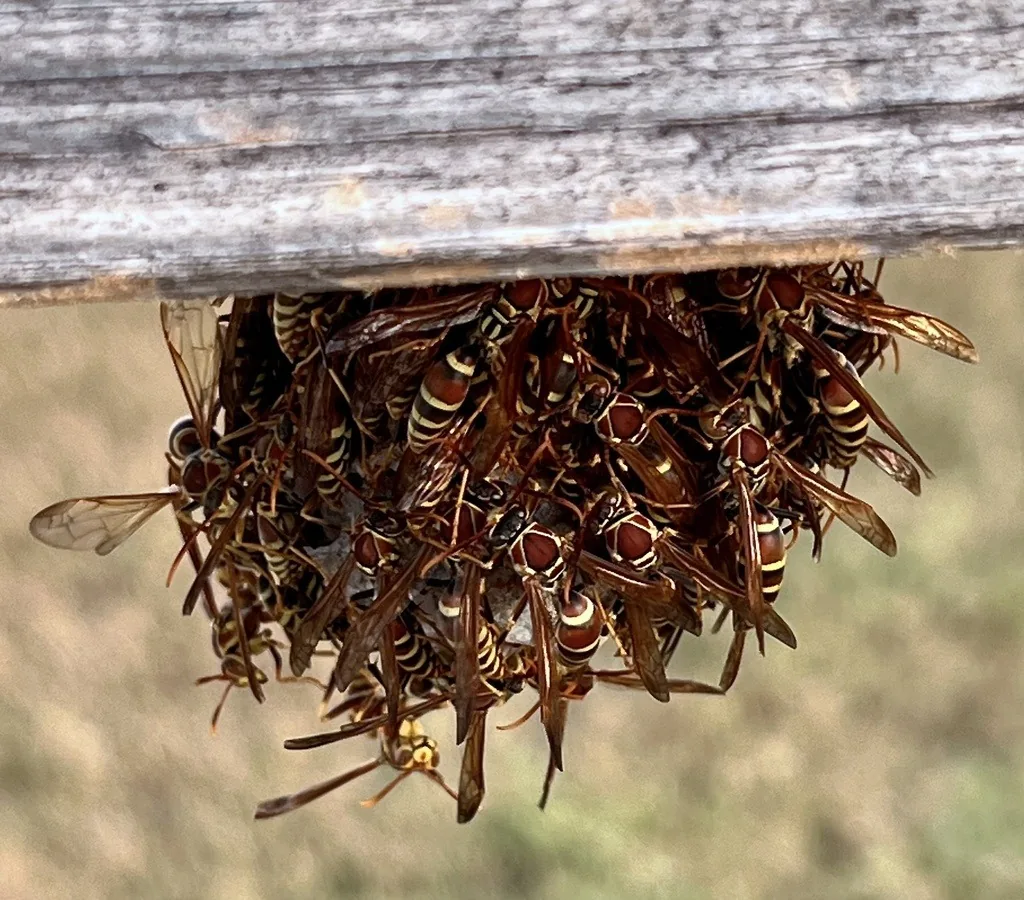
- Somewhat smaller than other paper wasps and yellow with brown bands; it is often mistaken for a yellowjacket.[2]
- Like other paper wasps it looks like a skinny yellowjacket and flies with its legs dangling; paper wasps are 1/2 to 1 inch long.[3]
- The nest is a single, umbrella-shaped layer of downward-facing paper cells on one stalk, with no outer covering.[2][3]
Look-alikes
| Look-alike | How to tell them apart |
|---|---|
| Yellowjackets | Yellowjackets nest in the ground and are yellow with black bands; guinea wasps build aerial nests and are yellow with brown bands.[2] |
| Red wasps | Larger paper wasps; Mississippi State uses 'red wasp' for the dark red Polistes metricus and P. annularis, whose nests can be as big as a straw hat.[2] |
| Orange paper wasps | Large, burnt-orange wasps with black wings (Polistes perplexus and P. carolina) that often nest inside wall voids.[2] |
Where it lives
One of the most common paper wasps in the Southeast and the most common in Mississippi; at least eight Polistes species occur in Missouri.[1][2][3]
Biology and life cycle
Mated females overwinter and start new nests each spring, usually in April; nests are rarely reused.[2][3]
A nest with two or three wasps in early May can hold dozens of workers by August.[1][2]
Workers feed caterpillars to the larvae; adults drink nectar and fruit juice.[2][3]
In fall, overwintering females can gather by the hundreds in attics and wall voids; they are not nesting and are seldom aggressive.[2]
Damage and signs
Health risk
Stings are painful. Guinea wasps tolerate a lot but react quickly once the nest is disturbed, and late-summer nests mean more stings; people allergic to stings should have someone else treat nests.[1][2]
Control
Prevention
Before moving rarely used items or pruning shrubs, shake them with a long tool, step back and watch for wasps.[1][2]
Leave nests in out-of-the-way places; paper wasps are beneficial caterpillar hunters.[2][3]
Keep them out
Seal the building before fall to keep overwintering wasps out of attics; if they are already inside, wait for them to leave in spring before sealing outside cracks.[2]
Pesticides
Treat nests that must go while they are small, using an aerosol wasp and hornet spray: approach quietly and soak the whole nest with a three- to five-second burst, ideally at night, wearing protective clothing.[1][2]
Common questions
- What are the small brown-and-yellow wasps nesting in my grill?
- Often guinea paper wasps.[1][2]
- Are they yellowjackets?
- No; yellowjackets nest in the ground and have black bands.[2]
- Why are there wasps in my attic in winter?
- Overwintering paper wasp females gather in attics and voids; they leave in spring.[2]
- Are guinea wasps aggressive?
- Not overly, until the nest is jarred.[1]
Sources
- Mississippi State University Extension (Bug's Eye View), “Guinea Wasps, Bug's Eye View Vol. 8, No. 17.” extension.msstate.edu/newsletters/bugs-eye-view/2022/guinea-wasps-vol-8-no-17 (accessed 2026-10-16)
- Mississippi State University Extension, “Bug-Wise No. 7: Paper Wasps (August 13, 2012).” extension.msstate.edu/sites/default/files/newsletter/bw07.pdf (accessed 2026-10-16)
- Missouri Department of Conservation, “Paper Wasps (Field Guide).” mdc.mo.gov/discover-nature/field-guide/paper-wasps (accessed 2026-10-16)
- iNaturalist, “Polistes exclamans taxon page (order and family).” www.inaturalist.org/taxa/133791 (accessed 2026-10-06)