The short answer
- Mud daubers are not aggressive. They don't defend their nests, and a female stings only if she is handled, trapped against your skin or otherwise threatened. Males can't sting at all.[1][2][3]
- A lump of mud cells about the size of a lemon or fist is a black and yellow mud dauber nest; a row of long vertical mud tubes is an organ pipe mud dauber nest; an irregular, lumpy old nest being reworked by a metallic blue wasp is the blue mud dauber.[2][3]
- If the nest isn't in your way, you can leave it. All three hunt spiders, and the blue mud dauber takes many black widows.[2]
- If it is in the way, scrape it off. UC IPM says you can safely remove nests in winter without spraying, and Penn State says mud nests can be scraped off and destroyed. Wipe the leftover mud with a wet cloth.[7][6][3]
- To keep new nests out of garages, attics and equipment, screen or caulk openings and remove nests as you find them. There is no one-time treatment that stops them for good.[1][3][6]
If someone may be poisoned
- Difficulty breathing or swallowing, face or mouth swelling, chest pain, fainting or lightheadedness, or a spreading rash or flushing after any sting can be anaphylaxis, which can come on quickly. Call 911 or your local emergency number, and use the person's epinephrine kit if they carry one.[8]
Related wasps on our site
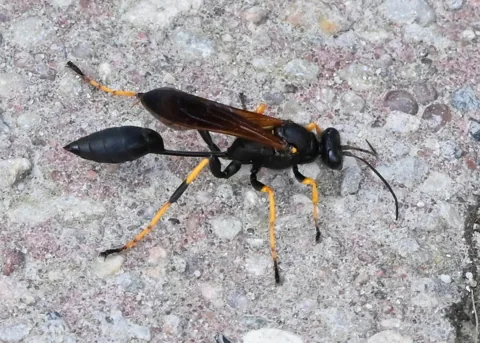 Black and Yellow Mud Dauber
Sceliphron caementarium
Mud daubers are solitary wasps that build mud nests on walls, ceilings, eaves and equipment and stock them with paralyzed spiders. They don't defend their nests and rarely sting.
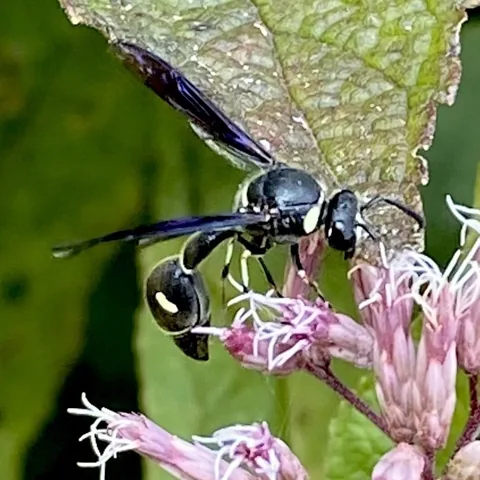 Potter Wasps
Eumenes species (e.g., E. fraternus), subfamily Eumeninae
Potter wasps are solitary wasps whose females build tiny urn-shaped mud nests, or use existing holes, and stock them with caterpillars for their young. They are rarely provoked enough to sting, and the caterpillar control makes them welcome in gardens.
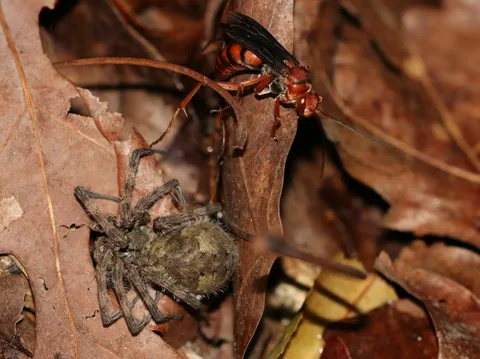 Spider Wasps
Pompilidae (shown: rusty spider wasp, Tachypompilus ferrugineus)
Spider wasps are solitary wasps that sting and paralyze spiders, then drag them to a nest as food for their young; the rusty spider wasp, with its orange body and blue wings, is a common eye-catching example.
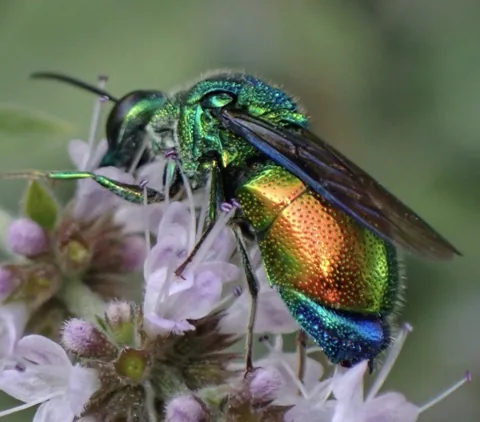 Cuckoo wasps
Chrysididae (e.g., Chrysis and Hedychrum species)
Cuckoo wasps are compact, hard-bodied wasps about the size of a rice grain that glitter metallic green, blue-green, purple or coppery red. They are parasitoids: a female slips into the nest of a ground- or wood-nesting wasp or bee and lays an egg, and her larva eats the host and its stored food. North America has more than 200 species, most of them in the West. Adults crawl over bare ground and dead wood hunting for nests, visit flowers, and roll into a ball when handled, which is the easiest way to separate them from the green sweat bees they resemble. They are harmless to people and need no control.
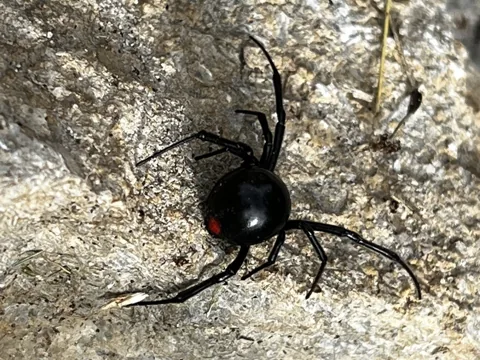 Southern Black Widow
Latrodectus mactans
Black widows are shy, web-building spiders with a neurotoxic venom; they live throughout North America and are most common in the southern and western United States. The southern black widow is found throughout states such as South Carolina.
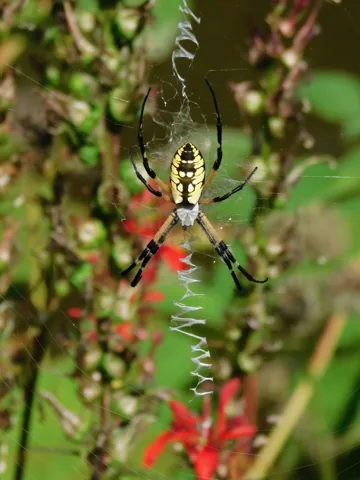 Orb Weaver Spiders (yellow garden spider)
Argiope aurantia
Orb weavers are the spiders that spin classic wheel-shaped webs in gardens and around porches. The best known is the yellow garden spider, a large black-and-yellow spider whose web has a white zigzag down the middle. They eat insects and aren't considered dangerous.
What a mud dauber is
Mud dauber is a name for wasps from two families, the thread-waisted wasps (Sphecidae) and the square-headed wasps (Crabronidae), that have narrow or thread-like waists and build their nests out of mud. They range from about 1/2 inch to slightly more than 1 inch long, and many have bright or metallic coloring.[2][1]
They are solitary, not social. A single female builds and supplies each nest, although many females may nest in the same general area. That is the main reason they are so much less of a sting risk than yellowjackets, paper wasps and hornets, whose workers defend the colony.[1][2][6][7]
In nature they build in cave entrances, under rock overhangs, in hollow trees and on the undersides of large limbs. Around people they choose the same kind of sheltered spot: eaves, walls and ceilings, barns, garages, attics, patios, bridges, and covered parts of cars, boats and machinery.[2][3][7]
The three common types
Black and yellow mud dauber (Sceliphron caementarium), also called the yellow-legged mud dauber. Black and yellow with yellow legs and a very long, thin waist. Its nest is a cluster of cells built side by side and on top of one another, often smoothed over with an extra coat of mud when it's done. The finished nest is a rounded lump about the size of a lemon or a fist; Mississippi State describes these nests as blocky, only a couple of inches long and usually horizontal.[2][3][1]
Blue mud dauber (Chalybion californicum). A metallic blue wasp. It doesn't carry mud. Instead it brings water to an old nest built by another mud dauber, softens and reworks it, so its nests look irregular, with a lumpy or blobby surface. Sometimes it takes over a nest that is still in use, throwing out the original larvae and their spiders and restocking the cells with its own.[2][1]
Organ pipe mud dauber (Trypoxylon politum). Black with blue wings and white 'stockings' on the hind legs. It builds long mud tubes side by side, oriented vertically with the opening at the bottom, so the finished nest looks like the pipes of an organ. It prefers fairly smooth, vertical, shaded surfaces with mud nearby. Mississippi State describes tubes up to six or more inches long; the University of Arkansas Arthropod Museum says a 4 to 6 inch nest can go up within 24 hours and a typical nest is a cluster of 5 to 7 pipes, each with 3 or 4 cells. It occurs in the eastern United States from Maine to Florida and west to Kansas and Texas.[2][3][4][5]
At an organ pipe nest you may meet the male. He sits just inside the entrance, day and night, guarding it against parasites and rival wasps while the female collects mud and spiders. He may buzz loudly at you if you come close, but like all male wasps he has no stinger.[2][3][5]
What they hunt, and how the nest works
The female carries balls of mud from the edge of a puddle and shapes them into a cell; one cell takes about an hour, and cells are about an inch long. She stings spiders to paralyze them, packs them into the cell, lays a single egg on one and seals it. The venom keeps the spiders alive and fresh until the larva eats them. When it is grown, the new wasp chews a hole through the side of its cell and leaves.[2][1][3]
Each type has its preferred prey. Black and yellow mud daubers favor crab spiders and other small, colorful spiders. Blue mud daubers use large numbers of black widows. Organ pipe mud daubers stock their tubes mainly with mid-sized orb weavers taken from nearby woods, plus a few wandering spiders.[2][3][5]
The numbers add up. Missouri's Department of Conservation says a black and yellow nest may hold as many as 25 cells with about 10 spiders each, and up to 40 in a single cell; organ pipe cells hold a few or even up to 18 spiders. In one organ pipe nest that fell off a machine, Mississippi State counted ten to twelve orb weavers per cell, across eleven finished cells.[2][4]
Organ pipe eggs hatch in a couple of days and the larvae finish their spiders in about 5 days. Adult mud daubers feed on flower nectar.[5][2]
Seasons and generations
Missouri mud daubers spend the winter as immature wasps sealed inside the nest, so a nest you find in winter may still hold live young.[2]
The black and yellow mud dauber has two generations each summer and the blue mud dauber can have several in a year. The organ pipe mud dauber has one or two; some of its young emerge in late spring or early summer and others stay in the nest through winter.[2][5]
Holes in the side of a cell mean the wasp has already left. Some species repair and reuse nests from earlier seasons, and blue mud daubers move into old nests of the other two.[1][2]
Do mud daubers sting?
They can, but it's rare. Only females have a stinger, their venom is meant for paralyzing spiders, and they don't defend the nest. Mississippi State says stings happen only when a female is trapped against the skin; Missouri's Department of Conservation says only when one is handled roughly.[1][2][3]
A sting is painful. The black and yellow mud dauber was rated 1, the mildest level, on a pain scale running from 1 to 4.[1]
For a sting, wash the site with soap and water, then hold ice wrapped in a washcloth on it for 10 minutes and off for 10 minutes, repeating as needed. An antihistamine or an anti-itch cream can help. Over the next several days, watch for increasing redness, swelling or pain, which can signal infection.[8]
Anyone who has had a severe, whole-body reaction to a sting should see a provider about a referral to an allergist and an emergency kit to carry.[8]
Other wasps and animals that build with mud
Potter and mason wasps don't have the long, narrow waist. Some build mud nests that look like little round pots or jugs stuck to a wall; others use mud to wall off cells inside existing cavities.[2]
Spider wasps also patrol eaves and foundations for spiders and flick their wings nervously, and many are bluish black like the blue mud dauber. Their legs are spinier, the long hind legs dangle in flight, and they are often seen dragging a spider across the ground. Some build mud cells or move into abandoned mud dauber cells.[2]
Not every mud nest is a wasp's. Cliff swallows and other swallows build jug-like mud nests under bridges and overpasses, eastern phoebes build cup nests of mud and moss under overhangs, and mason bees and some other bees make their cells from mud or clay.[2]
If many wasps or bees come and go from a paper nest, or from a hole in the ground or a wall, you are probably dealing with social insects such as paper wasps, yellowjackets, hornets or bumble bees. Their workers defend the nest, so the sting risk is higher than at a mud dauber nest.[6][7]
Should you leave the nest?
Missouri's Department of Conservation considers mud daubers beneficial and suggests letting them nest where you can tolerate them, since they hunt spiders, including black widows, and blue mud daubers reuse old nests of the other two. Clemson calls them nuisances rather than pests, and adds a caution: spiders also eat other insects, so fewer spiders isn't purely a gain.[2][1]
Real problems do happen. Nests are unsightly, the mud stains walls and ceilings, and Mississippi State warns that a nest in the wrong place on a machine that isn't used often can cause a lot of mechanical damage when it is started. Clemson notes they often fill round holes in equipment and lawn furniture.[3][1]
Clemson lists two situations where chemical control may be needed: someone in the household is allergic to wasp or bee stings, or large numbers of mud daubers are nesting where people walk a lot.[1]
How to remove a mud dauber nest
Scrape it off. Penn State says mud nests can simply be scraped off and destroyed, and UC IPM says you can safely remove them in winter without spraying, when the wasps inside are still immature.[6][7][2]
Finish with water. Mississippi State suggests scraping off the nest, then using a spray bottle of water and a wet cloth to remove the remaining mud.[3]
If adults are active and you want them gone, they can be killed with a swatter or a vacuum. Mississippi State says the best way to limit new nests in a garage or porch is to kill nesting females as soon as they appear.[6][3]
A wasp aerosol with a jet stream lets you treat a nest from a distance; Clemson suggests late evening or early morning, when the insects are less active, and long sleeves and pants. These sprays aren't meant for wasps in flight. Mississippi State warns that some contain petroleum products that can stain walls, so a nozzle straw aimed into the nest entrance keeps spray off surfaces. Read and follow the label.[1][3]
For the general approach to stinging-insect nests, including the defended paper and underground nests mud daubers are often confused with, see the wasp nest removal guide.[6]
Keeping mud daubers off your house and equipment
Exclusion works best. Screen or caulk openings that let wasps into attics, sheds and buildings, and close up holes in equipment. Mississippi State calls good physical exclusion the best way to keep nests out of attics and machinery.[1][3][6]
Look over machines and equipment that sit unused for a while before you start them, and clear mud out of openings.[3][1]
Fewer spiders means fewer mud daubers. Clemson suggests caulking cracks where spiders hide and regularly clearing webs from corners and crevices.[1]
Remove nests as you find them. Removing nests may discourage mud daubers and reduce later generations, but expect to repeat it: Mississippi State says there is no simple, once-and-done control.[1][3]
Common questions
- Are mud daubers dangerous?
- Rarely. They're solitary, don't defend their nests and sting only when handled or trapped against skin. A sting hurts, but the black and yellow mud dauber rates a 1 on a 1 to 4 pain scale.[1][2][3]
- What does a mud dauber nest look like?
- Black and yellow mud daubers build a rounded lump of cells about the size of a lemon or fist. Organ pipe mud daubers build long vertical mud tubes side by side. Blue mud daubers rework old nests into irregular, lumpy shapes.[2][3]
- Is a mud dauber nest empty?
- Not necessarily. Young wasps spend the winter inside the cells. Holes in the sides of the cells mean adults have already emerged.[2][1]
- Should I kill mud daubers?
- Usually there's no need. They hunt spiders, including black widows. If the nest is in a doorway, on equipment or near someone allergic to stings, scrape it off, preferably in winter.[2][7][1]
- Do mud daubers come back to the same nest?
- Some species repair and reuse old nests, and blue mud daubers move into the old nests of other mud daubers. Removing nests and sealing openings reduces repeat nesting.[1][2]
- Why is a wasp buzzing at me from an organ pipe nest?
- That's likely the male guarding the nest. Male wasps have no stinger.[2][5]
Photo credits
- Black and Yellow Mud Dauber: (c) Maciej Boenisch, some rights reserved (CC BY) — via iNaturalist, CC BY 4.0
- Potter Wasps: (c) Michelle Orcutt, some rights reserved (CC BY) — via iNaturalist, CC BY 4.0
- Spider Wasps: (c) hr_dragonfly, some rights reserved (CC BY) — via iNaturalist, CC BY 4.0
- Cuckoo wasps: (c) Albert Cardona, some rights reserved (CC BY) — via iNaturalist, CC BY 4.0
- Southern Black Widow: Carol Spence, public domain (CC0), via iNaturalist
- Orb Weaver Spiders (yellow garden spider): (c) Michael J. Papay, some rights reserved (CC BY) — via iNaturalist, CC BY 4.0
Sources
- Clemson Cooperative Extension Home & Garden Information Center, “Mud Daubers: Identification, Habits, and Control (HGIC 2512).” hgic.clemson.edu/factsheet/mud-daubers/ (accessed 2026-11-10)
- Missouri Department of Conservation, “Mud Daubers (Field Guide).” mdc.mo.gov/discover-nature/field-guide/mud-daubers (accessed 2026-11-10)
- Mississippi State University Extension Service, “Bug's Eye View: Organ Pipe Mud Dauber, Vol. 6, No. 20 (2020).” extension.msstate.edu/newsletters/bugs-eye-view/2020/organ-pipe-mud-dauber-vol-6-no-20 (accessed 2026-11-10)
- Mississippi State University Extension Service, “Bug's Eye View: Organ Pipe Mud Dauber, Vol. 8, No. 22 (2022).” extension.msstate.edu/newsletters/bugs-eye-view/2022/organ-pipe-mud-dauber-vol-8-no-22 (accessed 2026-11-10)
- University of Arkansas Arthropod Museum, “Organ-pipe mud-daubers.” arthropod.uark.edu/?p=27756 (accessed 2026-11-10)
- Penn State Extension, “Getting Rid of Paper Wasps, Yellowjackets, and Other Stinging Insects.” extension.psu.edu/getting-rid-of-paper-wasps-yellowjackets-and-other-stinging-insects (accessed 2026-11-10)
- University of California Statewide IPM Program, “Yellowjackets and Other Social Wasps (Home and Landscape).” ipm.ucanr.edu/home-and-landscape/yellowjackets-and-other-social-wasps/ (accessed 2026-11-10)
- MedlinePlus, U.S. National Library of Medicine (NIH), “Insect bites and stings (Medical Encyclopedia).” medlineplus.gov/ency/article/000033.htm (accessed 2026-11-10)