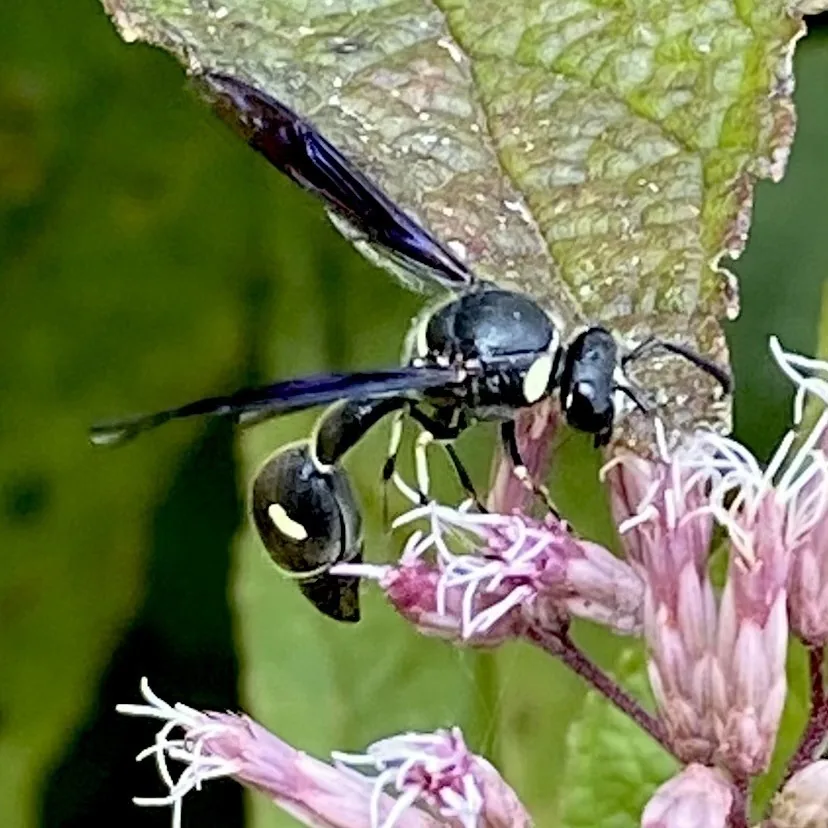
How to identify it
- Small to medium wasps, about 3/8 to 3/4 inch long, black with yellow or whitish markings on the thorax and abdomen.[2][1]
- The waist is long and narrow, with the first abdominal segment widening gradually toward the rear.[1][2]
- Like other vespid wasps, they fold their wings in half lengthwise when at rest.[2]
- Their nest is the giveaway: a small clay pot shaped like a tiny jug or vase, attached to a twig, wall or other object.[1][2]
Look-alikes
| Look-alike | How to tell them apart |
|---|---|
| Mud dauber wasps | Many wasps build mud nests, but the round, jug-like pots of potter wasps are not easily confused with other species' nests.[1] |
| Paper wasps | Potter wasps live alone and nest in mud pots or existing holes; they don't build a shared paper nest or defend it.[2] |
Where it lives
Eumenes fraternus occurs from about the 100th meridian eastward in the U.S. and Canada; other Eumenes species range through the South and from Mexico into Texas, Oklahoma, Kansas, Missouri and Arkansas.[1]
Biology and life cycle
The female builds a mud pot, hangs an egg from a thin thread inside, then fills the pot with caterpillars or beetle larvae she has stung and paralyzed before sealing it.[1][2]
Studies of Eumenes in Japan found that building one pot takes several hundred trips with mud pellets; after stocking it, the female seals it and leaves to start another.[1]
Some species nest in hollow twigs, old mud dauber nests, keyholes or holes in brick walls instead of building pots.[2]
Adults fly from about June to October and are often seen visiting flowers.[1][2]
Damage and signs
- A few small mud pots on a house or other structure are the only drawback; the wasps cause no damage.[1]
Health risk
Potter wasps can sting but are rarely aggressive, and females do not defend their nests. A finished pot holds only young wasps, so there is no sting risk from removing it.[2][1]
Control
Prevention
Leaving them alone is usually best: their destruction of caterpillars and other plant pests far outweighs a few mud pots on your home.[1]
Traps and physical control
If a nest must go, scrape it off with any blade-like tool; only immature wasps are inside.[1][2]
Common questions
- What are the little mud jugs on my house?
- Small jug-shaped mud nests found around the home are almost certainly made by potter wasps.[1]
- Will a potter wasp sting me?
- It's unlikely. They can sting but are rarely aggressive and don't defend their nests the way social wasps do.[2]
- Should I get rid of potter wasps?
- Usually not. They prey on caterpillars and beetle larvae that attack garden and ornamental plants, and their nests are harmless.[1][2]
Sources
- University of Florida IFAS Extension (EDIS), “Potter Wasps of Florida, Eumenes spp. (Featured Creatures, EENY-403/IN726).” edis.ifas.ufl.edu/publication/IN726 (accessed 2026-10-06)
- Texas A&M AgriLife Extension, “Potter Wasps (Field Guide to Common Texas Insects).” texasinsects.tamu.edu/potter-wasps/ (accessed 2026-10-06)
- iNaturalist, “Eumenes fraternus taxon page (order and family).” www.inaturalist.org/taxa/133765 (accessed 2026-10-06)