On this page
How to identify it
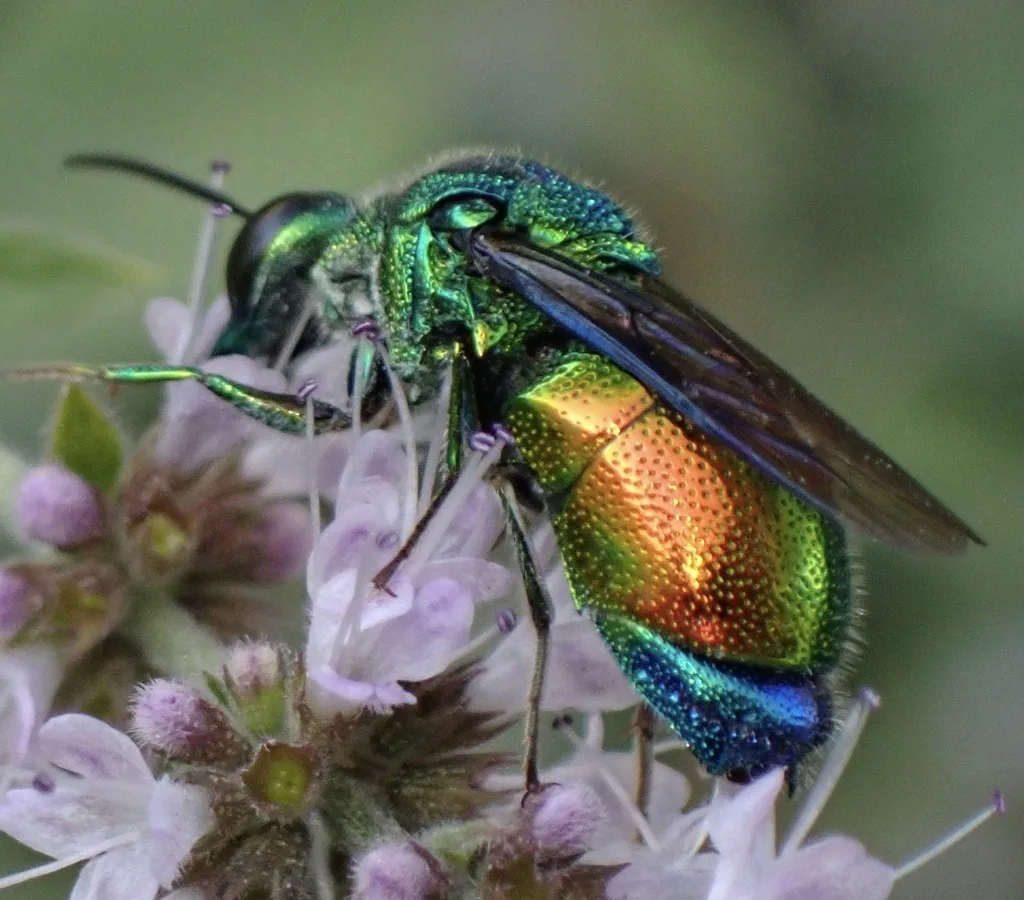
- Compact, iridescent wasps roughly the size of a rice grain, ranging from bright green to deep blue-green or purple, some with a coppery red shine; a few species are relatively large and others as small as a mosquito.[1][2]
- The body usually looks pitted, and many species have a row of small teeth projecting from the rear edge of the abdomen.[1]
- When disturbed they often play dead and roll into a ball; the underside of the abdomen is flat or concave in many species, which lets them curl up.[1][3]
- The forewing veins form only a few box-like cells.[1]
- Most often seen crawling on the ground, downed branches or other dead wood rather than at flowers.[1]
Look-alikes
| Look-alike | How to tell them apart |
|---|---|
| Green sweat bees | Cuckoo wasps superficially resemble green sweat bees, but sweat bees and other bright green wasps do not roll into a ball when disturbed, and bees carry pollen rather than hunting for nests.[2][1] |
| Pure gold-green sweat bee | A shiny green bee of eastern woods that nests in the ground and visits flowers for pollen; it does not play dead or curl up.[1][2] |
| Beewolf and weevil wasps (hosts) | Philanthus and Cerceris digger wasps are black and yellow, not metallic, and are among the hosts of Hedychrum cuckoo wasps, which mimic their chemical scent to enter their nests.[4] |
Where it lives
More than 200 species in North America, most of them in the West. Montana alone has at least 71 identified species, found from forests to grasslands.[2][1]
Biology and life cycle
Cuckoo wasps are solitary parasitoids. Adults crawling on the ground or dead wood are hunting for the nests of wasps and bees that nest in the ground or in wood. A female sneaks into a host nest and lays an egg; her larva devours the host and whatever food is stored in the cell, and the new adult emerges from the stolen nest the following summer.[1][3]
Depending on the species, the egg is laid on the prey stored by another wasp or on the pollen and nectar gathered by a bee.[2]
Many cuckoo wasps visit flowers (cow parsnip and goldenrod, for example) and help pollinate them; others specialize in feeding on aphid honeydew.[2][1]
Cuckoo wasps of the genus Hedychrum parasitize Cerceris and Philanthus digger wasps and mimic the cuticular hydrocarbons of their hosts to avoid detection. Hosts that coat their prey with hydrocarbons to prevent mold cannot change that chemical signature much, while hosts that do not preserve prey have diverged more from their parasites, evidence of a chemical arms race.[4]
Their iridescent colors come from the way light interacts with microstructures on the exoskeleton rather than from pigment. The name 'cuckoo' refers to their nest robbing, and Chrysididae comes from the Greek for 'gold vessel'.[3][1]
Damage and signs
Health risk
The sources describe cuckoo wasps as tiny solitary parasitoids that roll into a ball when handled; they are treated as pollinators and natural enemies, and none of the sources report stings to people.[1][2]
Control
Prevention
No control is needed. Cuckoo wasps are solitary, pollinate flowers and never nest in or around structures. If you want to keep them and other beneficial insects in the yard, plant native flora, avoid regular use of broad-spectrum insecticides and limit the area given over to lawn.[2][1]
Common questions
- A tiny shiny green wasp curled into a ball when I picked it up. What is it?
- Almost certainly a cuckoo wasp. Rolling into a ball and playing dead when disturbed is the family's signature, and the flat or concave underside of the abdomen lets them do it; green sweat bees and other green wasps do not curl up.[1][3]
- Are cuckoo wasps pests of my mason bees or mud daubers?
- They are nest parasites of wasps and bees that nest in the ground or in wood, laying an egg on a bee's pollen store or a wasp's stored prey so the larva can eat the host and its food. They are a natural part of those communities and are not controlled.[2][1]
- Where should I look for them?
- Rather than at flowers, cuckoo wasps are most often found crawling on the ground, on downed branches and dead wood in forests, or on bare ground in open habitats, from early summer on.[1]
Sources
- Montana Fish, Wildlife & Parks, “Outdoors Portrait: Cuckoo wasps, family Chrysididae (Shane Sater), Montana Outdoors, July-August 2024.” fwp.mt.gov/binaries/content/assets/fwp/montana-outdoors/outdoor-portraits/2024/cuckoowasp.pdf (accessed 2026-11-10)
- Washington State University Extension, “Chrysididae: Cuckoo Wasps (Hortsense pollinator fact sheet).” hortsense.cahnrs.wsu.edu/fact-sheet/chrysididae-cuckoo-wasps/ (accessed 2026-11-10)
- Montana State University Entomology Group, “chrysidid sp., Insects of the Greater Yellowstone Ecosystem.” montana.edu/yellowstoneinsects/hymenoptera/chrysididae/chrysididae_sp1.html (accessed 2026-11-10)
- BMC Ecology and Evolution (Springer Nature), abstract via PubMed, “Castillo R, Wurdack M, Pauli T, Keller A, Feldhaar H, Polidori C, Niehuis O, Schmitt T. Evidence for a chemical arms race between cuckoo wasps of the genus Hedychrum and their distantly related host apoid wasps. BMC Ecology and Evolution 22:138 (2022).” pubmed.ncbi.nlm.nih.gov/36443667/ (accessed 2026-11-10)
- iNaturalist, “Chrysididae taxon page (order and family).” www.inaturalist.org/taxa/126149 (accessed 2026-11-10)