On this page
How to identify it
- The wasp is black with blue wings and has white 'stockings' on the hind legs. Mud daubers run about 1/2 to 1 inch long and have a narrow waist.[1]
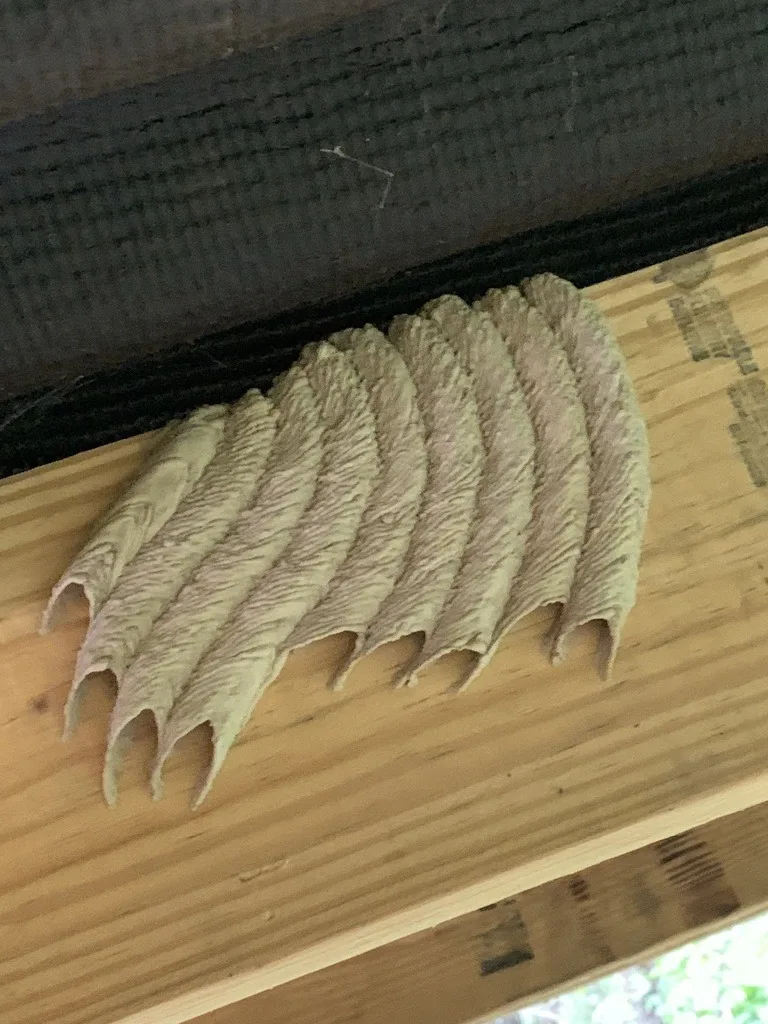
- The nest is the easiest clue: vertical mud tubes, often several side by side, each up to six inches or more long, with the opening at the bottom. A typical tube holds 3 to 4 cells, and a typical nest is a cluster of 5 to 7 tubes.[2][3][4][1]
- Each young wasp leaves by cutting a hole through the side of its cell, so used tubes are left with holes in their sides.[2]
Look-alikes
| Look-alike | How to tell them apart |
|---|---|
| Black and yellow mud dauber | Builds shorter, blockier nests only a couple of inches long and usually oriented horizontally, rounded into a lump about the size of a lemon or fist. The wasp itself is black with yellow markings and yellow legs.[2][1] |
| Common blue mud dauber | A metallic blue wasp that reworks old mud nests with water instead of building neat tubes, leaving an irregular, lumpy nest.[1] |
| Cuckoo wasps | Small metallic green wasps that parasitize mud dauber nests rather than building their own.[2] |
Where it lives
It occurs in the eastern United States from Maine to Florida and west to Kansas and Texas. Clemson Extension lists it as one of the three common mud daubers in South Carolina, and the Missouri Department of Conservation lists it among the three especially common ones in Missouri.[4][5][1]
Biology and life cycle
In nature the tubes go in caves, under rock overhangs, in hollow trees and under large limbs. Around people they turn up under bridges and eaves and in garages, attics, patios and covered parts of cars, boats and other equipment. Smooth, shaded vertical surfaces near a mud source and woods are favored.[2][4][1]
The female scoops up mud with her jaws, taking about eight lunges per load, and adds it as a strip to the mouth of the tube. Building often comes with bursts of buzzing that the hollow tube amplifies. A 4 to 6 inch nest can go up within 24 hours.[4]
She stocks each cell with paralyzed spiders, mostly mid-sized orb weavers such as Hentz orb weavers caught in nearby woods, plus a few wandering spiders. A cell can hold a few spiders or up to 18; in one Mississippi nest a finished cell was packed with ten to twelve. The spiders stay alive, paralyzed, until the larva eats them.[2][3][4][1]
The male stays in the nest day and night while the female hunts, guarding against other organ pipe mud daubers and parasites. The pair mate in the nest when a cell is fully stocked; she lays a single egg and seals it with a mud partition before starting the next cell.[4][1][2]
Eggs hatch in a couple of days, and the larvae finish their spiders in about 5 days. There are one or two generations a year: some offspring emerge in late spring or early summer and others spend the winter in the nest.[4][1]
Females also take over each other's nests, share a nest, swap their egg into another female's cell, or use existing holes such as hollow stems. Small metallic green cuckoo wasps and tiny Melittobia wasps try to slip into nests to parasitize the larvae.[4][2][3]
Damage and signs
Health risk
Stings are painful but rare. Like most solitary wasps, it does not defend its nest and stings only when a female is trapped against the skin or seriously molested. Males have no stinger, though a guarding male may buzz loudly at a person who comes close.[2][4][1]
Control
Prevention
Where nests do no harm, the Missouri Department of Conservation suggests leaving them, since mud daubers hunt spiders around the house.[1]
Keep them out
Good physical exclusion is the best way to keep nests out of attics and mechanical equipment. Screen or caulk openings into buildings.[2][5]
Traps and physical control
Scrape existing nests off, then wipe away the leftover mud with a wet cloth and a spray bottle of water. Nesting females can be killed with a fly swatter as soon as they show up; there is no simple, once-and-done fix.[2]
Pesticides
A can of wasp spray aimed at a nesting female or the nest entrance also works. Some sprays contain petroleum products that stain walls, and aerosols with a straw let you treat the entrance without coating walls and ceilings. Follow the label.[2]
Common questions
- What makes the long mud tubes on my garage wall?
- Vertical mud tubes several inches long, often in a row like organ pipes with the openings at the bottom, are the work of the organ pipe mud dauber.[2][3][1]
- Is the wasp sitting in the tube going to sting me?
- The wasp resting just inside the entrance is often the male guarding the nest. Males have no stinger, and females sting only if trapped against the skin.[2][1]
- How many spiders does one nest hold?
- Each cell can hold up to 18 spiders. For one Mississippi nest that reached twelve cells at ten to twelve spiders per cell, Mississippi State Extension worked out that the female had already taken more than 120 spiders.[1][3]
Sources
- Missouri Department of Conservation, “Mud Daubers (Field Guide).” mdc.mo.gov/discover-nature/field-guide/mud-daubers (accessed 2026-11-10)
- Mississippi State University Extension Service, “Bug's Eye View: Organ Pipe Mud Dauber, Vol. 6, No. 20 (2020).” extension.msstate.edu/newsletters/bugs-eye-view/2020/organ-pipe-mud-dauber-vol-6-no-20 (accessed 2026-11-10)
- Mississippi State University Extension Service, “Bug's Eye View: Organ Pipe Mud Dauber, Vol. 8, No. 22 (2022).” extension.msstate.edu/newsletters/bugs-eye-view/2022/organ-pipe-mud-dauber-vol-8-no-22 (accessed 2026-11-10)
- University of Arkansas Arthropod Museum, “Organ-pipe mud-daubers.” arthropod.uark.edu/?p=27756 (accessed 2026-11-10)
- Clemson Cooperative Extension Home & Garden Information Center, “Mud Daubers: Identification, Habits, and Control (HGIC 2512).” hgic.clemson.edu/factsheet/mud-daubers/ (accessed 2026-11-10)
- iNaturalist, “Trypoxylon politum taxon page (order and family).” www.inaturalist.org/taxa/84844 (accessed 2026-11-10)