On this page
How to identify it
Look-alikes
| Look-alike | How to tell them apart |
|---|---|
| Cuckoo wasps | Also small and metallic blue-green, but deeply pitted, able to roll into a ball, and the females can't sting.[2] |
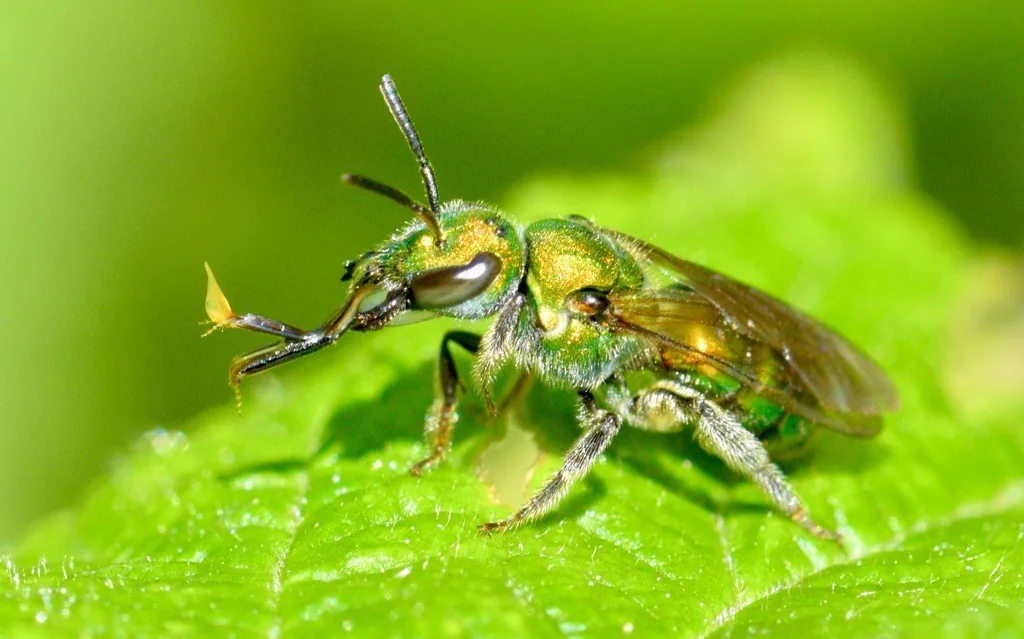
| Sweat bees | One of many sweat bees, a family of small, non-aggressive bees attracted to perspiration.[2] |
Where it lives
Native to the eastern United States from Quebec to Florida, west to Minnesota and Texas.[1]
Biology and life cycle
Females build galleries of cells in moist, rotting wood, often in old insect burrows, provisioning each cell with a ball of pollen and nectar and one egg.[1]
It is active from February to November in the South and April to September in the North; egg to adult takes 17 to 40 days.[1]
Damage and signs
- No damage: it is an important native pollinator in eastern deciduous forests and other habitats.[1]
Health risk
Sweat bees are small and not aggressive, though they are drawn to perspiration.[2]
Control
Prevention
No control is needed; sweat bees are small, gentle pollinators.[1][2]
Common questions
Sources
- University of Florida IFAS Extension (EDIS, Featured Creatures), “Pure Gold-Green Sweat Bee, Augochlora pura (EENY-715).” ask.ifas.ufl.edu/publication/IN1225 (accessed 2026-10-16)
- Missouri Department of Conservation, “Halictid Bees (Sweat Bees) (Field Guide).” mdc.mo.gov/discover-nature/field-guide/halictid-bees-sweat-bees (accessed 2026-10-16)
- iNaturalist, “Augochlora pura taxon page (order and family).” www.inaturalist.org/taxa/82523 (accessed 2026-10-06)